





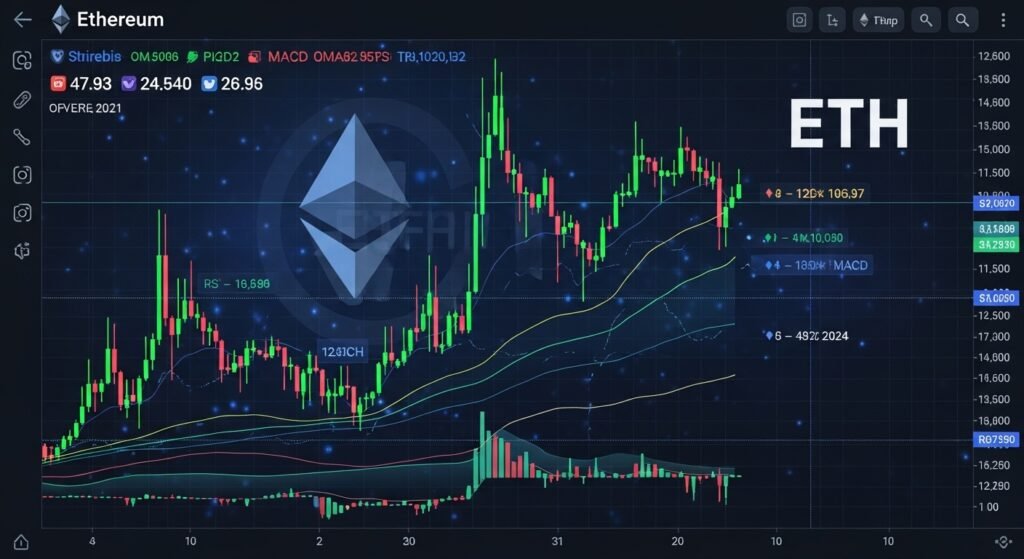
The Ethereum price analysis environment has entered a decisive phase, one defined by weakening momentum, persistent resistance, and a high-timeframe market structure that remains firmly under bearish control. After its earlier attempt to break above major psychological barriers, Ethereum has failed to establish sustained strength, leading to a gradual deterioration in trend quality. Current price behaviour reflects a market struggling to regain footing, with ETH hovering near the mid-$3,000 region while experiencing repeated rejections at overhead resistance zones.
Despite moments of temporary recovery, the broader outlook shows Ethereum consistently forming lower highs and lower lows, which is a clear indication that selling pressure remains dominant. A particularly important area sits between $3,450 and $3,500, a zone that previously offered strong demand but now acts as a heavy resistance ceiling. Until Ethereum convincingly reclaims this region, the prevailing bearish structure continues to govern price action. This article presents a detailed, high-timeframe and short-timeframe Ethereum technical analysis, examining key structural elements, potential reversal signals, liquidity dynamics, and both bullish and bearish scenarios that traders are currently monitoring.
The Bigger Picture: Ethereum’s High-Timeframe Market Structure
Examining Ethereum’s long-term technical footprint reveals a market that has shifted from bullish expansion to corrective contraction. The failure to maintain levels above $4,000 marked the beginning of an extended cooling phase. Each attempt to revisit the upper range has resulted in a loss of momentum, producing a pattern of soft reversals that ultimately roll back into lower levels.
The most important observation lies in the structural rhythm of the chart. Every significant bounce has stalled below the prior swing high, allowing the formation of a descending pattern over multiple weeks. This sequence of lower highs naturally produces an environment where sellers become increasingly confident, stepping in earlier during each rally. As a result, the once-strong bullish narrative has transitioned into a more cautious, defensive posture.
Volatility has also tightened in recent weeks, signalling a compression phase. Such phases often precede major directional moves, but the direction of that move depends heavily on how Ethereum behaves around the previously established resistance cluster. Without a break above the critical key level, volatility expansion would more likely favour the downside rather than initiate a bullish recovery.
Why the Bearish Structure Remains Dominant

The Importance of Lower Highs and Lower Lows
A bearish market structure is defined by a predictable sequence: each high is lower than the last, and each low drops beneath previous support. Ethereum’s chart fits this definition clearly. Since losing steam above $4,000, the price has continued to retrace into deeper territory while failing to reclaim any of its preceding peaks.
This arrangement creates a descending channel, visually outlining the market’s inability to sustain upward momentum. The upper boundary of the channel captures the series of lower highs, while the lower boundary indicates whether re price finds short-term relief before continuing downward. As long as Ethereum remains within this structure, any upward movement is better interpreted as a corrective bounce rather than the beginning of a genuine trend reversal.
When Support Turns into Resistance
The shift of the $3,450–$3,500 region from support to resistance is one of the clearest signals that the bearish trend remains intact. This zone served as a powerful cushion during previous declines, absorbing selling pressure and enabling multiple rebounds. Once it broke, however, the market redefined it as an exit window rather than a buying opportunity.
The moment a former support flips into resistance, it reinforces the idea that buyers are no longer in control. Traders who previously looked to accumulate near this level begin to use it as a point to reduce exposure. This behaviour intensifies the selling pressure in the area, making it even more difficult for Ethereum to reclaim the level.
The Key Level Ethereum Must Reclaim to Break the Bearish Trend
All eyes remain fixed on the $3,450 to $3,500 resistance cluster. This is the ultimate line Ethereum must revisit, conquer, and hold above to invalidate the pattern of descending highs. Only a decisive breakout and consolidation above this level would indicate that the bearish structure has been genuinely disrupted.
The significance of this zone comes from its historical role as a major support region, its alignment with the descending channel’s upper trendline, and the strong volume profile associated with earlier trading activity. A sustained move above it would mark the first successful challenge against the broader downtrend, suggesting that sellers no longer maintain full dominance. Until that happens, however, the market continues to lean in a downward direction.
Examining Short-Term Support and the Risk of Further Declines
The Crucial Nature of the $3,000 Support Area
The $3,000 level carries enormous weight in the short-term structure. It serves as both a psychological barrier and a location where liquidity tends to accumulate. Traders generally expect significant buying interest here, and the level has historically produced sharp bounces.
Should Ethereum revisit this region, the reaction will offer strong clues regarding market intention. A robust recovery from this support could set the stage for another attempt at the key resistance. A weak reaction, however, would suggest diminishing buyer confidence and an increasing likelihood of deeper pullbacks.
Potential Deeper Levels if $3,000 Fails
Breaking below the $3,000 region would place Ethereum in a vulnerable position, exposing the chart to the next major demand zone around the $2,800–$2,900 range. This area acted as a consolidation floor earlier in the year and may serve as the next structural checkpoint if selling pressure intensifies. More extreme bearish scenarios could push the price into even lower territory, especially if global market sentiment weakens around the same time.
Momentum Indicators and What They Reveal About Ethereum

Momentum tools such as the Relative Strength Index and various moving averages offer further insight into Ethereum’s current condition. The RSI on higher timeframes has retreated from previous overbought levels and now lingers near neutral or slightly weaker zones. This suggests that the market lacks the intensity required to drive a meaningful push higher. A prolonged stay in this area often indicates a market in consolidation or decline.
Moving averages present a similar message. Ethereum remains below key dynamic indicators such as the 50-day and 200-day EMAs. These moving averages tend to act as resistance during bearish phases, pushing back against attempts to climb higher. Only once the price begins to consistently trade above these averages, ideally with strong volume, can traders start to assign real weight to a bullish recovery narrative.
On-Chain Metrics and Ethereum Holder Behaviour
On-chain data plays a vital role in reinforcing the themes found in technical analysis. Large concentrations of liquidity and realised price clusters often become strong barriers during market retracements. Many long-term holders accumulated Ethereum in the mid-range, and these zones can sometimes transform into supply regions when the price climbs toward them from below.
If long-term holders begin distributing their tokens into rallies near resistance, it intensifies the bearish structure. Conversely, if these holders remain inactive or continue accumulating, it may provide the foundation for a future recovery. This behaviour allows analysts to identify whether the dominant trend is supported by underlying conviction or whether it reflects a temporary shift in market sentiment.
Macro Forces and Their Impact on Ethereum’s Trend
Cryptocurrency markets no longer operate in isolation. Ethereum frequently moves in correlation with global risk assets, meaning that broader macroeconomic conditions can exert considerable influence over its price. Fluctuations in interest rates, shifts in Federal Reserve policy, equity market performance and geopolitical developments can all impact liquidity flows into and out of digital assets.
When investors adopt a risk-off stance, cryptocurrencies tend to retreat as capital is redirected toward safer markets. Conversely, favourable macro conditions such as easing monetary policy or strong inflows into speculative sectors can fuel a renewed wave of buying activity. Any long-term Ethereum price analysis must therefore account for these external forces, acknowledging the way global markets shape local price behaviour.
How Traders Interpret the Current Ethereum Setup
Traders analysing Ethereum today often find themselves navigating a market defined by structural weakness but punctuated by short-term opportunities. While the long-term trend remains bearish, the presence of well-defined resistance and support zones allows for strategic interpretation.
Many traders view rallies toward the $3,450–$3,500 region as potential areas where selling pressure may re-emerge, given the strength of the resistance. Others remain focused on the $3,000 support zone, observing how the price responds there and whether the level produces meaningful accumulation or rapid breakdowns. In either approach, disciplined risk management remains essential because crypto markets can reverse abruptly and invalidate setups within hours rather than days.
See More: Ethereum Foundation’s new portal for institutions
What a True Bullish Reversal Would Look Like
A legitimate bullish reversal requires more than a temporary bounce. Ethereum must break the pattern of lower highs, regain the key resistance level and exhibit strong follow-through in the form of expanding volume and rising momentum indicators. Once the price establishes multiple daily closes above the $3,450–$3,500 area, the bearish structure would finally be invalidated.
Following such a reclaim, moving averages would begin to curve upward. Indicators like the RSI would return to bullish zones, and market sentiment would drastically improve. Traders who previously took a cautious stance would likely shift toward optimism, enabling a faster and more pronounced upward expansion. At that point, Ethereum could realistically target higher regions near $3,800 or even return to the $4,000 psychological threshold.
The Long-Term View: Ethereum’s Strength Beyond Short-Term Weakness
Despite temporary bearish patterns, Ethereum maintains its position as the leading smart contract platform, powering a large ecosystem of decentralised finance, NFTs, gaming and Web3 applications. Long-term investors often view downturns as opportunities to accumulate, especially if they believe in the network’s technological and economic potential.
However, even long-term participants benefit from key technical levels. Well-timed entries around major support zones can significantly improve overall returns and mitigate downside risk. In this sense, blending fundamental conviction with technical discipline becomes a powerful approach for navigating market volatility.
Conclusion
Ethereum remains in a structurally bearish environment as long as it trades below the crucial $3,450 to $3,500 resistance area. While short-term rebounds may occur, they do not constitute trend reversals unless they result in a sustained reclaim of this key zone. The $3,000 support level continues to play an essential role in preventing deeper declines, but its strength will be tested if the bearish trend persists.
The message from the current analysis is clear: Ethereum is bearish until proven otherwise. The burden of confirmation lies with the bulls, who must demonstrate strength through a decisive breakout above the key level rather than relying on temporary relief rallies. As always, traders and investors should remain aware of risks, conduct their own research and adjust strategies according to evolving market conditions.