











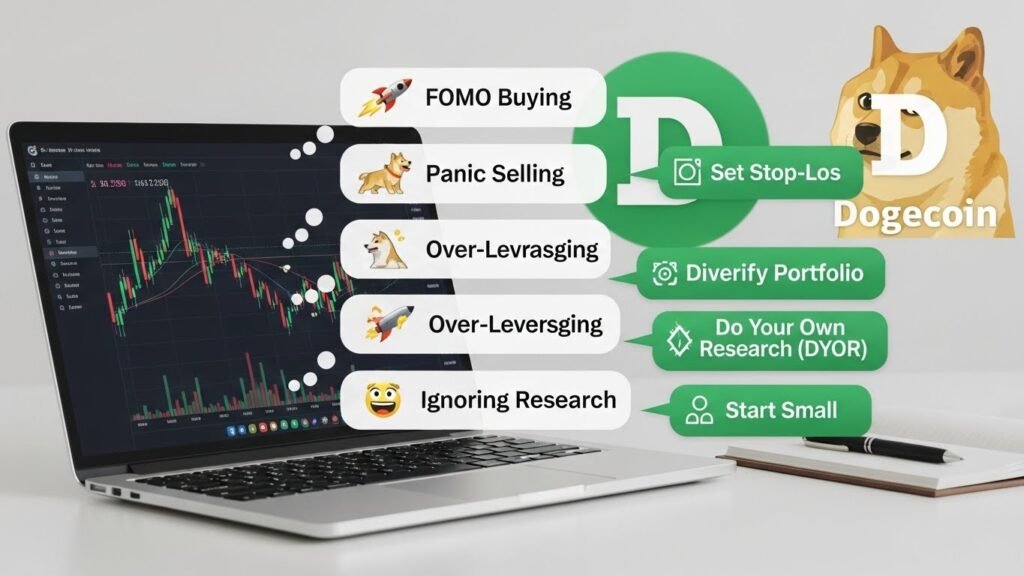
Common Dogecoin Trading Mistakes Beginners Make and How to Avoid Them

Dogecoin Trading

COIN4U IN YOUR SOCIAL FEED

Dogecoin has evolved from a lighthearted internet meme into one of the most recognized cryptocurrencies in the global market. Its low price per coin, strong community support, and frequent social media hype make it especially attractive to beginners. However, this accessibility often creates a false sense of simplicity. Many new traders jump into Dogecoin trading without proper knowledge, only to experience avoidable losses. Understanding common Dogecoin trading mistakes is essential for anyone looking to trade responsibly and sustainably.

Beginners often treat Dogecoin as a shortcut to quick profits, influenced by viral posts, celebrity mentions, and sudden price spikes. This mindset can lead to emotional decision-making, poor risk management, and unrealistic expectations. Like any digital asset, Dogecoin operates in a highly volatile market that rewards patience, discipline, and education rather than impulse.

This article explores the most frequent mistakes beginners make when trading Dogecoin and explains in detail how to avoid them. By learning these lessons early, traders can protect their capital, improve decision-making, and develop a healthier long-term approach to crypto trading.

Misunderstanding What Dogecoin Really Is

Treating Dogecoin Only as a Meme Coin

One of the most common Dogecoin trading mistakes is assuming it has no real market dynamics because it started as a joke. While Dogecoin’s origins are humorous, its market behavior is serious. Millions of traders actively buy and sell it, and its price responds to supply, demand, sentiment, and broader crypto trends. Ignoring these fundamentals leads beginners to trade casually without strategy.

Dogecoin may lack a hard supply cap, but that does not mean it has no value. Its inflationary model affects long-term price behavior, which traders must understand. Beginners who trade without acknowledging this often misjudge price potential and hold unrealistic expectations.

Not Understanding Market Cycles

Many beginners enter Dogecoin trading during hype phases without recognizing where the market is in its cycle. Buying near peaks and selling during fear-driven dips is a classic error. Understanding crypto market cycles, including accumulation, expansion, distribution, and correction phases, helps traders avoid buying at the worst possible time. Dogecoin tends to experience sharp rallies followed by extended pullbacks. Traders who fail to recognize this pattern often panic when prices fall, locking in losses that could have been avoided with patience and planning.

Trading Without a Clear Strategy
Dogecoin trading mistakes

Entering Trades Based on Emotions

Emotional trading is among the most damaging Dogecoin trading mistakes beginners make. Fear of missing out, excitement during price surges, and panic during drops can override logic. Emotional reactions lead to impulsive buying and selling, usually at unfavorable prices.

Successful Dogecoin trading requires predefined entry and exit points. Traders who act emotionally often abandon their plan mid-trade, resulting in inconsistent outcomes. Learning emotional discipline is just as important as understanding technical indicators.

Copying Social Media Influencers Blindly

Social media plays a major role in Dogecoin price movements, but blindly copying influencers is risky. Many online personalities promote Dogecoin without transparency about their own positions or motives. Beginners who follow these signals without verification often enter trades too late. Relying solely on online hype rather than personal analysis is a serious error. Crypto market sentiment should be one factor among many, not the sole reason for entering a trade.

Ignoring Risk Management Principles

Investing More Than You Can Afford to Lose

One of the most fundamental Dogecoin trading mistakes is risking money needed for daily expenses or emergency savings. Cryptocurrency markets are unpredictable, and Dogecoin is no exception. Beginners who overinvest experience extreme stress, which leads to poor decisions. Responsible trading starts with using disposable income only. This approach reduces emotional pressure and allows traders to think more rationally during market fluctuations.

Not Using Stop-Loss or Take-Profit Levels

Many beginners enter Dogecoin trades without defining when to exit. Without stop-loss strategies, small losses can turn into significant drawdowns. Similarly, failing to set take-profit levels can result in missed gains when prices reverse suddenly. Having predefined exit points ensures consistency and protects traders from emotional reactions. Risk management is not about avoiding losses entirely but about controlling them effectively.

Overtrading and Chasing Small Price Movements

Trading Too Frequently Without Purpose

Overtrading is a hidden but dangerous Dogecoin trading mistake. Beginners often believe more trades mean more profits. In reality, excessive trading increases exposure to fees, mistakes, and emotional fatigue.

Dogecoin’s volatility can tempt traders to chase every small movement. However, not every fluctuation represents a profitable opportunity. Learning when not to trade is just as important as knowing when to enter.

Confusing Noise With Trends

Short-term price movements often mislead beginners into thinking a trend is forming. Acting on market noise rather than confirmed trends results in unnecessary losses. Understanding technical analysis basics such as support, resistance, and volume can help differentiate real trends from temporary fluctuations.

Failing to Understand Volatility in Dogecoin Trading

Underestimating Sudden Price Swings

Dogecoin is known for its sharp and unpredictable price swings. Beginners often underestimate how quickly prices can rise or fall. Entering trades without accounting for volatility leads to unexpected losses or forced exits. Understanding volatility helps traders position sizes appropriately. Smaller positions reduce risk during unpredictable market conditions and provide more flexibility.

Panic Selling During Market Corrections

Market corrections are normal in crypto trading. Beginners who panic sell during temporary dips often sell at the worst possible time. This behavior locks in losses and prevents recovery gains. Experienced Dogecoin traders view corrections as part of the broader trend rather than a signal of failure. Patience and perspective are key to avoiding this mistake.

Neglecting Fundamental and Sentiment Analysis

Relying Only on Price Charts

While technical analysis is valuable, relying exclusively on charts is a limitation. Dogecoin is heavily influenced by market sentiment, news, and community activity. Ignoring these factors leaves traders unprepared for sudden market reactions. Understanding broader crypto sentiment, regulatory developments, and community trends provides a more complete trading picture.

Misinterpreting News and Hype

Not all news impacts Dogecoin equally. Beginners often overreact to headlines without evaluating their long-term significance. This leads to unnecessary trades driven by speculation rather than analysis. Learning to distinguish between short-term hype and meaningful developments is essential for smarter trading decisions.

Using Poor Trading Psychology

Expecting Instant Profits

Many beginners enter Dogecoin trading expecting quick riches. This unrealistic mindset leads to frustration and reckless decisions. Trading is a skill that develops over time through experience and learning. Accepting that losses are part of the process helps traders stay grounded and focused on improvement rather than instant success.

Refusing to Learn From Mistakes

Another common Dogecoin trading mistake is repeating the same errors without reflection. Beginners often blame the market rather than analyzing their own decisions. Keeping a trading journal helps identify patterns, strengths, and weaknesses. Continuous learning is essential in a fast-evolving crypto environment. Traders who review and adapt their strategies improve significantly over time.

Overlooking Security and Platform Knowledge
beginners

Ignoring Basic Security Practices

Security is often underestimated by beginners. Poor password management, lack of two-factor authentication, and phishing scams result in lost funds. These losses are avoidable with basic security awareness. Protecting assets is as important as making profitable trades. Understanding crypto wallet security is essential for long-term participation.

Not Understanding Trading Platform Features

Many beginners use trading platforms without fully understanding order types, fees, and tools. This leads to accidental mistakes, such as market orders executed at unfavorable prices. Taking time to learn platform features improves execution quality and reduces unnecessary losses.

Conclusion

Dogecoin trading offers exciting opportunities, but it also comes with significant risks, especially for beginners. The most common Dogecoin trading mistakes stem from emotional decision-making, lack of strategy, poor risk management, and unrealistic expectations. By understanding these pitfalls and learning how to avoid them, traders can significantly improve their chances of success.

Responsible Dogecoin trading requires patience, education, and discipline. Treating Dogecoin as a serious financial instrument rather than a quick gamble transforms the trading experience. Beginners who focus on long-term learning, proper risk control, and emotional balance are far more likely to achieve consistent results in the dynamic crypto market.

FAQs

Q: Why do beginners lose money so quickly in Dogecoin trading?

Many beginners lose money because they enter Dogecoin trading without a clear strategy or understanding of market behavior. Emotional decisions driven by hype, fear, and unrealistic expectations often result in buying at high prices and selling during panic-driven drops. Lack of risk management and overtrading further increase losses.

Q: Is Dogecoin trading suitable for beginners in crypto?

Dogecoin trading can be suitable for beginners if approached responsibly. Its relatively low price and high liquidity make it accessible, but beginners must first learn basic trading principles, volatility management, and emotional discipline to avoid common mistakes.

Q: How important is risk management in Dogecoin trading?

Risk management is critical in Dogecoin trading because of its high volatility. Using stop-loss levels, limiting position sizes, and only investing affordable capital help traders protect themselves from significant losses and emotional stress.

Q: Can social media trends be trusted for Dogecoin trading decisions?

Social media trends should not be trusted blindly. While they influence Dogecoin price movements, they often exaggerate expectations. Successful traders use social sentiment as a supplementary factor, not the primary reason for entering trades.

Q: How long does it take to become consistent in Dogecoin trading?

Consistency in Dogecoin trading takes time, practice, and continuous learning. Beginners should focus on education, analyzing past trades, and improving discipline rather than expecting quick profits. Over time, experience helps develop better judgment and confidence.


Explore more articles like this

Subscribe to the Finance Redefined newsletter

A weekly toolkit that breaks down the latest DeFi developments, offers sharp analysis, and uncovers new financial opportunities to help you make smart decisions with confidence. Delivered every Friday

By subscribing, you agree to our Terms of Services and Privacy Policy

READ MORE

Blockchain and Cryptocurrencies A Practical Guide for 2025

Blockchain and Cryptocurrencies

COIN4U IN YOUR SOCIAL FEED

Blockchain and cryptocurrencies started as a niche experiment and grew into a global conversation shaping finance, technology, and even culture. In a little over a decade, these ideas moved from developer forums to boardrooms, stock exchanges, and policy debates. Yet the topic is still surrounded by jargon, hype, and confusion. This guide cuts through the noise with a clear, human-readable tour of how blockchain works, why cryptocurrencies exist, where the value comes from, and what the risks and opportunities look like today.

At its core, blockchain is a way to coordinate trust at an internet scale. Instead of one company or government maintaining a master database, a network of computers agrees on the state of a shared ledger using math and incentives. Cryptocurrencies ride on top of that ledger as native digital assets, enabling payments, programmable finance, and new forms of ownership.

What Is a Blockchain?

A blockchain is a special kind of distributed ledger that records transactions in blocks, each cryptographically linked to the previous one. This link creates an append-only history that is extremely hard to tamper with. Instead of trusting a single authority, participants trust the network’s rules, which are enforced by math, game theory, and open-source software.

A key feature is consensus. In traditional databases, one server is the source of truth. In blockchains, nodes must agree on the latest valid block using a consensus mechanism such as proof of work or proof of stake. When nodes agree, the block is finalized, and the ledger advances. The result is a system that can operate without centralized control while resisting censorship and manipulation.

Why Decentralization Matters

Decentralization is not just a buzzword; it changes who gets to participate and how power is distributed. In conventional finance, access is tiered, and settlement is slow. In decentralized systems, anyone with an internet connection can validate, transact, or build applications. This openness allows permissionless innovation and competition, which is why startups and open-source teams continually introduce new protocols and features. Decentralization also reduces single points of failure. When a centralized database goes down, everything stops. When a blockchain node fails, others keep the network running.

The Security Model

Blockchain security blends public key cryptography with economic incentives. Users control their assets with a pair of keys: a public key that acts like an address, and a private key that signs transactions. Networks are secured by validators or miners who stake assets or expend energy to propose and attest to blocks. Attacking the chain requires either convincing a majority of validators to misbehave or buying enough resources to overpower honest participants—both are intentionally expensive. The transparency of a public ledger, visible through block explorers, adds another layer of integrity by making all activity auditable in real time.

What Are Cryptocurrencies

What Are Cryptocurrencies

Cryptocurrencies are native digital tokens that live on blockchain networks. They can function as money, fuel for computation, governance rights, or claim tickets on other assets. The most famous is Bitcoin, designed as a peer-to-peer electronic cash system. Ether, the token of Ethereum, powers smart contracts—programs that execute exactly as written without central oversight. Beyond these, thousands of tokens exist, but only a fraction have enduring utility.

Utility, Governance, and Speculation

Tokens serve different roles. Utility tokens pay for services such as transaction fees or network storage. Governance tokens confer voting power over protocol upgrades and treasury allocations. Some tokens represent ownership or access within DeFi protocols, where people lend, borrow, and trade without traditional intermediaries. Speculation is part of the story; prices can swing dramatically as markets react to adoption, regulation, and narratives. Long-term value, however, tends to track genuine usage, developer activity, and network effects.

Stablecoins and CBDCs

Volatility is the biggest obstacle to using crypto as everyday money. Stablecoins aim to solve this by pegging to assets like the U.S. dollar through reserves or algorithmic mechanisms. Reserve-backed stablecoins publish attestations and often integrate with banking rails, making them useful for remittances and on-chain commerce. Central banks are also exploring CBDC designs—government-issued digital cash with programmable features. While CBDCs and stablecoins share surface similarities, they differ in custody, privacy, and governance, with CBDCs remaining state-controlled and stablecoins operating on public or consortium blockchains.

How Does a Blockchain Work, Step by Step?

When you send a transaction, your wallet signs it with your private key and broadcasts it to the network’s mempool. Validators pick transactions, assemble them into a block, and propose it to the network. Other validators verify the block’s validity, ensuring signatures are correct, balances are sufficient, and smart contract rules are respected. Once consensus is reached, the block is added to the chain, and your transaction is confirmed.

Proof of Work vs. Proof of Stake

In proof of work, miners compete to solve cryptographic puzzles; the first to find a valid solution earns the right to add a block and collect rewards. The hash rate reflects the network’s security, as higher computational power makes attacks costlier. In proof of stake, validators lock up tokens as collateral. Misbehavior can be penalized through slashing, while honest validation earns staking rewards. Proof of stake reduces energy usage and can enhance scalability, though it concentrates influence among large stakers if not designed carefully.

Fees, Throughput, and Layer 2

On busy networks, users bid for block space, paying gas fees to prioritize their transactions. To ease congestion, developers build layer 2 solutions like rollups, which execute transactions off-chain and post proofs back to the main chain. These systems deliver higher throughput and lower costs while inheriting the security of the base layer. Cross-network communication occurs through cross-chain bridges, though bridge security remains a critical challenge.

Smart Contracts and Programmable Money

Smart contracts transformed blockchains from payment networks into application platforms. A smart contract is code that holds funds, enforces rules, and triggers outcomes based on inputs. Because it runs on a shared state machine, all participants see the same results, enabling trust-minimized coordination without a central operator.

DeFi: Rebuilding Finance in Code

In DeFi, exchanges, lending markets, derivatives, and asset managers exist as smart contracts. Users trade on automated market makers, deposit collateral to borrow, or supply liquidity to earn fees and governance rewards. Transparency is a double-edged sword: anyone can audit reserves and yields, but exploits and oracle failures can cascade quickly. Risk management in DeFi relies on overcollateralization, insurance funds, and stress-tested code. Serious users evaluate contract audits, on-chain metrics, and community governance before committing capital.

NFTs and the Creator Economy

Non-fungible tokens, or NFTs, represent unique items—art, tickets, domain names, game assets—secured on-chain. NFTs unlock programmable ownership. A musician can mint concert tickets with built-in resale royalties; a game studio can let players move items between worlds. While the speculative art frenzy cooled, practical NFT use cases are maturing, especially in ticketing, membership, and digital identity.

Real-World Use Cases Beyond Hype

The strongest blockchain projects solve concrete problems more efficiently than legacy systems.  cross-border payments, stablecoins, and on-chain rails cut settlement times from days to minutes, with 24/7 availability. In supply chains, distributed ledger systems create shared records across manufacturers, shippers, and regulators, improving traceability and reducing fraud. In capital markets, tokenization fractionalizes assets like real estate and treasuries, enabling instant settlement and broader access.

Enterprise and Consortium Chains

Not every organization wants to build on a public network. Enterprises sometimes use permissioned chains to meet compliance and privacy requirements. These systems apply smart contracts to automate workflows, while limiting who can read or write data. Consortium chains can speed up reconciliation among partners, even if they sacrifice some openness. The key is recognizing trade-offs: the more private and permissioned a chain becomes, the closer it behaves to a traditional database, with the added benefit of standardized, shared logic.

Identity, Privacy, and Zero-Knowledge

Identity is evolving from siloed accounts to portable credentials secured by cryptography. Zero-knowledge proofs let users prove facts—age, solvency, credentials—without revealing underlying data. This helps platforms satisfy KYC/AML mandates while preserving user privacy. As zero-knowledge technology matures, expect decentralized identity to enable login, credit checks, and access control with fewer honeypots of sensitive information.

Risks, Pitfalls, and How to Manage Them

The promise of blockchain and cryptocurrencies does not erase risk. Markets are volatile, and projects can fail despite good intentions. Smart contracts can contain bugs. Bridges and wallets can be compromised. Regulatory frameworks vary by jurisdiction and change over time. Managing these risks starts with informed custody and rational position sizing.

Wallets, Keys, and Custody Choices

Your private key is the single point of control over your assets. A hot wallet connected to the internet offers convenience but exposes you to phishing and malware. Cold storage using hardware wallets or air-gapped devices reduces the attack surface by keeping keys offline. Some users prefer qualified custodians that offer insurance and institutional-grade security; others opt for multisignature schemes distributing control across several keys. Whatever you choose, write down seed phrases securely, avoid screenshots, and test recovery procedures before sending significant funds.

Security Hygiene

Phishing remains the most common failure mode. Always verify URLs, bookmark official sites, and use hardware wallets to confirm transaction details on a physical screen. Treat approvals and signatures as serious commitments; malicious contracts can drain your wallet if you grant broad permissions. Rely on reputable block explorers to verify addresses, and consider whitelisting known contacts. For trading, be wary of tokens with thin liquidity or opaque ownership. In DeFi, look for audits, time-tested code, transparent reserves, and robust governance processes before depositing funds.

Regulatory and Tax Considerations

Regulation aims to protect consumers, prevent money laundering, and maintain market integrity. Expect requirements around disclosures, custody, and KYC/AML compliance to tighten. Tax treatment typically recognizes crypto disposals as taxable events, including trades between tokens and certain staking rewards. Keep meticulous records, use compliant exchanges, and consult qualified professionals in your jurisdiction. Regulatory clarity may feel restrictive at times, but it ultimately encourages institutional participation and mainstream adoption.

Investing and Building with a Long-Term View

Sustainable participation in crypto blends curiosity with discipline. Diversify across narratives—payments, DeFi, infrastructure, layer 2 networks—rather than chasing every new token. Align your exposure with your time horizon and risk tolerance, and automate safeguards like two-factor authentication and hardware security keys. If you are a builder, focus on genuine user pain points, clear token value accrual, and measurable product-market fit.

Evaluating Projects

Start with the fundamentals. Does the protocol solve a specific problem better than existing alternatives? Is there a credible team, open-source code, and an active developer community? How is the token integrated—does it provide real utility or just speculation? Analyze on-chain data for organic usage: unique addresses, transaction counts, fees, and retention. Study documentation for clarity on consensus mechanisms, governance procedures, and security assumptions. Finally, assess ecosystem health: integrations with wallets, exchanges, oracles, and cross-chain bridges are signs of maturity.

The Role of Tokenization

Tokenization converts rights to an asset into a digital token on a blockchain. This can extend market access to smaller investors, improve settlement speed, and enable programmable compliance. Institutional interest is rising around tokenized treasuries, money market funds, and real-world collateral for DeFi lending. As standards solidify, expect consistent reporting, transparent on-chain audits, and composable compliance layers that let institutions participate without sacrificing regulatory obligations.

The Future of Blockchain and Cryptocurrencies

The next phase of blockchain is less about novelty and more about integration. Payments will feel invisible as stablecoins plug into point-of-sale systems and wallets offer fiat on-ramps by default. Layer 2 scaling will make everyday transactions cheap and fast, while zero-knowledge tech enhances privacy and compliance. Tokenized assets will coexist with traditional finance, converging through standardized APIs and shared settlement layers.

Culturally, NFTs will underpin memberships, event tickets, and digital collectibles, with ownership portable across platforms and the metaverse. For developers, smart contract languages will improve safety with formal verification and memory-safe tooling, reducing the frequency of catastrophic exploits. For policymakers, CBDC pilots will clarify boundaries between public money, private stablecoins, and bank deposits, creating a layered monetary system that blends programmability with safeguards.

The outcome is unlikely to be a single chain ruling them all. Instead, specialized networks will interoperate via secure bridges and shared schemas. Users may not even realize blockchain is involved—only that their apps are cheaper, faster, and more transparent.

How to Get Started Safely

If you are new, begin with education and small steps. Install a reputable wallet, practice sending tiny amounts, and learn to verify addresses. Explore a testnet to experiment without risk. If you invest, favor established networks with proven security and liquidity. For builders, start with open-source templates, audited libraries, and standard token frameworks rather than inventing everything from scratch. Maintain backups, enable hardware confirmations, and keep your operating system clean and updated.

Above all, approach blockchain and cryptocurrencies as a long-term learning journey. The technology is still maturing, but the direction is clear: programmable value exchange is a new building block for the internet.

See More: Best Blockchain Investment Platforms for Beginners Top 10 Trusted Options 2025

Conclusion

Blockchain turns trust into software. Cryptocurrencies are the first native assets of that new trust machine. Together, they reimagine payments, markets, ownership, and identity by replacing centralized intermediaries with transparent, programmable rules. The path has been bumpy, marked by cycles of exuberance and fear, but the steady progress is undeniable. With careful custody, security hygiene, and a focus on real utility, individuals and institutions can benefit from this shift while managing risk.

Whether you are curious about decentralization, exploring DeFi, experimenting with NFTs, or evaluating tokenization for your business, the smartest move is to learn by doing—slowly, safely, and with clear goals. As the ecosystem matures, the line between “crypto” and “the internet” will blur, leaving behind a more open, interoperable financial fabric for everyone.

FAQs

Q: What is the difference between blockchain and a traditional database?

A traditional database is controlled by one organization, which can edit or delete records at will. A blockchain is a distributed ledger where participants reach agreement through consensus mechanisms, making the history tamper-resistant and auditable by anyone. The trade-off is that blockchains prioritize openness and security over raw throughput, though layer 2 solutions narrow that gap.

Q: Are cryptocurrencies only used for speculation?

Speculation exists, but it is not the whole story. People use stablecoins for remittances, merchants accept crypto in high-inflation regions, and developers build DeFi apps that run 24/7. The most enduring value emerges where blockchain offers lower costs, faster settlement, or new capabilities compared to legacy systems.

Q: How do I store crypto safely?

Use a reputable wallet and learn how public key cryptography works at a basic level. For larger balances, prefer cold storage via hardware wallets and keep seed phrases offline. Double-check addresses with a block explorer, limit smart contract approvals, and consider multisignature setups for shared or high-value accounts.

Q: What are gas fees, and why do they fluctuate?

Gas fees compensate validators for processing transactions. When demand for block space rises, users pay higher fees to get included sooner. Layer 2 scaling and more efficient consensus reduce fees by increasing capacity, but busy periods can still cause spikes. Monitoring network conditions and using fee estimators can help you time transactions.

Q: Will governments ban crypto?

Outright bans are rare and difficult to enforce. Most governments focus on regulation, emphasizing KYC/AML, consumer protection, and market integrity. The growth of CBDC pilots and licensed stablecoin issuers suggests a future where regulated digital assets and public blockchains coexist, each serving different needs.

Explore more articles like this

Subscribe to the Finance Redefined newsletter

A weekly toolkit that breaks down the latest DeFi developments, offers sharp analysis, and uncovers new financial opportunities to help you make smart decisions with confidence. Delivered every Friday

By subscribing, you agree to our Terms of Services and Privacy Policy

READ MORE

ADD PLACEHOLDER