















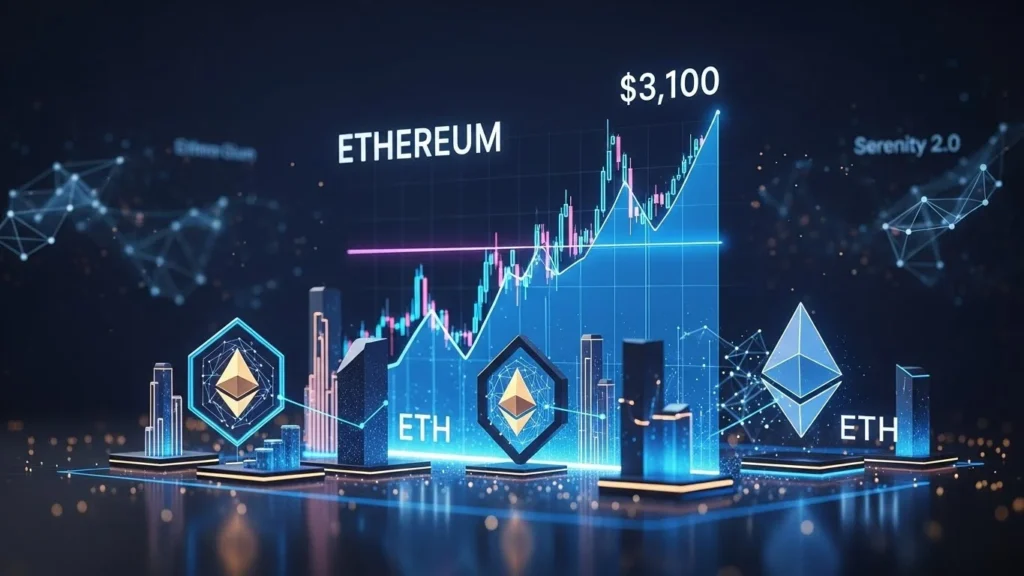
Ethereum consolidating above the $3,100 level is more than a short-term price development. It represents a critical phase where market structure, institutional confidence, and technological progress intersect. Over the years, Ethereum has evolved from a smart contract experiment into the backbone of decentralized finance, non-fungible tokens, and Web3 innovation. Holding above this psychological and technical zone signals that the market is recognizing Ethereum’s expanding role beyond speculation.
Unlike previous cycles driven largely by retail enthusiasm, the current environment surrounding Ethereum is increasingly shaped by institutional adoption, regulatory awareness, and fundamental network improvements. Investors are paying closer attention to Ethereum’s utility, scalability, and economic model. This consolidation phase reflects balance, where profit-taking pressure meets sustained long-term demand.
Ethereum consolidates above $3,100 while network upgrades, enterprise participation, and broader market maturity reinforce its long-term fundamentals. By examining price behavior, on-chain metrics, institutional interest, and technological evolution, we can better understand why Ethereum’s current positioning could be a foundation for its next growth phase.
Understanding Ethereum’s Price Consolidation Above $3,100
Market Structure and Psychological Significance
When Ethereum consolidates above $3,100, it demonstrates resilience at a level that was previously considered resistance. In financial markets, consolidation often signals accumulation rather than weakness. Buyers and sellers reach equilibrium, allowing the asset to build a base for future moves. For Ethereum, this zone reflects growing confidence that its valuation is supported by more than hype.
The $3,100 area also carries psychological weight. Investors tend to anchor expectations around round-number levels, and holding above them reinforces bullish sentiment. Ethereum’s ability to remain stable in this range suggests that long-term holders are less inclined to sell aggressively, while new participants are willing to accumulate on dips.
Reduced Volatility and Market Maturity
Another important aspect of Ethereum’s consolidation is reduced volatility. While short-term price swings still occur, the overall structure appears more controlled compared to earlier cycles. This shift aligns with Ethereum’s maturation as a digital asset increasingly held by institutions and long-term investors.
Lower volatility does not imply lack of opportunity but rather reflects a healthier market. It indicates deeper liquidity, improved derivatives markets, and more sophisticated risk management. As Ethereum continues to consolidate above $3,100, it increasingly behaves like a core crypto asset rather than a speculative outlier.
Institutional Adoption Strengthening Ethereum’s Foundation
Growing Interest From Financial Institutions
One of the strongest drivers behind Ethereum’s stability is rising institutional adoption. Large asset managers, hedge funds, and corporations are exploring Ethereum for both investment exposure and infrastructure use. Unlike Bitcoin, which is often viewed primarily as a store of value, Ethereum offers programmable functionality that appeals to enterprises.
Institutions are drawn to Ethereum’s ability to support tokenization, decentralized finance protocols, and settlement systems. This dual role as both an asset and a platform enhances its long-term appeal. As institutional capital enters the ecosystem, it brings longer investment horizons and a focus on fundamentals rather than short-term price movements.
Ethereum as Infrastructure, Not Just an Asset
Ethereum’s value proposition extends beyond price appreciation. Institutions increasingly view it as critical infrastructure for blockchain technology. From issuing digital securities to enabling automated compliance systems, Ethereum provides a flexible environment for innovation.
This shift in perception supports Ethereum’s consolidation above $3,100. When investors see Ethereum as infrastructure similar to cloud computing platforms, valuation becomes tied to network usage and adoption rather than speculative cycles. This perspective aligns closely with traditional investment frameworks, making Ethereum more accessible to conservative capital.
Network Upgrades Driving Long-Term Fundamentals
Ethereum’s Transition and Scalability Enhancements
Ethereum’s ongoing upgrades are central to its long-term strength. The transition to proof-of-stake fundamentally changed the network’s economic and environmental profile. Reduced energy consumption and improved security have made Ethereum more attractive to institutions concerned about sustainability.
Scalability remains a core focus. Layer-two solutions and protocol optimizations aim to lower transaction costs and increase throughput. These developments directly support Ethereum’s use in decentralized finance, gaming, and enterprise applications. As scalability improves, Ethereum becomes more competitive with alternative blockchains while maintaining its decentralized ethos.
Fee Dynamics and Network Efficiency
Transaction fees have historically been a challenge for Ethereum. However, recent upgrades and scaling solutions are addressing this issue. More predictable and manageable fees improve user experience and support consistent network activity.
Efficient fee mechanisms also impact Ethereum’s monetary dynamics. With portions of transaction fees being burned, supply growth is increasingly constrained. This structural change enhances Ethereum’s long-term value proposition, supporting its ability to consolidate above key price levels.
On-Chain Metrics Supporting Ethereum’s Strength
Network Activity and User Engagement
On-chain data provides valuable insight into Ethereum’s fundamentals. Sustained network activity, active addresses, and transaction volume suggest that usage remains robust even during consolidation. This indicates that Ethereum’s ecosystem continues to grow organically.
Developers play a crucial role in this equation. Ethereum remains one of the most active development platforms in the blockchain space. Continuous innovation reinforces confidence that the network will adapt to future demands, further justifying its valuation.
Staking and Long-Term Commitment
Staking has become a defining feature of Ethereum’s economic model. A significant portion of ETH is now locked in staking contracts, reducing liquid supply. This dynamic supports price stability by limiting selling pressure.
Stakers are typically long-term participants who believe in Ethereum’s future. Their commitment reflects confidence in network security, governance, and economic incentives. As staking participation grows, Ethereum’s consolidation above $3,100 gains additional structural support.
Ethereum’s Role in Decentralized Finance and Web3
DeFi as a Core Use Case
Decentralized finance remains one of Ethereum’s most compelling applications. Lending protocols, decentralized exchanges, and derivatives platforms continue to rely heavily on Ethereum’s infrastructure. Even as alternative chains emerge, Ethereum’s liquidity and security keep it at the center of DeFi innovation.
This dominance supports Ethereum’s long-term fundamentals. DeFi activity generates transaction demand, fee revenue, and developer interest. As financial products become more sophisticated, Ethereum’s role as a settlement layer strengthens, reinforcing its market position.
Web3 and Digital Ownership
Ethereum also underpins much of the Web3 ecosystem. From decentralized identity solutions to NFT marketplaces, Ethereum enables digital ownership and programmable rights. These applications extend Ethereum’s relevance beyond finance into culture, gaming, and media. As Web3 adoption grows, Ethereum benefits from network effects. More users attract more developers, which in turn creates more applications. This virtuous cycle supports sustained demand for ETH and contributes to its ability to consolidate above significant price thresholds.
Regulatory Environment and Its Impact on Ethereum
Increasing Clarity and Institutional Confidence
Regulatory developments play a crucial role in shaping Ethereum’s future. While uncertainty remains, there is a growing trend toward clearer frameworks for digital assets. This clarity benefits Ethereum due to its decentralized structure and transparent governance. Institutions are more comfortable engaging with assets that have defined regulatory considerations. Ethereum’s established history and widespread use make it a strong candidate for compliant adoption. As regulations mature, Ethereum could see increased participation from traditional financial players.
Balancing Innovation and Compliance
Ethereum’s open nature allows innovation to flourish, but it also requires careful navigation of compliance issues. Developers and organizations are increasingly building tools that integrate regulatory requirements without compromising decentralization. This balance supports Ethereum’s long-term sustainability. By accommodating both innovation and compliance, Ethereum positions itself as a versatile platform capable of supporting global adoption. This adaptability reinforces confidence during periods of price consolidation.
Market Sentiment and Long-Term Investor Behavior
Shift From Speculation to Fundamentals
Market sentiment around Ethereum has evolved. While speculative interest remains, a growing segment of investors focuses on fundamentals such as network usage, upgrade timelines, and institutional adoption. This shift contributes to more stable price behavior. Long-term holders are less reactive to short-term volatility. Their confidence is rooted in Ethereum’s roadmap and ecosystem growth. As this mindset spreads, Ethereum’s consolidation above $3,100 appears increasingly sustainable.
The Role of Macro Conditions
Broader economic factors also influence Ethereum’s market dynamics. Inflation concerns, monetary policy shifts, and technological adoption trends shape investor decisions. Ethereum’s position as both a technological platform and a digital asset allows it to benefit from multiple narratives. During periods of macro uncertainty, assets with clear utility and adoption potential tend to attract interest. Ethereum’s consolidation suggests that it is increasingly viewed as such an asset, capable of weathering diverse market conditions.
Long-Term Outlook for Ethereum Above $3,100
Building a Base for Future Growth
Consolidation is often a precursor to significant moves. For Ethereum, holding above $3,100 provides a base that could support future appreciation as fundamentals continue to strengthen. Network upgrades, institutional adoption, and ecosystem expansion all contribute to this outlook. Rather than chasing rapid gains, the market appears to be valuing Ethereum more thoughtfully. This approach aligns with long-term growth rather than speculative spikes. As a result, Ethereum’s current phase may be laying the groundwork for a more sustainable trajectory.
Ethereum’s Position in the Evolving Crypto Landscape
The broader crypto market is evolving toward maturity, and Ethereum plays a central role in this transition. Its ability to adapt, innovate, and attract diverse participants sets it apart. While competition remains intense, Ethereum’s established network effects provide a significant advantage. As Ethereum continues to consolidate above $3,100, it signals confidence in its long-term relevance. This positioning reflects not only price stability but also trust in the network’s future.
Conclusion
Ethereum consolidating above $3,100 is a reflection of growing maturity rather than market hesitation. Institutional adoption, ongoing network upgrades, and robust ecosystem activity are reinforcing its long-term fundamentals. Instead of relying solely on speculative momentum, Ethereum’s valuation is increasingly supported by real-world use cases and technological progress.
This phase highlights a shift in how Ethereum is perceived, from a high-risk experiment to a foundational layer of the digital economy. As upgrades continue and adoption expands, Ethereum’s ability to maintain and build upon this consolidation could define its next chapter. For long-term investors and ecosystem participants, the current environment underscores Ethereum’s resilience and enduring potential.
FAQs
Q: Why is Ethereum consolidating above $3,100 considered a positive signal?
Ethereum consolidating above $3,100 indicates that buyers and sellers have reached a stable balance at a key psychological level. This stability suggests confidence in Ethereum’s valuation, supported by strong fundamentals such as institutional adoption, network usage, and ongoing upgrades rather than short-term speculation.
Q: How does institutional adoption influence Ethereum’s long-term price stability?
Institutional adoption introduces longer investment horizons and more disciplined capital into the market. Institutions often focus on fundamentals and risk management, which can reduce extreme volatility. Their involvement also validates Ethereum as a credible asset and infrastructure platform, supporting long-term price stability.
Q: What role do network upgrades play in Ethereum’s future growth?
Network upgrades improve scalability, security, and efficiency, making Ethereum more attractive to users and developers. These improvements enhance the network’s ability to support decentralized applications and enterprise use cases, directly contributing to sustained demand and long-term growth potential.
Q: Can Ethereum maintain its dominance as competition from other blockchains increases?
Ethereum faces strong competition, but its extensive ecosystem, developer activity, and network effects provide a significant advantage. Continuous innovation and adaptability allow Ethereum to remain relevant, even as alternative blockchains emerge with specialized features.
Q: Is Ethereum’s current consolidation phase likely to lead to another major price move?
While no outcome is guaranteed, consolidation often precedes significant market moves. If Ethereum’s fundamentals continue to strengthen through adoption and upgrades, the current base above $3,100 could support future growth. However, broader market conditions and macroeconomic factors will also play a role.