












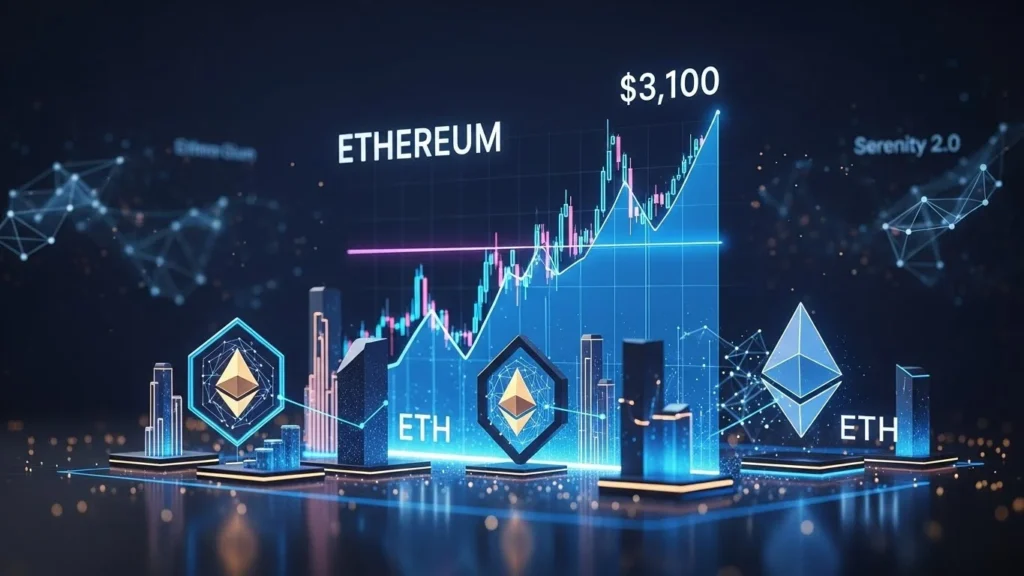
Ethereum Consolidates Above $3,100 as Network Upgrades Drive Long-Term Fundamentals

Ethereum Consolidates

COIN4U IN YOUR SOCIAL FEED

Ethereum consolidating above the $3,100 level is more than a short-term price development. It represents a critical phase where market structure, institutional confidence, and technological progress intersect. Over the years, Ethereum has evolved from a smart contract experiment into the backbone of decentralized finance, non-fungible tokens, and Web3 innovation. Holding above this psychological and technical zone signals that the market is recognizing Ethereum’s expanding role beyond speculation.

Unlike previous cycles driven largely by retail enthusiasm, the current environment surrounding Ethereum is increasingly shaped by institutional adoption, regulatory awareness, and fundamental network improvements. Investors are paying closer attention to Ethereum’s utility, scalability, and economic model. This consolidation phase reflects balance, where profit-taking pressure meets sustained long-term demand.

Ethereum consolidates above $3,100 while network upgrades, enterprise participation, and broader market maturity reinforce its long-term fundamentals. By examining price behavior, on-chain metrics, institutional interest, and technological evolution, we can better understand why Ethereum’s current positioning could be a foundation for its next growth phase.

Understanding Ethereum’s Price Consolidation Above $3,100

Market Structure and Psychological Significance

When Ethereum consolidates above $3,100, it demonstrates resilience at a level that was previously considered resistance. In financial markets, consolidation often signals accumulation rather than weakness. Buyers and sellers reach equilibrium, allowing the asset to build a base for future moves. For Ethereum, this zone reflects growing confidence that its valuation is supported by more than hype.

The $3,100 area also carries psychological weight. Investors tend to anchor expectations around round-number levels, and holding above them reinforces bullish sentiment. Ethereum’s ability to remain stable in this range suggests that long-term holders are less inclined to sell aggressively, while new participants are willing to accumulate on dips.

Reduced Volatility and Market Maturity

Another important aspect of Ethereum’s consolidation is reduced volatility. While short-term price swings still occur, the overall structure appears more controlled compared to earlier cycles. This shift aligns with Ethereum’s maturation as a digital asset increasingly held by institutions and long-term investors.

Lower volatility does not imply lack of opportunity but rather reflects a healthier market. It indicates deeper liquidity, improved derivatives markets, and more sophisticated risk management. As Ethereum continues to consolidate above $3,100, it increasingly behaves like a core crypto asset rather than a speculative outlier.

Institutional Adoption Strengthening Ethereum’s Foundation

Growing Interest From Financial Institutions

One of the strongest drivers behind Ethereum’s stability is rising institutional adoption. Large asset managers, hedge funds, and corporations are exploring Ethereum for both investment exposure and infrastructure use. Unlike Bitcoin, which is often viewed primarily as a store of value, Ethereum offers programmable functionality that appeals to enterprises.

Institutions are drawn to Ethereum’s ability to support tokenization, decentralized finance protocols, and settlement systems. This dual role as both an asset and a platform enhances its long-term appeal. As institutional capital enters the ecosystem, it brings longer investment horizons and a focus on fundamentals rather than short-term price movements.

Ethereum as Infrastructure, Not Just an Asset

Ethereum’s value proposition extends beyond price appreciation. Institutions increasingly view it as critical infrastructure for blockchain technology. From issuing digital securities to enabling automated compliance systems, Ethereum provides a flexible environment for innovation.

This shift in perception supports Ethereum’s consolidation above $3,100. When investors see Ethereum as infrastructure similar to cloud computing platforms, valuation becomes tied to network usage and adoption rather than speculative cycles. This perspective aligns closely with traditional investment frameworks, making Ethereum more accessible to conservative capital.

Network Upgrades Driving Long-Term Fundamentals


Ethereum’s Transition and Scalability Enhancements

Ethereum’s ongoing upgrades are central to its long-term strength. The transition to proof-of-stake fundamentally changed the network’s economic and environmental profile. Reduced energy consumption and improved security have made Ethereum more attractive to institutions concerned about sustainability.

Scalability remains a core focus. Layer-two solutions and protocol optimizations aim to lower transaction costs and increase throughput. These developments directly support Ethereum’s use in decentralized finance, gaming, and enterprise applications. As scalability improves, Ethereum becomes more competitive with alternative blockchains while maintaining its decentralized ethos.

Fee Dynamics and Network Efficiency

Transaction fees have historically been a challenge for Ethereum. However, recent upgrades and scaling solutions are addressing this issue. More predictable and manageable fees improve user experience and support consistent network activity.

Efficient fee mechanisms also impact Ethereum’s monetary dynamics. With portions of transaction fees being burned, supply growth is increasingly constrained. This structural change enhances Ethereum’s long-term value proposition, supporting its ability to consolidate above key price levels.

On-Chain Metrics Supporting Ethereum’s Strength

Network Activity and User Engagement

On-chain data provides valuable insight into Ethereum’s fundamentals. Sustained network activity, active addresses, and transaction volume suggest that usage remains robust even during consolidation. This indicates that Ethereum’s ecosystem continues to grow organically.

Developers play a crucial role in this equation. Ethereum remains one of the most active development platforms in the blockchain space. Continuous innovation reinforces confidence that the network will adapt to future demands, further justifying its valuation.

Staking and Long-Term Commitment

Staking has become a defining feature of Ethereum’s economic model. A significant portion of ETH is now locked in staking contracts, reducing liquid supply. This dynamic supports price stability by limiting selling pressure.

Stakers are typically long-term participants who believe in Ethereum’s future. Their commitment reflects confidence in network security, governance, and economic incentives. As staking participation grows, Ethereum’s consolidation above $3,100 gains additional structural support.

Ethereum’s Role in Decentralized Finance and Web3

DeFi as a Core Use Case

Decentralized finance remains one of Ethereum’s most compelling applications. Lending protocols, decentralized exchanges, and derivatives platforms continue to rely heavily on Ethereum’s infrastructure. Even as alternative chains emerge, Ethereum’s liquidity and security keep it at the center of DeFi innovation.

This dominance supports Ethereum’s long-term fundamentals. DeFi activity generates transaction demand, fee revenue, and developer interest. As financial products become more sophisticated, Ethereum’s role as a settlement layer strengthens, reinforcing its market position.

Web3 and Digital Ownership

Ethereum also underpins much of the Web3 ecosystem. From decentralized identity solutions to NFT marketplaces, Ethereum enables digital ownership and programmable rights. These applications extend Ethereum’s relevance beyond finance into culture, gaming, and media. As Web3 adoption grows, Ethereum benefits from network effects. More users attract more developers, which in turn creates more applications. This virtuous cycle supports sustained demand for ETH and contributes to its ability to consolidate above significant price thresholds.

Regulatory Environment and Its Impact on Ethereum

Increasing Clarity and Institutional Confidence

Regulatory developments play a crucial role in shaping Ethereum’s future. While uncertainty remains, there is a growing trend toward clearer frameworks for digital assets. This clarity benefits Ethereum due to its decentralized structure and transparent governance. Institutions are more comfortable engaging with assets that have defined regulatory considerations. Ethereum’s established history and widespread use make it a strong candidate for compliant adoption. As regulations mature, Ethereum could see increased participation from traditional financial players.

Balancing Innovation and Compliance

Ethereum’s open nature allows innovation to flourish, but it also requires careful navigation of compliance issues. Developers and organizations are increasingly building tools that integrate regulatory requirements without compromising decentralization. This balance supports Ethereum’s long-term sustainability. By accommodating both innovation and compliance, Ethereum positions itself as a versatile platform capable of supporting global adoption. This adaptability reinforces confidence during periods of price consolidation.

Market Sentiment and Long-Term Investor Behavior

Shift From Speculation to Fundamentals

Market sentiment around Ethereum has evolved. While speculative interest remains, a growing segment of investors focuses on fundamentals such as network usage, upgrade timelines, and institutional adoption. This shift contributes to more stable price behavior. Long-term holders are less reactive to short-term volatility. Their confidence is rooted in Ethereum’s roadmap and ecosystem growth. As this mindset spreads, Ethereum’s consolidation above $3,100 appears increasingly sustainable.

The Role of Macro Conditions

Broader economic factors also influence Ethereum’s market dynamics. Inflation concerns, monetary policy shifts, and technological adoption trends shape investor decisions. Ethereum’s position as both a technological platform and a digital asset allows it to benefit from multiple narratives. During periods of macro uncertainty, assets with clear utility and adoption potential tend to attract interest. Ethereum’s consolidation suggests that it is increasingly viewed as such an asset, capable of weathering diverse market conditions.

Long-Term Outlook for Ethereum Above $3,100


Building a Base for Future Growth

Consolidation is often a precursor to significant moves. For Ethereum, holding above $3,100 provides a base that could support future appreciation as fundamentals continue to strengthen. Network upgrades, institutional adoption, and ecosystem expansion all contribute to this outlook. Rather than chasing rapid gains, the market appears to be valuing Ethereum more thoughtfully. This approach aligns with long-term growth rather than speculative spikes. As a result, Ethereum’s current phase may be laying the groundwork for a more sustainable trajectory.

Ethereum’s Position in the Evolving Crypto Landscape

The broader crypto market is evolving toward maturity, and Ethereum plays a central role in this transition. Its ability to adapt, innovate, and attract diverse participants sets it apart. While competition remains intense, Ethereum’s established network effects provide a significant advantage. As Ethereum continues to consolidate above $3,100, it signals confidence in its long-term relevance. This positioning reflects not only price stability but also trust in the network’s future.

Conclusion

Ethereum consolidating above $3,100 is a reflection of growing maturity rather than market hesitation. Institutional adoption, ongoing network upgrades, and robust ecosystem activity are reinforcing its long-term fundamentals. Instead of relying solely on speculative momentum, Ethereum’s valuation is increasingly supported by real-world use cases and technological progress.

This phase highlights a shift in how Ethereum is perceived, from a high-risk experiment to a foundational layer of the digital economy. As upgrades continue and adoption expands, Ethereum’s ability to maintain and build upon this consolidation could define its next chapter. For long-term investors and ecosystem participants, the current environment underscores Ethereum’s resilience and enduring potential.

FAQs

Q: Why is Ethereum consolidating above $3,100 considered a positive signal?

Ethereum consolidating above $3,100 indicates that buyers and sellers have reached a stable balance at a key psychological level. This stability suggests confidence in Ethereum’s valuation, supported by strong fundamentals such as institutional adoption, network usage, and ongoing upgrades rather than short-term speculation.

Q: How does institutional adoption influence Ethereum’s long-term price stability?

Institutional adoption introduces longer investment horizons and more disciplined capital into the market. Institutions often focus on fundamentals and risk management, which can reduce extreme volatility. Their involvement also validates Ethereum as a credible asset and infrastructure platform, supporting long-term price stability.

Q: What role do network upgrades play in Ethereum’s future growth?

Network upgrades improve scalability, security, and efficiency, making Ethereum more attractive to users and developers. These improvements enhance the network’s ability to support decentralized applications and enterprise use cases, directly contributing to sustained demand and long-term growth potential.

Q: Can Ethereum maintain its dominance as competition from other blockchains increases?

Ethereum faces strong competition, but its extensive ecosystem, developer activity, and network effects provide a significant advantage. Continuous innovation and adaptability allow Ethereum to remain relevant, even as alternative blockchains emerge with specialized features.

Q: Is Ethereum’s current consolidation phase likely to lead to another major price move?

While no outcome is guaranteed, consolidation often precedes significant market moves. If Ethereum’s fundamentals continue to strengthen through adoption and upgrades, the current base above $3,100 could support future growth. However, broader market conditions and macroeconomic factors will also play a role.

Explore more articles like this

Subscribe to the Finance Redefined newsletter

A weekly toolkit that breaks down the latest DeFi developments, offers sharp analysis, and uncovers new financial opportunities to help you make smart decisions with confidence. Delivered every Friday

By subscribing, you agree to our Terms of Services and Privacy Policy

READ MORE

Best Cryptocurrency to Invest in 2025 Top 10 Coins & Expert Guide

best cryptocurrency to invest in 2025

COIN4U IN YOUR SOCIAL FEED

The digital currency landscape continues to evolve at breakneck speed, making it increasingly challenging for investors to identify the best cryptocurrency to invest in 2025. With thousands of digital assets competing for attention and market capitalization fluctuating daily, making informed investment decisions has never been more critical. Whether you’re a seasoned crypto veteran or a newcomer exploring digital assets for the first time, understanding which cryptocurrencies offer the most promising returns requires careful analysis of technology, adoption rates, and market fundamentals.

This comprehensive guide examines the top cryptocurrency investment opportunities for 2025, providing you with expert insights, risk assessments, and strategic recommendations. We’ll explore established giants like Bitcoin and Ethereum alongside emerging projects that could deliver substantial gains. By the end of this article, you’ll have the knowledge needed to build a diversified crypto portfolio aligned with your investment goals and risk tolerance.

Understanding Cryptocurrency Investment in 2025

The Current State of the Crypto Market

The cryptocurrency market has matured significantly since Bitcoin’s inception in 2009. Today’s landscape features institutional adoption, regulatory clarity in many jurisdictions, and sophisticated financial products that make crypto investing more accessible than ever. Market capitalization has surpassed previous all-time highs, with increased participation from traditional financial institutions, governments, and retail investors worldwide.

Why 2025 Is a Pivotal Year for Crypto Investors

Several factors make 2025 an exceptional year for cryptocurrency investment. The Bitcoin halving event that occurred in 2024 historically leads to bull markets within 12-18 months. Additionally, clearer regulatory frameworks in the United States and Europe have reduced uncertainty, while institutional adoption through spot ETFs continues to drive mainstream acceptance.

The maturation of blockchain technology has also enabled real-world applications beyond speculation, including decentralized finance (DeFi), non-fungible tokens (NFTs), and enterprise solutions. These developments create genuine utility and demand for specific cryptocurrencies.

Top 10 Best Cryptocurrency to Invest in 2025

Top 10 Best Cryptocurrency to Invest in 2025

1. Bitcoin (BTC): The Digital Gold Standard

Market Cap: $1.2+ Trillion | Current Price Range: $60,000-$70,000

Bitcoin remains the undisputed king of cryptocurrency and arguably the best cryptocurrency to invest in 2025 for conservative investors seeking stability. As the first and most widely recognized digital asset, Bitcoin benefits from network effects, institutional adoption, and its role as a store of value.

Why Invest in Bitcoin:

  • Proven track record spanning over 15 years
  • Limited supply of 21 million coins creates scarcity
  • Increasing institutional adoption through spot ETFs
  • Recognition as “digital gold” for portfolio diversification
  • Strong security through the largest proof-of-work network

Investment Strategy: Bitcoin serves as the foundation of any crypto portfolio. Consider allocating 30-50% of your crypto investments to BTC for stability and long-term appreciation.

2. Ethereum (ETH): The Smart Contract Pioneer

Market Cap: $400+ Billion | Current Price Range: $3,200-$4,000

Ethereum transformed blockchain technology by introducing smart contracts and decentralized applications. As the leading platform for DeFi, NFTs, and enterprise solutions, Ethereum continues to dominate the programmable blockchain space.

Why Invest in Ethereum:

  • Largest developer community in the blockchain space
  • Successful transition to proof-of-stake reduces energy consumption
  • Foundation for most DeFi protocols and NFT marketplaces
  • Ongoing scaling improvements through Layer 2 solutions
  • Strong institutional interest and real-world utility

Investment Consideration: Ethereum represents growth potential beyond Bitcoin. The upcoming upgrades to improve scalability and reduce transaction costs could drive significant price appreciation.

3. Solana (SOL): The High-Performance Blockchain

Market Cap: $70+ Billion | Current Price Range: $140-$180

Solana has emerged as a serious Ethereum competitor, offering high-speed transactions and low fees. Despite past network outages, Solana’s technical improvements and growing ecosystem make it a compelling investment option.

Key Advantages:

  • Transactions process in under one second with minimal fees
  • Rapidly expanding DeFi and NFT ecosystem
  • Strong backing from major venture capital firms
  • Active developer community building innovative applications
  • Mobile-first approach with Saga smartphone integration

Risk Factor: While Solana offers impressive technology, past network stability issues mean investors should allocate a smaller portion of their portfolio (5-10%) to this asset.

4. Cardano (ADA): The Research-Driven Platform

Market Cap: $35+ Billion | Current Price Range: $0.95-$1.20

Cardano distinguishes itself through peer-reviewed research and a methodical development approach. This scientific methodology appeals to long-term investors seeking a fundamentally sound blockchain platform.

Investment Highlights:

  • Academic approach ensures robust and secure protocol
  • Energy-efficient proof-of-stake consensus mechanism
  • Growing ecosystem of decentralized applications
  • Strong community support and governance structure
  • Expansion into emerging markets for financial inclusion

5. Polkadot (DOT): The Interoperability Solution

Market Cap: $12+ Billion | Current Price Range: $8-$11

Polkadot enables different blockchains to communicate and share information, solving one of crypto’s most significant challenges. This interoperability focus positions Polkadot as essential infrastructure for the multi-chain future.

Why Consider Polkadot:

  • Unique parachain architecture allows specialized blockchains
  • Founded by Ethereum co-founder Dr. Gavin Wood
  • Strong technical team and robust development roadmap
  • Growing ecosystem of interconnected blockchain projects
  • Flexible governance model through on-chain voting

6. Chainlink (LINK): The Oracle Network Leader

Market Cap: $16+ Billion | Current Price Range: $25-$32

Chainlink provides critical infrastructure that connects smart contracts with real-world data. As blockchain adoption increases, Chainlink’s oracle services become increasingly valuable across industries.

Investment Case:

  • Essential infrastructure for DeFi protocols
  • Partnerships with major enterprises and blockchains
  • Cross-chain interoperability protocol (CCIP) expands utility
  • Staking mechanism provides passive income opportunities
  • First-mover advantage in the oracle market

7. Avalanche (AVAX): The Subnet Innovation

Market Cap: $14+ Billion | Current Price Range: $38-$46

Avalanche offers a unique subnet architecture that allows customizable blockchain networks. This flexibility attracts enterprises and developers seeking tailored blockchain solutions.

Key Features:

  • Fast finality with transactions confirmed in under two seconds
  • Ethereum Virtual Machine (EVM) compatibility
  • Subnet technology enables private, permissioned blockchains
  • Strong partnerships with traditional finance institutions
  • Energy-efficient proof-of-stake consensus

8. Polygon (MATIC): The Ethereum Scaling Solution

Market Cap: $8+ Billion | Current Price Range: $0.90-$1.15

Polygon addresses Ethereum’s scalability challenges through Layer 2 solutions. As Ethereum remains the dominant smart contract platform, Polygon’s infrastructure becomes increasingly critical.

Growth Drivers:

  • Official Ethereum scaling solution with strong partnerships
  • Major brands and applications building on Polygon
  • zkEVM technology provides cutting-edge scaling
  • Low transaction costs attract developers and users
  • Strong institutional backing and adoption

9. VeChain (VET): The Enterprise Supply Chain Solution

Market Cap: $3+ Billion | Current Price Range: $0.04-$0.05

VeChain focuses on real-world enterprise adoption, particularly in supply chain management and authenticity verification. This practical application differentiates VeChain from speculation-driven projects.

Business Applications:

  • Partnerships with major corporations like Walmart China
  • Proven use cases in logistics and product authentication
  • Dual-token economic model (VET and VTHO)
  • Strong presence in Asian markets
  • Growing adoption in luxury goods verification

10. Render Token (RNDR): The Decentralized GPU Network

Market Cap: $4+ Billion | Current Price Range: $10-$13

Render Token represents the intersection of cryptocurrency and artificial intelligence. As AI and 3D rendering demand explodes, Render’s decentralized GPU network offers compelling investment potential.

Future-Focused Investment:

  • Captures AI and rendering market growth
  • Decentralized alternative to centralized cloud providers
  • Real revenue generation through network usage
  • Partnerships with entertainment and tech industries
  • Growing demand for decentralized compute power

Investment Strategies for Cryptocurrency in 2025

Dollar-Cost Averaging (DCA)

Rather than attempting to time the market, dollar-cost averaging involves investing fixed amounts at regular intervals. This strategy reduces the impact of volatility and removes emotional decision-making from your investment process.

Implementation: Invest a set amount weekly or monthly regardless of price movements. This approach is particularly effective when considering the best cryptocurrency to invest in 2025, as it builds positions systematically over time.

Portfolio Diversification

Never allocate your entire investment to a single cryptocurrency. A balanced portfolio might include:

  • 40-50% in Bitcoin for stability
  • 25-30% in Ethereum for growth
  • 15-20% in mid-cap alternatives (Solana, Cardano, Polkadot)
  • 5-10% in small-cap, high-risk opportunities

Risk Management and Position Sizing

Only invest capital you can afford to lose. Cryptocurrency remains volatile, and even the strongest projects experience significant price fluctuations. Consider your risk tolerance, investment timeline, and financial goals before determining position sizes.

Factors to Consider When Choosing Crypto Investments

Technology and Innovation

Evaluate the underlying technology, unique value proposition, and competitive advantages. Does the project solve real problems? Is the technology scalable and sustainable? Strong fundamentals typically correlate with long-term success.

Team and Development Activity

Research the founding team, advisors, and development community. Active GitHub repositories, regular updates, and transparent communication indicate healthy projects. Absent or anonymous teams raise red flags.

Market Adoption and Use Cases

Real-world adoption drives sustainable value. Examine partnerships, user growth, transaction volume, and practical applications. Cryptocurrencies with genuine utility outperform pure speculation plays over time.

Tokenomics and Supply Dynamics

Understand the token supply, distribution, and inflation rate. Limited supply assets like Bitcoin benefit from scarcity, while unlimited supply tokens require strong demand drivers to appreciate in value.

Regulatory Compliance

With increasing regulatory scrutiny, projects demonstrating compliance and working within legal frameworks position themselves for long-term success. Regulatory clarity reduces risk and enables institutional adoption.

Common Mistakes to Avoid in Crypto Investing

Chasing Pump and Dump Schemes

Avoid cryptocurrencies promoted through aggressive marketing, celebrity endorsements, or promises of guaranteed returns. These characteristics often indicate fraudulent schemes designed to separate you from your money.

Ignoring Security Best Practices

Never store significant cryptocurrency holdings on exchanges. Use hardware wallets for long-term storage, enable two-factor authentication, and never share private keys or seed phrases.

Emotional Trading

Fear and greed drive poor investment decisions. Stick to your predetermined strategy, avoid panic selling during downturns, and resist FOMO (fear of missing out) during euphoric rallies.

Neglecting Tax Obligations

Cryptocurrency transactions trigger taxable events in most jurisdictions. Maintain detailed records of purchases, sales, and trades. Consider using crypto tax software to simplify reporting and ensure compliance.

The Future of Cryptocurrency Investment

The Future of Cryptocurrency Investment

Emerging Trends Shaping 2025 and Beyond

Institutional Adoption: Traditional financial institutions increasingly offer cryptocurrency services, from custody solutions to trading platforms. This legitimization drives mainstream acceptance and price stability.

Central Bank Digital Currencies (CBDCs): Government-issued digital currencies are rolling out globally. While different from decentralized cryptocurrencies, CBDCs normalize digital money and blockchain technology.

Artificial Intelligence Integration: The convergence of AI and blockchain creates new investment opportunities. Projects combining these technologies address complex problems and unlock new use cases.

Real-World Asset Tokenization: Physical assets like real estate, art, and commodities are being tokenized on blockchains, creating new markets and investment opportunities.

Regulatory Landscape

Clearer regulations in major markets reduce uncertainty and enable institutional participation. The United States, European Union, and Asian countries are implementing comprehensive frameworks that distinguish between security tokens and utility tokens, creating a more predictable investment environment.

Tools and Resources for Crypto Investors

Portfolio Tracking Applications

Use platforms like CoinMarketCap, CoinGecko, or Delta to monitor your investments, track performance, and analyze market trends. These tools provide real-time data and portfolio insights essential for informed decision-making.

Research Platforms

Quality research separates successful investors from gamblers. Resources like Messari, Glassnode, and CryptoQuant provide on-chain analytics, market insights, and fundamental analysis that inform better investment decisions.

Secure Storage Solutions

Hardware wallets from manufacturers like Ledger and Trezor provide the highest security for long-term holdings. These devices store private keys offline, protecting against hacks and unauthorized access.

Educational Resources

Continuous learning is essential in the rapidly evolving crypto space. Follow reputable sources, join community discussions, and stay updated on technological developments and market dynamics.

Conclusion

Identifying the best cryptocurrency to invest in 2025 requires careful analysis of technology, market dynamics, and your personal investment goals. While Bitcoin and Ethereum remain foundational assets for any crypto portfolio, emerging platforms like Solana, Cardano, and Polkadot offer compelling growth opportunities for those willing to accept additional risk.

Success in cryptocurrency investing comes from education, diversification, risk management, and patience. Avoid chasing short-term gains, implement dollar-cost averaging strategies, and focus on projects with strong fundamentals and real-world utility. The cryptocurrency market will experience volatility, but quality projects with genuine adoption tend to appreciate significantly over multi-year timeframes

READ MORE:Best Cryptocurrency to Invest in 2025 Top 10 Picks

Explore more articles like this

Subscribe to the Finance Redefined newsletter

A weekly toolkit that breaks down the latest DeFi developments, offers sharp analysis, and uncovers new financial opportunities to help you make smart decisions with confidence. Delivered every Friday

By subscribing, you agree to our Terms of Services and Privacy Policy

READ MORE

ADD PLACEHOLDER