




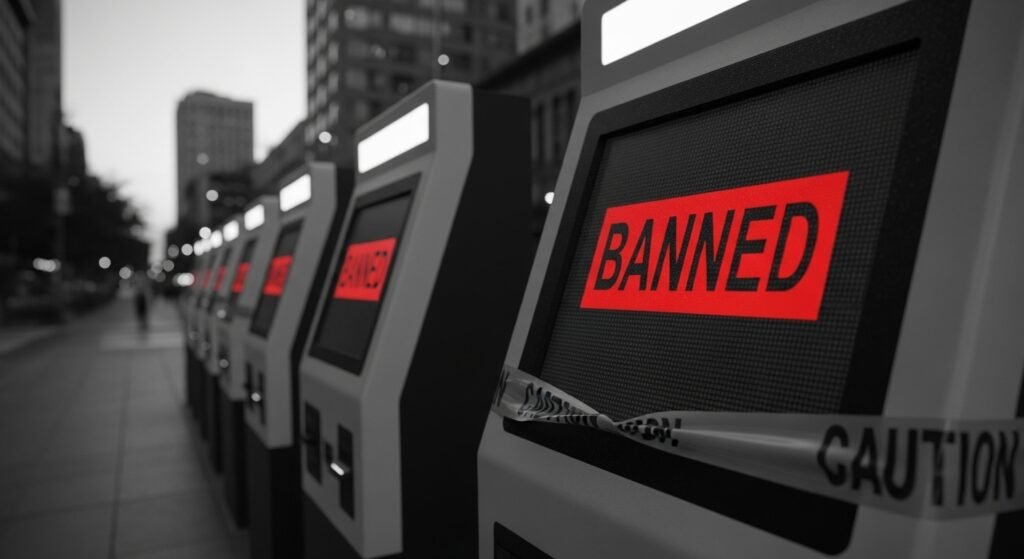
takenSt. Paul is on the verge of a major shift in how residents can access digital assets. Under a proposed ordinance, cryptocurrency kiosks – often called crypto ATMs or Bitcoin ATMs – will be prohibited from operating within the city, with the ban slated to take effect as early as next month after the final City Council vote. The move comes in response to mounting evidence that these machines play a significant role in crypto-related scams targeting vulnerable residents, especially seniors.
Across St. Paul, there are roughly 80–90 virtual currency kiosks, typically tucked into everyday locations like gas stations, grocery stores, laundromats and corner shops. For some residents, these machines have offered convenient cash-to-crypto access. For others, they have become a gateway to devastating financial losses after being manipulated by scammers posing as government officials, law enforcement or tech support.
The proposed St. Paul ordinance would create a new chapter in the city’s legislative code that outright bans the use and placement of virtual currency kiosks. City leaders argue that, while cryptocurrency itself will remain legal, removing Bitcoin kiosks from high-traffic locations is necessary to protect the public and reduce fraud. Critics, including industry representatives and retail trade associations, warn that a blanket ban could push crypto users to less regulated channels and create a confusing patchwork of local rules.
As the city prepares for the final council vote, residents and businesses alike are asking what this means for the future of cryptocurrency in St. Paul. Will the ban truly curb scams? How will it affect legitimate crypto users? And could other cities follow St. Paul’s lead?
Why St. Paul is targeting cryptocurrency kiosks
City officials did not arrive at “Cryptocurrency kiosks banned in St. Paul beginning next month” overnight. The ordinance is the culmination of months of discussion, testimony and a growing body of data showing how crypto ATMs are used in fraud schemes.
According to figures cited in the ordinance, the FBI received nearly 150,000 complaints involving cryptocurrency in 2024, with about $9.3 billion in reported losses. Of those, nearly 11,000 complaints and roughly $246–257 million in losses were tied specifically to transactions at cryptocurrency kiosks.
The Minnesota numbers are particularly striking. In 2024, around 1,852 victims in Minnesota reported losses connected to crypto, totalling more than $91 million, much of it linked to kiosk transactions.
Local officials and consumer advocates describe a familiar pattern. Scammers call victims pretending to be law enforcement, bank fraud departments or government agencies. They claim there is a warrant, a frozen account or a relative in crisis. The victim is told to withdraw cash, go to a Bitcoin kiosk, scan a QR code and deposit the money. Once the transaction is processed, the funds are effectively irreversible, and the victim is left with little recourse.
St. Paul’s City Council President and other supporters of the ban argue that, in practice, crypto ATMs offer “zero public benefit” compared to their outsized role in fraud, especially for seniors and financially vulnerable residents.
How the new St. Paul crypto kiosk ban works

At the heart of the initiative is a clear and simple rule: no more cryptocurrency kiosks in St. Paul. The proposed ordinance would add Chapter 297 to the city’s legislative code, prohibiting both the placement and operation of virtual currency kiosks within city limits.
Defining “virtual currency kiosks”
The ordinance refers to these machines as virtual currency kiosks or cryptocurrency kiosks, but in everyday language, they are the Bitcoin ATMs and crypto vending machines seen near cash registers and ATM clusters. These devices allow users to insert cash and receive cryptocurrency in a digital wallet, or in some cases, to sell crypto for cash.
Under the proposed law, such machines would no longer be allowed to operate in St. Paul, whether they dispense Bitcoin, Ethereum, Litecoin or other digital assets. The ban targets the machines themselves, not the underlying technology of blockchain or cryptocurrency.
Not a total ban on cryptocurrency
One of the most important clarifications is that St. Paul is not banning cryptocurrency as an asset or technology. Residents will still be able to buy and sell crypto through:
Traditional centralised exchanges and investment apps.
Peer-to-peer platforms that comply with state and federal law.
Custodial services are offered by licensed money transmitters and financial institutions.
What will change is the availability of walk-up, cash-based cryptocurrency access points in local stores. By removing crypto ATMs, the city hopes to cut off what it sees as a primary on-ramp for scammers rather than a vital tool for everyday investors.
Timeline: Why “beginning next month” matters
The phrase “Cryptocurrency kiosks banned in St. Paul beginning next month” reflects the expected timeline laid out in council discussions. The ordinance has already been introduced and advanced, and the City Council is scheduled to take a final vote. If adopted, the law would take effect after a short waiting period, placing the practical start of the ban in the following month.
That said, the exact effective date will ultimately depend on the final form of the ordinance and when it is formally adopted and published. For residents and businesses, the key takeaway is that the window to operate or use cryptocurrency kiosks in St. Paul is closing rapidly.
The rise of crypto ATM scams in Minnesota
St. Paul’s proposed ban is part of a wider response across Minnesota to the rapid growth of crypto ATM fraud.
The Minnesota Department of Commerce reports that there are about 90 registered cryptocurrency machines in St. Paul and more than 300 statewide. These kiosks are concentrated in high-traffic spaces like liquor stores, small grocers and gas stations.
Law enforcement agencies across the Twin Cities have documented hundreds of thousands – and in some cities, millions – of dollars in losses tied to virtual currency machines. In Forest Lake alone, police say victims have lost more than $300,000 in schemes involving crypto kiosks over the past two years, while other cities like Woodbury and White Bear Lake have reported substantial losses as well.
Scammers rely on a combination of urgency and fear. A typical script might involve a phone call from someone claiming to be a “detective” or “IRS agent” who says the victim will be arrested unless they pay immediately. The caller then guides the victim step-by-step: drive to a particular store, find the Bitcoin ATM, scan a QR code and deposit thousands in cash. The scammer sometimes stays on the line for the entire transaction, making it hard for store employees or bystanders to intervene.
In one widely discussed incident, a St. Paul city attorney in plain clothes reportedly prevented a large loss by noticing two elderly residents attempting to send a significant sum at a kiosk and stepping in before the transaction was completed. Stories like this have fueled the push to declare cryptocurrency kiosks banned in St. Paul beginning next month as a direct fraud-prevention measure.
Consumer protection vs. financial innovation

Supporters of the ban frame it as a necessary step in consumer protection. The ordinance cites limited local law enforcement resources and the difficulty of recovering funds once they move through cross-border, pseudonymous cryptocurrency networks. From this perspective, eliminating crypto ATMs is a way to reduce harm in an area where investigations are complex and recovery is rare.
Advocacy groups like AARP and the Better Business Bureau have also highlighted the emotional and psychological toll of these scams. Victims not only lose money; they often feel shame and fear, making them less likely to report the crime or seek help.
On the other side, kiosk operators and some retail associations argue that the machines do serve a legitimate financial purpose. Representatives from companies like Bitcoin Depot note that they are licensed under Minnesota law, use transaction monitoring tools and implement safeguards such as warnings on screens and transaction limits. State-level rules that took effect in August 2024 already require disclosures and consumer protections for licensed operators.
From their point of view, a total ban overshoots the mark, punishing compliant businesses as well as bad actors. Retail groups worry that customers who rely on Bitcoin kiosks for remittances or small-scale investments will simply travel to neighbouring cities, creating a patchwork of local rules that is harder to enforce and less transparent for consumers.
Impact on everyday crypto users in St. Paul
For residents who have become accustomed to using crypto ATMs as a quick bridge between cash and digital assets, the headline “Cryptocurrency kiosks banned in St. Paul beginning next month” is not just a policy update; it is a practical lifestyle change.
Many Bitcoin ATM users fall into two broad groups. Some are already active in the crypto ecosystem and simply prefer to use cash or want an extra layer of privacy. Others are less experienced investors who were drawn in by word of mouth or online promotions and found the kiosk interface to be more approachable than setting up an online exchange account.
Once the ban takes effect, these users will need to rely on:
Online exchanges that require traditional bank accounts and identity verification.
Licensed money services businesses that offer crypto purchases via apps or websites.
Peer-to-peer platforms that connect buyers and sellers directly.
For tech-savvy investors, this shift may be minor. For underbanked residents, lack reliable internet access or are wary of online platforms, the loss of in-store crypto ATMs may feel like a reduction in financial inclusion. This tension between fraud prevention and access to digital finance is at the core of the St. Paul debate.
See More: Cryptocurrency and Digital Commerce Regulation Guide
What the ban means for local retailers and operators
The St. Paul cryptocurrency kiosk ban will also reshape the relationship between kiosk operators and local businesses that host the machines.
For many small retailers, Bitcoin kiosks have become another revenue stream, similar to traditional ATMs or lottery machines. They earn commissions or rental fees and sometimes benefit from increased foot traffic. Losing these machines may not be catastrophic, but it does remove a source of ancillary income in a competitive retail environment.
Industry groups like the Minnesota Retailers Association, Minnesota Grocers Association and the Minnesota Service Station and Convenience Store Association have expressed concerns in letters to the Council. They argue that the ban could:
Encourage customers to visit stores in neighbouring cities that still host crypto ATMs.
>Create a fragmented regulatory landscape, making it harder for both businesses and consumers to understand where and how they can legally use cryptocurrency kiosks.
Send a message that St. Paul is hostile to financial technology innovation, potentially discouraging future fintech investment in the city.
Kiosk operators stress that they are already subject to state licensing rules, anti-money-laundering requirements and consumer protection obligations. In their view, targeted enforcement against fraudulent operators and improved education would be preferable to a sweeping ban that lumps all machines together.
Minnesota’s broader crypto regulatory landscape
The move to declare cryptocurrency kiosks banned in St. Paul beginning next month does not happen in a vacuum. Minnesota has been steadily tightening its approach to digital asset oversight.
On August 1, 2024, a new Minnesota crypto law took effect, requiring virtual currency. Companies operating in the state to be licensed and adhere to specific consumer protection rules. These include mandatory disclosure of key terms, transaction limits for new customers and refunds. Obligations for certain fraud cases involving first-time users.
Meanwhile, other Minnesota cities are taking different approaches. Stillwater and several suburbs around the Twin Cities have debated a range of options, from detailed registration and. Fee structures for crypto kiosks to outright bans, similar to what St. Paul is considering.
St. Paul’s ordinance is therefore both a local response and part of a broader regional experiment in virtual currency regulation. If the ban significantly reduces fraud reports in the city, it could become a model for other municipalities. If it simply pushes scams across city lines, pressure may grow for more coordinated state or. Federal action targeting crypto ATM fraud directly rather than via city-by-city bans.
Staying safe with cryptocurrency after the kiosk ban
Even with crypto kiosks banned in St. Paul, cryptocurrency scams will not disappear overnight. They may simply shift to online platforms, social media investment schemes or phishing attacks. That makes crypto education and digital literacy more important than ever.
Residents considering any form of cryptocurrency transaction should be especially wary of urgent payment demands. No legitimate government agency, court, utility or bank will ever ask you to pay fees. Fines or “protect your money” by moving funds through a Bitcoin ATM or crypto transfer. This red flag remains valid even if the caller knows personal details about you or a family member.
Before sending any money, it is crucial to independently verify the request. That could mean hanging up, finding the official phone number of your bank or the government. Agency in question and calling them directly, rather than using the number given by the caller. For second opinions, organisations like the Better Business Bureau and the Minnesota Department of Commerce offer hotlines and scam-tracking tools.
For those who still want exposure to Bitcoin and other cryptocurrencies, using a reputable. Regulated platforms are far safer than responding to unsolicited pitches or instructions from strangers. Reading reviews, checking licensing status and starting with small test transactions can all help reduce risk. Whether or not crypto ATMs are available in your neighbourhood.
The future of cryptocurrency access in St. Paul
As the ordinance moves toward final adoption, St. Paul is effectively betting that. Removing physical crypto kiosks will reduce one of the most visible pathways for scammers to exploit residents. If the ban is implemented next month as anticipated, the city will become one. The largest U.S. municipalities to take such a strong stand against crypto ATMs in retail locations.
In the short term, residents can expect to see Bitcoin kiosks gradually disappear from gas stations, groceries and convenience stores. In the medium term, policymakers will be watching the data closely: Do fraud reports fall? Do victims report fewer incidents involving kiosks? Or do scammers quickly pivot to other methods?
For the broader crypto industry, St. Paul’s move is another sign. That local regulations are tightening, particularly where consumer harm is easy to document. Companies that want to serve everyday users may need to invest more heavily in compliance, user education. And transparent safeguards to reassure regulators that digital asset access can be offered safely.
For now, though, the message from city leaders is clear. In their view, the cost of allowing virtual currency kiosks to operate in high-traffic public spaces outweighs their benefits. As a result, cryptocurrency kiosks in St. Paul beginning next month is more than a headline. It marks a new chapter in the city’s cautious relationship with digital money and sets the stage for continued debate. About how best to balance innovation with protection in the age of crypto.