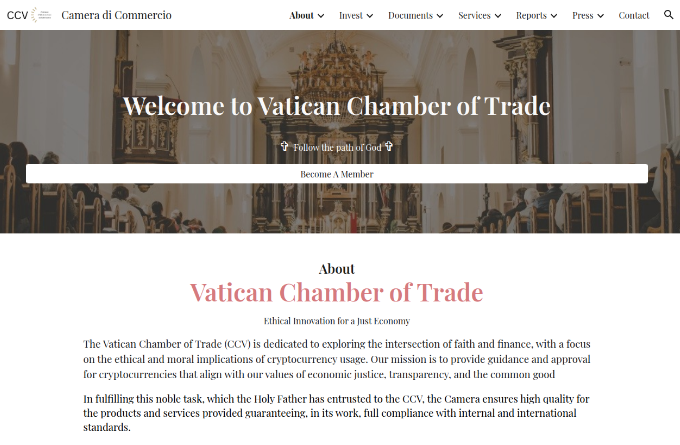
The Istituto per le Opere di Religione (IOR), commonly known as the Vatican Bank, has denied any connection to a fake cryptocurrency project claiming ties to it. Fake ‘Vatican Chamber’ token
The fake token, dubbed Vatican Chamber Token (VCT), was promoted on an online . Phishing scam website claiming to offer a “formal invitation to join one of the world’s most exclusive economic institutions.” The promoters said the “Vatican Chamber of Trade” was accepting new applicants “for the first time in a generation.”
The website goes as far as to include the real number of the Vatican Bank on its website. A representative of the Vatican Bank confirmed during a call with toponline4u that the project “is a scam,” and denied any affiliation with it.
Vatican Chamber of Trade scam token exposed
Toponline4u found no institution exists in the Vatican called the “Vatican Chamber of Trade.” Adding to the sophistication of the scam, a link was recently added to the Vatican Bank’s Wikipedia page, claiming the organization was created in 1950.
However, the link is highlighted in red, indicating that it lacks a source and is likely vandalism. The edit history shows that the mention was added as part of a second edit of the page that took place on June 11.
The project’s website promised that accepted members would gain access to private investor introductions and custodial holding. As well as “recognition and credibility.” Members would also gain access to a presale of the fake VCT tokens, priority access to tokenized asset offerings and exclusive events.
Eligibility criteria raise red flags
The website lists strict eligibility criteria. With potential members being required to “operate a formally registered company or project in compliance with local and international laws.” Traditional businesses require a minimum annual revenue of 100,000 euros ($117,000), while crypto projects need at least 300,000 euros in total value locked or a verified 500,000 euros in a 12-month cumulative trading volume.
Prospective members are also expected to be ethically aligned with the organization’s core values, cited as transparency. Stewardship, financial inclusion and sustainability.
The promoters claim the VCT token will allow investors to participate in . The economic growth of the Vatican Chamber of Trade and. Is backed by a diverse portfolio of tokenized assets and real-world initiatives.
The token’s promised total supply is 10 million, with each priced at 25 euros. The token’s circulating supply is 7 million, with 3 million — nearly a third of the supply — being allocated to . The reserve fund to finance “future development and operational stability.”
The “buy token” button redirects the user to a Coinbase wallet page. Still, the redirect comes from vaticantrade.cb.id, suggesting the website originally led to a now-deleted page on the Coinbase-controlled domain cb.id.
Coinbase lets any user claim a “username.cb.id” sub-domain free without Know Your Customer checks thanks to an Ethereum Name Service (ENS) integration. Coinbase had not responded to Cointelegraph’s request for comment by publication.
The incident follows several high-profile fraud cases in the crypto space. In January, Washington pastor Francier Obando Pinillo was charged with 26 counts . Of fraud for allegedly stealing from more than 1,500 investors. The Solano Fi scheme — which he reportedly claimed came to him in a dream — could cost him up to 20 years in prison.
Explore more articles like this
Subscribe to the Finance Redefined newsletter
A weekly toolkit that breaks down the latest DeFi developments, offers sharp analysis, and uncovers new financial opportunities to help you make smart decisions with confidence. Delivered every Friday
By subscribing, you agree to our Terms of Services and Privacy Policy
Finding thebest digital banking platform for small business operations has become crucial for entrepreneurs seeking to streamline their financial management in today’s competitive marketplace. With traditional banking falling short of modern business needs, digital banking solutions offer unprecedented convenience, cost-effectiveness, and advanced features that can transform how small businesses handle their finances.
Small business owners are increasingly turning to digital banking platforms that provide 24/7 access, lower fees, integrated accounting tools, and seamless payment processing capabilities. These innovative financial solutions eliminate the constraints of traditional brick-and-mortar banking, offering everything from instant transfers to automated bookkeeping integration. Whether you’re a startup founder or an established small business owner, choosing the right digital banking platform can significantly impact your operational efficiency and bottom line.
What Makes the Best Digital Banking Platform for Small Businesses?
When evaluating digital banking solutions, several key factors distinguish exceptional platforms from average ones. The most effective digital banking platforms combine robust security measures with user-friendly interfaces and comprehensive financial tools.
Essential Features to Look For
Modern small businesses require banking platforms that offer more than basic account management. The ideal platform should provide real-time transaction monitoring, multi-user access controls, and integration capabilities with popular accounting software like QuickBooks and Xero.
Advanced features such as automated expense categorization, invoice generation, and cash flow forecasting tools can dramatically improve your financial workflow. Additionally, look for platforms that offer competitive interest rates on business savings accounts and minimal fees for common transactions.
Security and Compliance Standards
Security remains paramount when selecting any financial platform. The best digital banking solutions employ bank-level encryption, two-factor authentication, and comply with federal regulations including FDIC insurance protection for deposits.
Top Digital Banking Platforms for Small Businesses
Traditional Banks Going Digital
Several established financial institutions have developed sophisticated digital platforms specifically designed for small business needs. These platforms typically offer the stability of traditional banking combined with modern digital convenience.
Bank of America Business Advantage and Chase Business Complete Banking have invested heavily in their digital infrastructure, providing mobile apps with advanced features like mobile check deposit and real-time notifications.
Fintech-Focused Solutions
Innovative fintech companies have emerged as strong competitors in the digital banking space, often offering more flexible terms and cutting-edge features than traditional banks.
Platforms like Mercury, Novo, and BlueVine have gained popularity among small business owners for their streamlined onboarding processes, transparent fee structures, and integration-friendly APIs that connect seamlessly with business management tools.
Neobanks and Digital-First Options
Digital-first banking solutions eliminate physical branches entirely, passing cost savings to customers through reduced fees and enhanced digital experiences. These platforms often provide superior mobile applications and customer support tailored to small business needs.
Comparing Fees and Pricing Structures
Understanding the cost structure of different digital banking platforms is essential for making an informed decision. Fee structures vary significantly between providers, with some offering completely free business checking accounts while others charge monthly maintenance fees.
Monthly Maintenance Fees
Many digital banking platforms have eliminated monthly maintenance fees as a competitive advantage. However, some premium platforms charge monthly fees ranging from $10 to $30 in exchange for enhanced features and higher transaction limits.
Transaction and Processing Fees
Pay close attention to transaction fees, especially if your business processes a high volume of payments. Some platforms offer unlimited transactions, while others may charge per transaction after reaching certain thresholds.
Wire transfer fees, ACH processing costs, and international transaction fees can significantly impact your operational expenses if not carefully evaluated during the selection process.
Integration Capabilities and Third-Party Connections
The ability to integrate with existing business tools represents a crucial advantage of modern digital banking platforms. Seamless integration with accounting software, payment processors, and business management systems can eliminate manual data entry and reduce errors.
Accounting Software Integration
Leading digital banking platforms offer direct integration with popular accounting solutions, automatically categorizing transactions and reconciling accounts. This integration capability saves countless hours of manual bookkeeping work.
Payment Processing Integration
Look for platforms that integrate with payment processors like Stripe, Square, or PayPal, enabling unified financial management across all revenue streams.
Security Features and Data Protection
Digital banking platforms must prioritize security to protect sensitive financial information and maintain customer trust. The most reliable platforms implement multiple layers of security including encryption, fraud monitoring, and secure authentication protocols.
Fraud Prevention and Monitoring
Advanced fraud detection systems use machine learning algorithms to identify suspicious activities and automatically flag potentially fraudulent transactions. Real-time alerts ensure business owners can respond quickly to any security concerns.
Data Encryption and Storage
End-to-end encryption protects data transmission between devices and banking servers. Additionally, secure data storage practices ensure that sensitive information remains protected even in the event of a security breach.
Mobile Banking Features and Accessibility
Mobile accessibility has become essential for small business owners who need to manage finances on the go. The best digital banking platforms provide comprehensive mobile applications with full-featured functionality.
Mobile Check Deposit
Mobile check deposit capabilities allow business owners to deposit checks remotely using smartphone cameras, eliminating trips to physical bank branches and accelerating cash flow.
Real-Time Notifications
Instant notifications for account activities help business owners stay informed about their financial status and quickly identify any unauthorized transactions.
Internal Link Suggestion: Consider linking to an article about “Mobile Banking Security Best Practices for Small Businesses” with anchor text: “mobile banking security tips”
Customer Support and Service Quality
Reliable customer support becomes critical when dealing with financial matters. The best digital banking platforms provide multiple support channels including phone, email, chat, and comprehensive online resources.
Support Availability
Look for platforms offering extended support hours or 24/7 availability, especially if your business operates outside traditional banking hours.
Response Times and Resolution
Quick response times and efficient problem resolution demonstrate a platform’s commitment to customer service quality.
Making Your Final Decision
Business process and workflow automation with a flowchart. A businessman pointing to an illustration of process management
Selecting the best digital banking platform requires careful consideration of your specific business needs, transaction volume, and growth projections. Create a comparison chart listing essential features and associated costs for each platform under consideration.
Consider starting with a trial period or basic account to test the platform’s functionality before fully committing to a particular solution.
ALT Text: Mobile banking app interface displaying small business account management features
Conclusion
Choosing the best digital banking platform for small businesses requires careful evaluation of features, fees, security measures, and integration capabilities. The right platform will streamline your financial operations, reduce administrative overhead, and provide the flexibility needed to support business growth.
Take time to assess your specific business requirements and compare multiple options before making your final decision. Consider factors such as transaction volume, international payment needs, and integration requirements with existing business tools.
Ready to transform your business banking experience? Start by requesting demos from top-rated digital banking platforms and discover how the right solution can revolutionize your financial management. Choose the best digital banking platform for small business success and position your company for sustained growth in the digital economy.
Explore more articles like this
Subscribe to the Finance Redefined newsletter
A weekly toolkit that breaks down the latest DeFi developments, offers sharp analysis, and uncovers new financial opportunities to help you make smart decisions with confidence. Delivered every Friday
By subscribing, you agree to our Terms of Services and Privacy Policy