















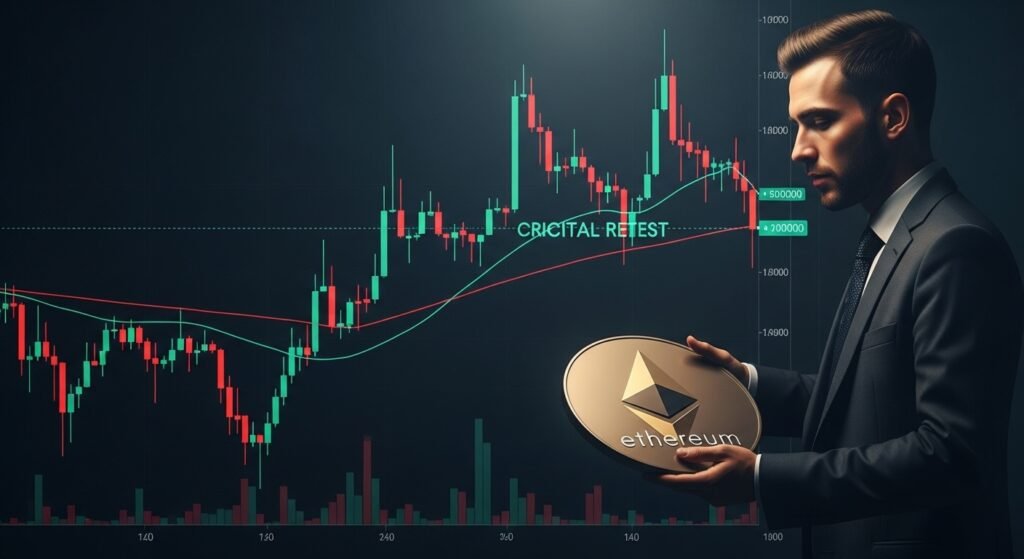
After a turbulent period marked by shifting macro conditions, fluctuating liquidity, and evolving regulatory landscapes, Ethereum has once again become a centerpiece of discussion in the digital asset world. The question rising to the forefront of investor conversations is whether Ethereum can retest $4,000 as confidence returns to the market. With prices stabilizing in the low-to-mid $3,000 range recently, the possibility of an upward surge has become far more than mere speculation. Instead, it reflects the convergence of improved fundamentals, a maturing market structure, new institutional pathways, and a broader revival of risk appetite across global markets.
Ethereum is no longer simply a speculative token. It has solidified itself as the backbone of decentralized finance, the primary home of NFTs, the foundation of Web3 innovation, and the preferred platform for the growing trend of real-world asset tokenization. It also carries an additional layer of appeal that Bitcoin does not: the ability to generate yield through staking. As the network continues to evolve through major upgrades and as spot Ethereum ETFs unlock institutional demand, the landscape looks increasingly supportive of another attempt at the psychologically important $4,000 level.
In this article, we explore where Ethereum stands today, what is fueling the return of investor confidence, what catalysts could propel ETH toward a retest of $4,000, and what risks remain in place. The goal is to provide a clear, nuanced, and thorough understanding of the forces shaping Ethereum’s trajectory.
Where Ethereum Stands in the Current Market Cycle
Price Context and Market Conditions
Ethereum’s current price action reflects a market that has transitioned from a deep bearish phase into a more constructive and cautiously optimistic environment. The low-to-mid $3,000 level represents an important zone of historical relevance, serving both as a point of consolidation and as a base for previous breakouts toward $4,000. Market memory plays a significant role here. Traders remember this region as a battleground between buyers and sellers, and each revisit builds additional psychological weight.
Recent trading patterns have shown higher lows forming on key timeframes. This phenomenon is often interpreted as a sign of strengthening underlying demand. Even when short-term pullbacks occur, the market continues to show resilience by maintaining a structure that leans more bullish than bearish. The absence of dramatic sell-offs, combined with healthier liquidity conditions, reinforces the notion that Ethereum’s price floor is steadily rising.
The technical outlook does not present $4,000 as an unrealistic leap. Instead, it appears to be a natural continuation of a trend that emerged after Ethereum successfully reclaimed the $3,000 level. For ETH to reach $4,000 again, it does not need to enter an entirely new price discovery phase; it merely needs momentum that brings it back to a level it has already known.
On-Chain Indicators Signaling Investor Confidence
Ethereum’s on-chain metrics provide additional context for its current market posture. One of the most telling signs of returning confidence is the continued growth of staking participation. As more ETH becomes locked in staking contracts, the circulating supply available for trading decreases, creating a tighter market. A reduced liquid supply tends to magnify the impact of incremental demand, which can accelerate upward price movement during bullish phases.
Another encouraging sign is the steady decline of ETH held on exchanges. When investors feel uncertain or anticipate a downturn, they often move assets onto exchanges in preparation for selling. The opposite behavior—moving assets off exchanges—indicates a growing preference for long-term holding. Many investors now choose to stake their ETH or store it in cold wallets, reflecting a shift toward a more patient and fundamentally driven investment mindset.
Ethereum’s role in decentralized finance also remains stable. Total value locked across the network shows signs of recovery, and activity among stablecoins and lending markets hints at renewed engagement. While the frenzy of past DeFi booms has not returned, the ecosystem appears healthier and more robust, with improved protocols, better risk management, and more mature liquidity infrastructure.
Macro Trends Supporting Ethereum’s Potential Move Toward $4,000

Improving Global Market Sentiment
Ethereum’s price does not move independently of broader financial markets. Historically, it thrives during periods when global risk appetite rises. Periods of lower inflation, stable interest rates, or expectations of monetary easing typically lead investors to re-enter higher-risk asset classes. When conditions become favorable, capital tends to flow not only into equities but also into digital assets like Ethereum.
The recent stabilization in global equity markets has created a supportive environment for cryptocurrencies. Investors appear more confident in taking calculated risks, and digital assets are benefiting from this shift. Each time macro indicators point toward improving liquidity or easing financial pressure, Ethereum tends to respond with increased momentum.
If these favorable macro trends continue, they could form the backdrop for a sustained push toward the $4,000 level, as risk-on behavior often leads to renewed inflows into established crypto assets.
Institutional Demand via Ethereum ETFs
One of the most significant developments shaping Ethereum’s new market cycle is the rise of spot Ethereum ETFs. For the first time, major institutional and traditional investors can gain direct exposure to Ethereum through conventional brokerage accounts. This has altered the demand structure for ETH in a material way.
The approval of Ethereum ETFs in the United States has validated ETH as an investable asset class. These products have attracted inflows from a wide range of participants, including wealth managers, pension funds, and retail investors who prefer regulated financial instruments. The ETF wrapper also allows for easier inclusion of ETH in diversified investment portfolios, further expanding demand.
ETF inflows may not be explosive every week, but their steady accumulation presents a long-term tailwind for Ethereum’s price. The existence of a regulated, easily accessible investment vehicle creates a persistent pipeline for capital. This inflow, even at modest levels, can contribute significantly to price strength, given Ethereum’s tightening supply structure.
If Ethereum ETFs continue to expand, and if more thematic or staked ETH products gain approval in the future, the cumulative effect of institutional adoption could provide the momentum needed for Ethereum to retest $4,000 and potentially establish a new support level above that threshold.
Ethereum’s Network Upgrades Strengthening Fundamentals
Ethereum’s ongoing improvements through upgrades like Dencun and the planned Fusaka update represent another important pillar of its bullish outlook. The Dencun upgrade significantly decreased the data costs for Layer 2 networks, making Ethereum a more efficient and scalable settlement layer. By lowering transaction costs and improving performance, the network has positioned itself to support a larger volume of decentralized applications.
The upcoming Fusaka upgrade is expected to deliver additional enhancements, particularly in scalability, validator performance, and user experience. Each successful upgrade reinforces the perception that Ethereum is a continuously evolving technology, capable of adapting to meet growing demand. This ongoing innovation strengthens investor confidence, as it demonstrates the network’s commitment to long-term usability and efficiency.
When technological progress aligns with increasing institutional demand and favorable macro conditions, the combination becomes particularly powerful. These factors working together create a foundation upon which Ethereum can realistically challenge the $4,000 level once again.
Assessing Whether Ethereum Can Realistically Retest $4,000
Technical Significance of the $4,000 Level
The $4,000 level holds both psychological and technical significance. Psychologically, round numbers often serve as emotional anchors for traders, influencing behavior and decision-making. Technically, $4,000 has acted as a pivotal point in previous market cycles. When Ethereum trades near this level, trading volumes typically rise, volatility increases, and market participants pay heightened attention.
Because Ethereum has already surpassed $4,000 in the past, retesting this level does not require unprecedented conditions. Instead, it depends on whether the current cycle has enough strength to match prior demand. The gradual buildup of higher lows, the increasing firmness of support levels, and the resurgence of investor engagement all suggest that Ethereum has the underlying strength to approach and potentially break through this level again.
If Ethereum does retest $4,000 with conviction, it could signal the beginning of a stronger rally. Historically, when ETH breaks through major resistance levels, it often enters periods of accelerated price discovery, driven by a combination of momentum traders, institutional inflows, and long-term holders adding to positions.
Fundamental Catalysts Fueling a Potential Breakout
Ethereum’s fundamentals are arguably stronger today than they were during previous attempts to reach or surpass $4,000. The expansion of staking has reduced the liquidity supply, making price movements more sensitive to demand. The improvement of the network through upgrades has increased Ethereum’s attractiveness as a platform for developers and users. The rise of Layer 2 networks has significantly expanded Ethereum’s scalability, enabling more use cases at lower cost.
Institutional adoption through ETFs creates a steady source of inflows that did not exist during earlier cycles. The tokenization of real-world assets, stablecoin settlements, and enterprise interest in blockchain technology all add layers of long-term value and potential demand.
When these catalysts converge, they create the ideal scenario for Ethereum to regain momentum and approach the $4,000 threshold with strong support behind it.
Risks That Could Delay or Prevent a Retest
No bullish scenario is complete without acknowledging the risks. Ethereum remains sensitive to macro shocks, such as rising interest rates, geopolitical tensions, or liquidity crises. Regulatory developments, especially regarding staking and decentralized finance, could create uncertainty in key markets. Competition from other smart contract platforms could also influence investor preference, even if Ethereum maintains a technological advantage.
These risks do not necessarily invalidate the possibility of Ethereum reaching $4,000, but they remind investors that the road upward is rarely linear. Monitoring the interaction between macro forces, regulatory environments, and network fundamentals is crucial for anticipating potential challenges.
Investor Confidence: A Key Factor in Ethereum’s Path Forward

Differences Between Retail and Institutional Sentiment
Retail investors and institutional participants often approach Ethereum from different perspectives. Retail investors tend to react swiftly to headlines and price movements, displaying higher sensitivity to short-term news. Institutions, by contrast, take a more methodical approach, evaluating Ethereum based on macro trends, technological developments, and long-term market positioning.
The return of institutional confidence—evident through ETF participation, staking products, and increased research coverage—provides a stabilizing effect on Ethereum’s market outlook. When institutions show interest, retail investors often follow, creating a reinforcing cycle of demand. If both groups align in their optimism, Ethereum’s path toward $4,000 becomes considerably smoother.
The Importance of Staking for Long-Term Confidence
Staking gives Ethereum a unique property among major cryptocurrencies: it offers yield. This yield transforms ETH into a hybrid asset with both growth potential and income generation. Investors increasingly view Ethereum as a digital bond with built-in appreciation potential. The existence of products that offer exposure to staked ETH enhances this narrative and broadens its appeal beyond traditional crypto participants.
Staking also reduces selling pressure by locking up supply. This structural feature supports long-term confidence, as investors can benefit from both price appreciation and passive rewards. Over time, this dual utility strengthens Ethereum’s position within both decentralized and institutional ecosystems.
Ethereum’s Future Beyond the $4,000 Level
Growing Real-World Use Cases
While the $4,000 level dominates near-term discussions, Ethereum’s long-term value derives from its expanding utility. The tokenization of real-world assets is gaining traction, with institutions exploring the potential of blockchain to streamline settlement, reduce costs, and increase transparency. Ethereum’s early leadership in this space positions it favorably as adoption increases.
Decentralized finance continues to expand with new protocols, improved designs, and more sustainable models. Stablecoins remain one of the most important innovations on blockchain, and a significant portion of stablecoin activity still occurs on Ethereum. As global financial systems evolve, Ethereum stands to benefit from being the base layer of choice for many emerging financial applications.
Competition and the Multi-Chain Future
Ethereum operates within a competitive landscape. Chains like Solana, Avalanche, and others continue to innovate, offering alternative models for scalability and execution. However, Ethereum’s lead in terms of developers, infrastructure, and ecosystem depth remains substantial. The multi-chain future does not require Ethereum to dominate every niche. Instead, it allows Ethereum to maintain its role as a foundational settlement layer while specialized chains cater to specific use cases.
The continued expansion of Layer 2 networks ensures that Ethereum can meet demand without sacrificing decentralization or security. This structure strengthens Ethereum’s long-term prospects and supports a bullish outlook beyond the next resistance level.
See More: Ethereum Price Reversal Looms as One Major Test Awaits
Conclusion
The possibility that Ethereum can retest $4,000 as investor confidence returns is not only realistic but increasingly supported by both data and sentiment. The combination of improving macro conditions, rising institutional adoption, growing staking participation, and successful network upgrades creates an environment conducive to upward movement. Ethereum does not need an extraordinary series of events to reach $4,000. It simply needs a continuation of present trends and a stable macro backdrop.
At the same time, investors should remain aware of the inherent risks. Market volatility, regulatory developments, and macro shifts can influence Ethereum’s trajectory. However, when analyzing Ethereum’s price potential, it becomes clear that the network’s fundamentals and adoption curve give it a strong foundation for future growth.
A retest of $4,000 appears not only plausible but increasingly likely. The question may soon shift from whether Ethereum can reach $4,000 to how long it can sustain that level and what new heights it may explore once it breaks through.