











































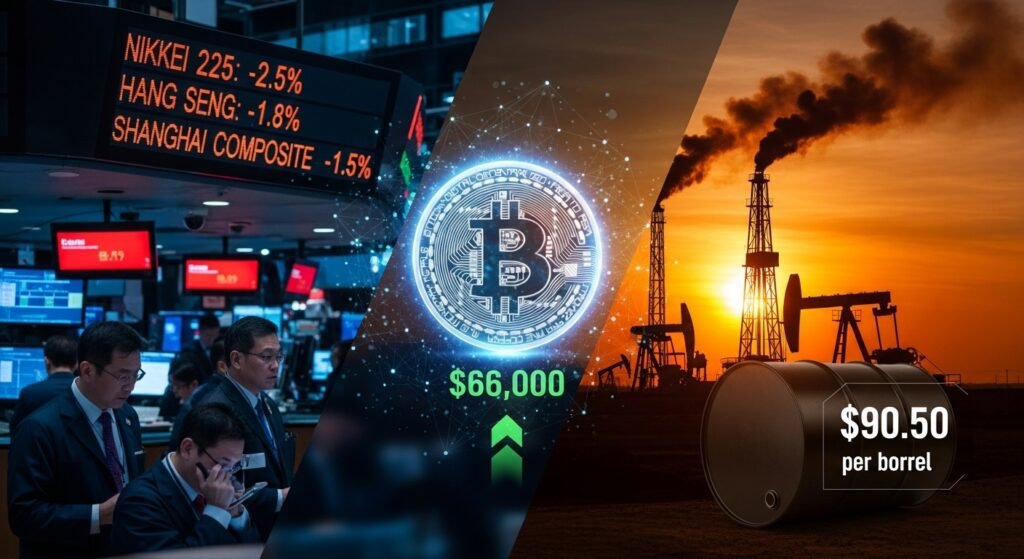
Bitcoin has continued to hold its ground near the $66,000 mark, showing remarkable resilience in the face of global market volatility. The cryptocurrency market has been closely following broader financial trends, and recent developments in Asia and the Middle East have caused ripples across both traditional and digital markets. While Asia stocks have fallen due to geopolitical concerns, oil prices have surged on fears of escalating US-Iran tensions, creating a unique scenario for investors. Despite these pressures, Bitcoin’s stability highlights its emerging role as a potential safe-haven asset amid uncertainty.
Investors are increasingly monitoring how geopolitical conflicts, currency fluctuations, and energy market dynamics intersect with digital currencies. The latest movements in Bitcoin, paired with shifts in commodities like crude oil and broader stock indices, reveal a complex market environment where cryptocurrencies, traditional finance, and global geopolitics are intricately linked. This article delves into the reasons behind Bitcoin’s stability, explores the broader market implications, and offers insights into what traders and investors should consider in this evolving landscape.
Bitcoin’s Stability Amid Market Turbulence
Despite the volatile environment, Bitcoin has managed to maintain its price around $66,000. The digital currency has faced multiple challenges, including regulatory scrutiny, profit-taking by large holders, and fluctuations in investor sentiment. Yet, its relative stability indicates growing maturity in the crypto market.
One key factor behind this steadiness is Bitcoin’s limited supply. Unlike fiat currencies, which can be printed by governments, Bitcoin’s total supply is capped at 21 million coins. This scarcity creates a hedge against inflation and economic instability, making it increasingly attractive during periods of market uncertainty.
Moreover, institutional adoption has played a significant role. Major companies and investment funds have integrated Bitcoin into their portfolios, which provides a level of support and confidence for the market. This has helped Bitcoin maintain its value even when traditional markets, like Asia stocks, are experiencing declines due to external shocks such as geopolitical conflicts.
Asia Stocks and the Ripple Effect on Global Markets
Asian stock markets recently experienced notable declines, reflecting investor concerns over the US-Iran tensions and their potential economic consequences. Markets in Japan, South Korea, and China have been particularly affected, with investors seeking safer assets amidst growing uncertainty.
These declines have a direct impact on global market sentiment. As Asian stocks fall, there is often a flight to safer assets, including gold, US Treasury bonds, and increasingly, Bitcoin. This relationship underscores the cryptocurrency’s evolving role as a hedge against traditional market volatility.
Analysts note that while Bitcoin is not immune to market sentiment, its performance during periods of stock market weakness suggests that it can serve as a counterbalance in diversified portfolios. Investors are now paying closer attention to how macroeconomic events in Asia influence not just traditional equities, but also digital assets worldwide.
Oil Prices Surge on US-Iran Tensions

Meanwhile, oil markets have reacted sharply to the geopolitical situation in the Middle East. Reports of escalating tensions between the United States and Iran have caused oil prices to jump, creating a ripple effect across energy markets. Higher oil prices contribute to inflationary pressures globally, which in turn impacts stock markets and consumer confidence.
Rising oil prices can also influence Bitcoin indirectly. Inflation fears often lead investors to seek alternative stores of value, and cryptocurrencies have emerged as one of these options. While Bitcoin is not a traditional commodity like gold or oil, its decentralized nature and limited supply make it appealing during periods of economic uncertainty.
Additionally, energy market volatility can affect mining costs for Bitcoin, particularly as electricity prices fluctuate. Miners may adjust operations based on energy expenses, which can influence overall network activity and market sentiment. Despite these potential challenges, Bitcoin’s price has remained resilient, highlighting its growing stability and investor confidence.
Factors Supporting Bitcoin’s Resilience
Several factors contribute to Bitcoin’s ability to withstand market shocks:
First, the increasing adoption of institutional investment provides a safety net. Large-scale investors often hold Bitcoin for the long term, reducing the frequency of panic selling during turbulent times.
Second, Bitcoin’s decentralized structure offers protection from direct government interventions or monetary policy fluctuations that typically affect fiat currencies. Investors who are concerned about traditional markets may view Bitcoin as a way to diversify and mitigate risk.
Third, technological advancements in the blockchain ecosystem continue to enhance security, transparency, and liquidity, making Bitcoin more accessible and reliable for both retail and institutional investors.
Finally, the growing awareness of macroeconomic trends, including inflation and geopolitical conflicts, has prompted more sophisticated trading strategies. Investors increasingly consider Bitcoin as part of a broader strategy to protect their portfolios from global uncertainty, which contributes to its ongoing stability.
Market Sentiment and Investor Behavior

Investor psychology plays a significant role in Bitcoin’s market dynamics. The cryptocurrency often reacts to broader news cycles, geopolitical developments, and macroeconomic indicators. Current trends suggest that even amid declines in Asia stocks and volatility in commodities like oil, investors perceive Bitcoin as a store of value and a potential hedge.
Sentiment analysis indicates that traders are balancing short-term fluctuations with long-term growth potential. While some profit-taking occurs during spikes in traditional markets or commodities, overall confidence in Bitcoin remains strong. This trend is particularly evident as Bitcoin holds its price near the $66,000 range, showing resilience that contrasts with the more volatile movements seen in equities and oil markets.
Furthermore, media coverage and analyst predictions shape market expectations. Positive narratives around institutional adoption, technological developments, and Bitcoin’s scarcity reinforce confidence, while geopolitical tensions add complexity to investor decision-making. This duality contributes to a dynamic but stable market environment for cryptocurrencies.
Implications for Traders and Investors
For traders, Bitcoin’s current stability offers opportunities to engage in strategic buying, selling, or hedging. Those who focus on short-term gains must consider market volatility in equities and commodities, while long-term investors may view the current price level as a favorable entry point.
Investors should also monitor external factors such as geopolitical conflicts, currency fluctuations, and energy market trends, all of which indirectly affect Bitcoin’s price. Diversifying across asset classes, including cryptocurrencies, stocks, and commodities, can help mitigate risks and capture growth opportunities in volatile markets.
Analysts emphasize that maintaining a well-informed approach is crucial. Understanding correlations between traditional markets, oil prices, and cryptocurrencies enables investors to anticipate potential market reactions and make more informed decisions.
Conclusion
Bitcoin’s ability to hold steady near $66,000 amid falling Asia stocks and surging oil prices underscores its growing significance as a resilient asset in the global financial landscape. While geopolitical tensions and macroeconomic volatility continue to shape market sentiment, Bitcoin’s scarcity, institutional adoption, and decentralized nature provide a level of stability not always seen in traditional markets.
As investors navigate uncertain times, understanding the interplay between cryptocurrencies, equities, and commodities becomes increasingly important. Bitcoin’s resilience signals that digital assets may play a larger role in future investment strategies, serving as both a hedge and a potential growth vehicle in a rapidly evolving global economy.
FAQs
Q: How do US-Iran tensions specifically influence Bitcoin prices, and why does geopolitical conflict affect cryptocurrencies differently than traditional stocks?
Geopolitical tensions like those between the US and Iran create uncertainty in global markets, leading to fluctuations in traditional equities, commodities, and currencies. Bitcoin, as a decentralized digital asset, is not directly tied to any single economy, which allows it to act differently from stocks. During periods of conflict, investors often seek alternative stores of value, viewing Bitcoin as a hedge against market instability. Its limited supply and growing institutional adoption further enhance its appeal as a safe-haven asset, making it less susceptible to immediate government interventions or currency devaluations.
Q: Why have Asia stocks fallen while Bitcoin remains stable, and what does this tell investors about market correlations?
Asia stocks have fallen due to investor concerns over geopolitical tensions and global economic uncertainty. These declines reflect traditional market reactions to potential risks affecting trade, corporate profits, and investor confidence. Bitcoin’s stability during this period indicates that while it can be influenced by global sentiment, it often behaves independently of traditional stock indices. This divergence suggests that cryptocurrencies may offer portfolio diversification benefits, allowing investors to balance exposure between volatile equity markets and relatively resilient digital assets.
Q: In what ways do rising oil prices impact Bitcoin indirectly, and why might this attract more investors to cryptocurrencies?
Rising oil prices can increase inflation and energy costs globally, affecting consumer spending and corporate earnings. This can create market instability, prompting investors to seek alternative assets like Bitcoin. Additionally, higher energy costs influence Bitcoin mining operations, which depend on electricity for blockchain validation. While this may affect supply dynamics, the perception of Bitcoin as a hedge against inflation and economic uncertainty can attract investors looking for protection from traditional market volatility and rising commodity prices.
Q: How does institutional adoption contribute to Bitcoin’s stability, and why is this important for long-term investors?
Institutional adoption stabilizes Bitcoin by creating large, long-term holdings that reduce the frequency of panic selling. Companies, investment funds, and other financial institutions increasingly view Bitcoin as part of diversified portfolios, which enhances market confidence. For long-term investors, this means reduced volatility compared to early years of cryptocurrency trading and a higher likelihood of sustained growth. Institutional involvement also encourages the development of infrastructure, security, and market regulation, further solidifying Bitcoin’s position as a mainstream investment vehicle.
Q: What strategies should investors consider when navigating Bitcoin alongside volatile traditional markets and commodities?
Investors should adopt a multi-faceted approach, monitoring both cryptocurrency trends and macroeconomic indicators like stock indices, oil prices, and geopolitical events. Diversification is key, balancing holdings across digital assets, equities, and commodities to reduce risk. Staying informed about market correlations, investor sentiment, and technological developments in blockchain ecosystems enables more strategic decision-making. Additionally, investors may consider both short-term trading opportunities and long-term positions in Bitcoin to capture potential growth while mitigating exposure to market shocks.