











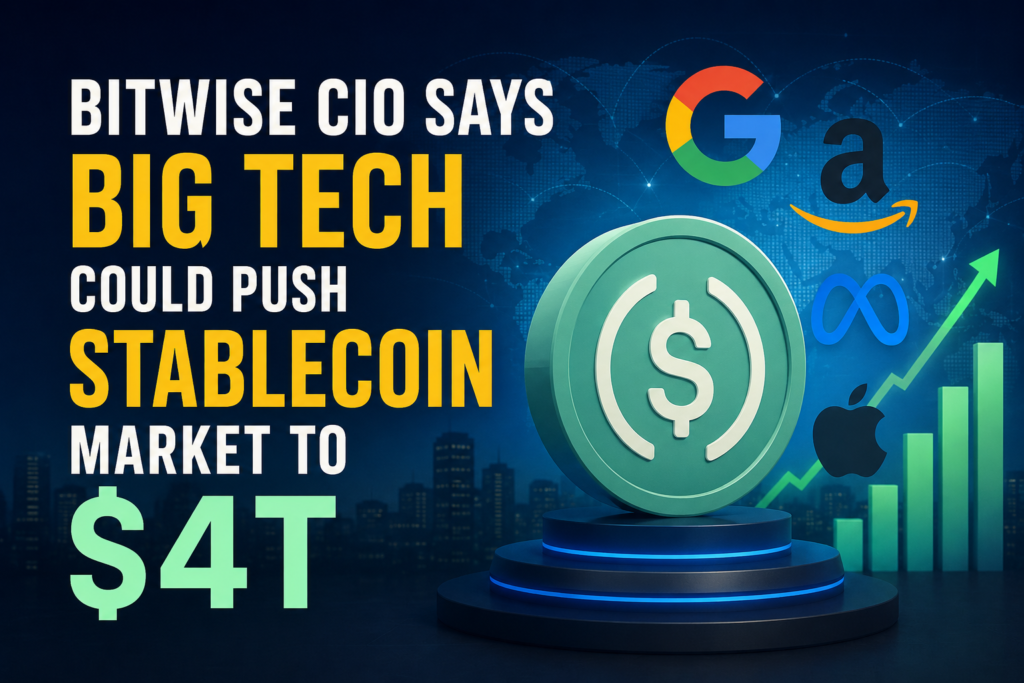
Big Tech Could Drive $4T Stablecoin Boom: Bitwise CIO

Big Tech Could Drive $4T Stablecoin Boom Bitwise CIO

COIN4U IN YOUR SOCIAL FEED

The global financial landscape is undergoing a profound transformation, and at the center of this shift lies the rapid evolution of stablecoins. According to the Bitwise Chief Investment Officer, the convergence of blockchain innovation and large-scale technology adoption could propel the stablecoin market toward an astonishing $4 trillion valuation. This bold prediction reflects not only the growing legitimacy of digital assets but also the increasing involvement of Big Tech companies in reshaping financial infrastructure.

Stablecoins, often described as the bridge between traditional finance and the crypto ecosystem, have already demonstrated their utility in payments, remittances, and decentralized finance. However, the entry of major technology corporations into this space signals a new phase of expansion. With their vast user bases, global reach, and technological expertise, these companies have the potential to accelerate adoption at an unprecedented scale.

This article explores how Big Tech could drive the stablecoin market to $4 trillion, the implications for global finance, and the opportunities and risks that lie ahead. By examining industry trends, regulatory developments, and technological advancements, we gain a deeper understanding of how this transformation could unfold in the coming years.

The Rise of Stablecoins in the Digital Economy

Stablecoins have emerged as a cornerstone of the modern digital economy. Unlike volatile cryptocurrencies, these digital assets are typically pegged to stable reserves such as fiat currencies, making them more reliable for everyday transactions. Over the past few years, the stablecoin market has grown rapidly, fueled by increasing demand for fast, low-cost, and borderless payments.

The appeal of stablecoins lies in their ability to combine the efficiency of blockchain technology with the stability of traditional currencies. This unique combination has made them a preferred choice for traders, businesses, and individuals seeking a seamless financial experience. As adoption continues to grow, stablecoins are becoming an integral part of the broader financial ecosystem.

The Bitwise CIO’s projection of a $4 trillion market highlights the immense potential of this sector. It suggests that stablecoins are no longer a niche innovation but a mainstream financial instrument capable of transforming how money moves across the globe.

How Big Tech Could Accelerate Stablecoin Adoption

Expanding User Access and Financial Inclusion

One of the most significant advantages Big Tech companies bring to the stablecoin market is their massive user base. Platforms with billions of active users can introduce stablecoin functionality directly into their ecosystems, making digital finance accessible to a wider audience. This level of integration could significantly reduce barriers to entry and drive mass adoption.

By embedding stablecoins into payment systems, social media platforms, and e-commerce networks, Big Tech firms can create a seamless user experience. This approach not only enhances convenience but also promotes financial inclusion, particularly in regions with limited access to traditional banking services.

Leveraging Advanced Technology Infrastructure

Big Tech companies are known for their advanced technological capabilities, including cloud computing, artificial intelligence, and data analytics. These resources can be leveraged to improve the efficiency, security, and scalability of stablecoin networks. As a result, the stablecoin market could experience rapid growth and innovation.

The integration of blockchain technology with existing digital infrastructure can create powerful synergies. For example, real-time transaction processing, enhanced fraud detection, and improved user interfaces can make stablecoins more attractive to both consumers and businesses.

Building Trust and Credibility

Trust is a critical factor in financial adoption, and Big Tech companies have the advantage of established brand recognition. While the crypto industry has faced skepticism in the past, the involvement of well-known technology firms can enhance credibility and encourage wider acceptance.

As these companies enter the stablecoin space, they bring with them a level of trust that can help bridge the gap between traditional finance and digital assets. This trust factor could play a crucial role in driving the stablecoin market toward the projected $4 trillion valuation.

The Role of Regulation in Shaping the Market
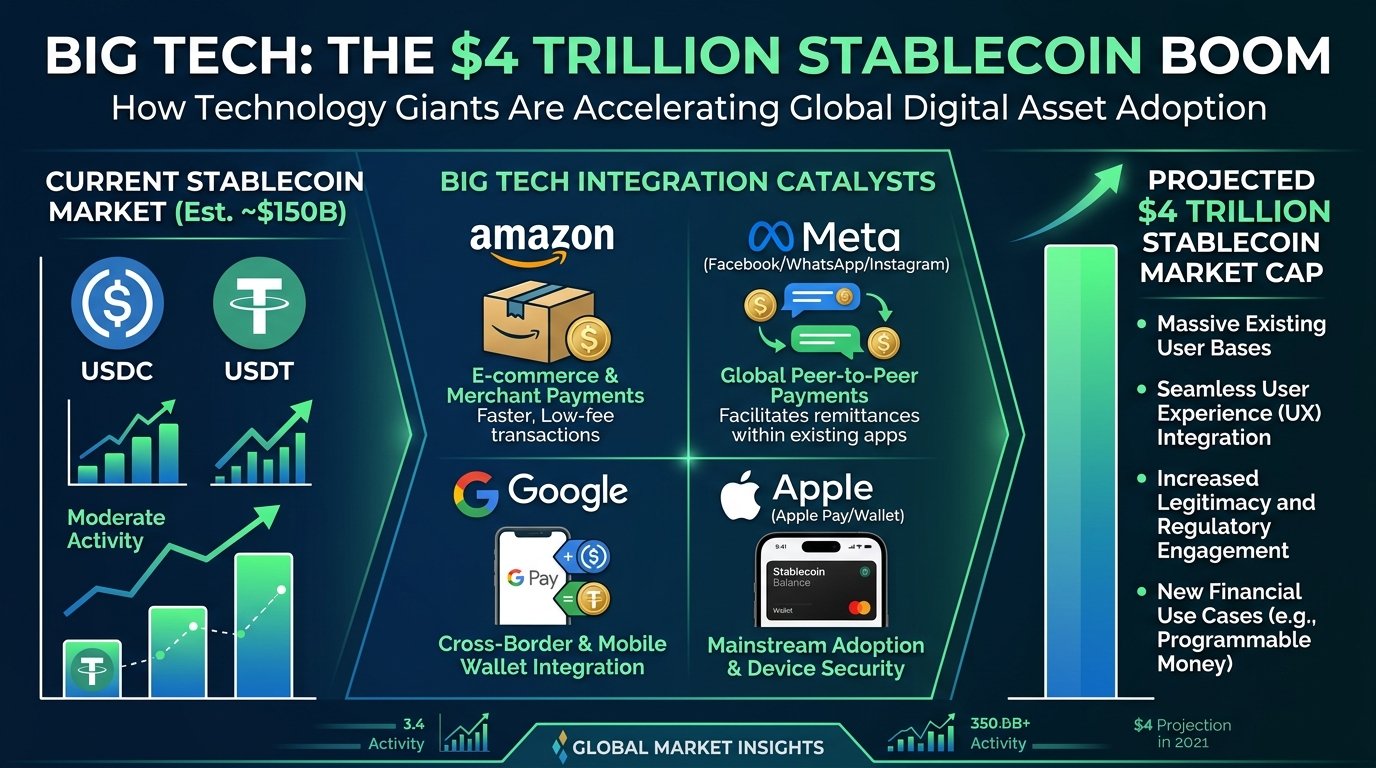
Big Tech Could Drive $4T Stablecoin Boom Bitwise CIO

Regulation will play a pivotal role in determining the future of stablecoins. Governments and financial authorities around the world are increasingly focusing on creating frameworks to govern digital assets. While regulatory clarity can provide stability and encourage innovation, overly restrictive policies could hinder growth.

The involvement of Big Tech companies may accelerate the development of regulatory standards. These firms often have the resources and influence to engage with policymakers and shape the regulatory landscape. As a result, the stablecoin market could benefit from clearer guidelines and increased institutional participation.

However, regulatory challenges remain. Issues such as compliance, transparency, and consumer protection must be addressed to ensure the long-term sustainability of the market. Balancing innovation with regulation will be key to unlocking the full potential of stablecoins.

Stablecoins and the Evolution of Global Payments

Transforming Cross-Border Transactions

One of the most promising applications of stablecoins is in cross-border payments. Traditional international transfers are often slow, expensive, and complex. Stablecoins offer a faster and more cost-effective alternative, enabling near-instant transactions across borders.

As Big Tech companies integrate stablecoins into their platforms, cross-border payments could become more efficient and accessible. This transformation has the potential to reshape global commerce and facilitate economic growth.

Enhancing E-Commerce and Digital Transactions

The integration of stablecoins into e-commerce platforms can revolutionize online transactions. By reducing transaction fees and processing times, stablecoins can improve the overall shopping experience for consumers. This innovation can also benefit merchants by increasing efficiency and reducing costs.

As digital commerce continues to expand, the role of stablecoins is likely to become more prominent. The involvement of Big Tech companies can further accelerate this trend, driving widespread adoption across various industries.

The Impact on Traditional Financial Institutions

The rise of stablecoins presents both challenges and opportunities for traditional financial institutions. Banks and payment providers may face increased competition as digital assets gain popularity. However, they also have the opportunity to adapt and integrate stablecoins into their services.

Collaboration between traditional finance and Big Tech could lead to the development of hybrid financial systems. These systems can combine the strengths of both sectors, offering enhanced services to consumers and businesses. As the stablecoin market grows, traditional institutions must evolve to remain relevant in this changing landscape.

Risks and Challenges in the Stablecoin Market

Despite the promising outlook, the stablecoin market is not without risks. Concerns about security, regulatory compliance, and market stability must be addressed to ensure sustainable growth. The involvement of Big Tech companies introduces additional complexities, including data privacy and market dominance issues.

Another challenge is maintaining the stability of stablecoins themselves. Ensuring that these digital assets remain properly backed and transparent is crucial for maintaining trust. Any failure in this regard could have significant implications for the broader financial system.

Additionally, the rapid growth of the stablecoin market could lead to increased scrutiny from regulators. Addressing these challenges will require collaboration between industry stakeholders, policymakers, and technology providers.

The Future Outlook: A $4 Trillion Opportunity

The prediction that Big Tech could push the stablecoin market to $4 trillion reflects a broader trend toward digital financial transformation. As technology continues to evolve, the integration of blockchain and traditional systems is likely to accelerate.

The future of stablecoins will depend on several factors, including technological innovation, regulatory developments, and market adoption. Big Tech companies are well-positioned to drive this growth, leveraging their resources and expertise to create new opportunities.

As the market expands, stablecoins could become a fundamental component of the global financial system. This transformation has the potential to redefine how money is used, stored, and transferred, paving the way for a more inclusive and efficient financial ecosystem.

Conclusion

The Bitwise CIO’s projection of a $4 trillion stablecoin market underscores the transformative potential of this emerging sector. With the involvement of Big Tech companies, stablecoins are poised to move beyond their current role and become a central pillar of global finance.

From enhancing cross-border payments to driving financial inclusion, the impact of stablecoins is far-reaching. However, achieving this vision will require careful navigation of regulatory challenges and market risks. By fostering innovation while ensuring stability, the industry can unlock new possibilities and shape the future of finance.

As we move further into 2026, the convergence of technology and finance will continue to redefine the global economy. The rise of stablecoins, supported by Big Tech, represents a significant step toward a more connected and efficient financial world.


Explore more articles like this

Subscribe to the Finance Redefined newsletter

A weekly toolkit that breaks down the latest DeFi developments, offers sharp analysis, and uncovers new financial opportunities to help you make smart decisions with confidence. Delivered every Friday

By subscribing, you agree to our Terms of Services and Privacy Policy

READ MORE

How Altcoins Are Paving the Way for Blockchains Mainstream Adoption

Blockchain's Mainstream Adoption

COIN4U IN YOUR SOCIAL FEED

Blockchain technology has steadily grown from a niche concept for tech enthusiasts and investors to a transformative force that has captured the attention of industries worldwide. At the forefront of this revolution are altcoins, or alternative cryptocurrencies to Bitcoin, which play a significant role in pushing blockchain technology towards mainstream adoption.

While Bitcoin remains the most well-known cryptocurrency, altcoins are increasingly driving blockchain’s evolution by solving key challenges such as scalability, privacy, transaction speed, and sustainability. As the blockchain space expands, altcoins are not just diversifying the digital asset market but are also accelerating blockchain adoption in various sectors, including finance, healthcare, and supply chain management.

The Role of Altcoins in the Blockchain Ecosystem

Exploring the Diverse World of Altcoins

Altcoins are essentially any cryptocurrency that is not Bitcoin. The term “altcoin” encompasses a wide range of digital assets, including well-known coins like Ethereum, Ripple (XRP), and Litecoin, as well as newer projects like Cardano and Polkadot. Each altcoin comes with its own unique set of features, use cases, and technological innovations designed to improve upon Bitcoin’s limitations.

Altcoins are often developed to address issues that Bitcoin’s protocol doesn’t effectively solve. For instance, Ethereum introduced the concept of smart contracts, allowing for programmable transactions that go beyond simple peer-to-peer transfers. Similarly, coins like Litecoin and Ripple offer faster transaction speeds and lower fees, making them more practical for everyday use.

These variations among altcoins are key drivers of blockchain adoption because they introduce fresh use cases, scalability, and interoperability across different blockchain networks, which is crucial for attracting a larger audience to blockchain technology.

Altcoins and Blockchain Scalability

Altcoins and Blockchain Scalability

Solving the Scalability Trilemma

One of the most significant hurdles in blockchain technology is scalability. As the number of users and transactions increases, blockchain networks can become congested, leading to slower transaction speeds and higher fees. This scalability problem is often referred to as the “scalability trilemma,” where blockchain networks struggle to balance three critical factors: decentralization, security, and scalability.

Altcoins are at the forefront of solving this issue. For instance, Ethereum’s Ethereum 2.0 upgrade aims to move from a proof-of-work consensus mechanism to proof-of-stake, significantly increasing transaction throughput. Similarly, Polkadot and Cardano have introduced innovative features such as sharding and multi-chain networks, allowing transactions to be processed simultaneously across different chains without sacrificing decentralization or security.

By improving scalability, altcoins help blockchain technology scale beyond its current limitations, paving the way for widespread adoption in industries that require high throughput, such as finance, healthcare, and supply chain logistics.

The Drive for Lower Transaction Fees

Reducing Costs for Users and Businesses

High transaction fees have long been a barrier to blockchain adoption, particularly for small-scale transactions. Bitcoin’s transaction fees can become prohibitively expensive during periods of high network congestion. This is where altcoins shine. Many altcoins offer lower transaction fees, making them more suitable for everyday use, microtransactions, and even small businesses.

Litecoin, for example, is often hailed as the “silver” to Bitcoin’s “gold” because it offers much faster transaction times and lower fees. In fact, Litecoin transactions cost just a fraction of a cent, which makes it far more feasible for everyday purchases. Likewise, Ripple (XRP) was designed specifically for remittances and international payments, where transaction costs are crucial. XRP boasts ultra-low fees and fast settlement times, making it an attractive option for cross-border transactions.

Altcoins that reduce transaction fees also make blockchain more accessible to the general public. For users who want to send money across the globe or pay for goods and services in digital currencies, the ability to do so with minimal fees enhances the practicality of blockchain technology in everyday life.

Fostering Privacy and Security

Fostering Privacy and Security

Enhancing User Privacy in the Digital Age

Privacy is a critical concern for digital users and businesses alike, especially as data breaches and privacy violations continue to make headlines. Traditional financial systems and centralized platforms collect vast amounts of personal data, which can be vulnerable to cyberattacks. Altcoins like Monero and Zcash offer advanced privacy features that ensure transactions are confidential, giving users more control over their financial data.

Monero, for example, uses a technique called ring signatures to hide the sender, receiver, and transaction amount, making it nearly impossible to trace the transaction. Similarly, Zcash employs zk-SNARKs (zero-knowledge succinct non-interactive arguments of knowledge) to ensure complete privacy while still allowing for transaction validation on the blockchain.

These privacy features are vital in attracting users who value anonymity and security, especially in industries such as finance, healthcare, and law, where confidentiality is paramount. Altcoins that prioritize privacy help build trust in blockchain technology, enabling more individuals and businesses to use decentralized systems without fearing exposure.

Altcoins Enabling Cross-Chain Interoperability

Bridging Blockchain Networks for Seamless Interaction

Blockchain networks often operate in isolation, creating silos that limit their effectiveness and scalability. For blockchain to reach its full potential, different networks must be able to communicate with each other. Altcoins like Polkadot, Cosmos, and Chainlink are developing solutions for cross-chain interoperability, enabling different blockchains to communicate, share information, and execute transactions across different platforms seamlessly.

Polkadot, for example, allows for the transfer of data and value between different blockchains through its “parachain” structure. This cross-chain communication is a game-changer for blockchain adoption because it expands the functionality and reach of decentralized applications (dApps), allowing them to tap into multiple networks and user bases.

Altcoins driving interoperability help foster a more interconnected and versatile blockchain ecosystem. This is essential for creating a global decentralized economy, where assets, information, and services can flow freely across borders and blockchain networks.

See More: Cryptocurrency and blockchain technology Powers Digital Money Safely

Driving User Adoption with Real-World Use Cases

Altcoins in Everyday Applications

For blockchain technology to gain mainstream adoption, it needs to be more than just a tool for investors and developers—it needs to be a part of everyday life. Altcoins contribute significantly to this by powering real-world use cases in various industries. Ethereum, for example, is the foundation of the decentralized finance (DeFi) ecosystem, where users can borrow, lend, and trade cryptocurrencies without relying on traditional financial institutions.

Similarly, altcoins like VeChain are revolutionizing supply chain management by offering tamper-proof, traceable data for products as they move from manufacturer to consumer. This provides businesses with a more efficient and transparent supply chain while also benefiting consumers who can verify the authenticity and origin of their purchases.

As more altcoins support real-world applications, they increase blockchain’s practical value and pave the way for broader acceptance. Businesses and individuals will be more inclined to adopt blockchain technology if it addresses tangible needs and improves their daily lives.

The Future of Altcoins and Blockchain Adoption

A Collaborative Ecosystem

Looking ahead, it’s clear that altcoins will continue to play an essential role in driving blockchain technology towards mainstream adoption. By addressing issues such as scalability, privacy, transaction costs, and real-world use cases, altcoins are paving the way for blockchain to become a ubiquitous part of our digital lives.

Furthermore, as more industries and governments embrace blockchain’s potential, the influence of altcoins will only grow. Their ability to innovate, enhance network interoperability, and offer tangible benefits to users will help blockchain technology become more widespread and accepted on a global scale.

Conclusion

Altcoins are a crucial part of the blockchain revolution. By improving scalability, reducing transaction fees, enhancing privacy, enabling interoperability, and supporting real-world use cases, they are driving blockchain towards mainstream adoption. As more industries recognize the potential of blockchain and embrace altcoins, the technology will continue to evolve, shaping the future of finance, business, and beyond.

FAQs

Q: What is the primary difference between Bitcoin and altcoins?

The main difference lies in their purpose and technology. While Bitcoin is primarily a store of value and a digital currency, altcoins often offer additional features, such as smart contracts, privacy enhancements, or solutions for scalability.

Q: Can altcoins replace Bitcoin?

While altcoins offer unique features and advantages, Bitcoin remains the dominant cryptocurrency. However, certain altcoins could surpass Bitcoin in specific use cases, such as faster payments or privacy.

Q: How do altcoins impact blockchain scalability?

Altcoins improve scalability by introducing features like sharding, proof-of-stake, and multi-chain networks, allowing blockchain networks to process more transactions without sacrificing security.

Q: Are privacy-focused altcoins safe to use?

Privacy-focused altcoins like Monero and Zcash offer advanced encryption methods, making them secure for users who prioritize confidentiality. However, users should always be aware of the regulatory landscape in their region.

Q: How do altcoins contribute to mainstream adoption of blockchain?

Altcoins drive blockchain adoption by solving key challenges such as scalability, transaction costs, privacy, and real-world applicability. They provide innovative solutions that make blockchain more accessible to a broader audience.

Explore more articles like this

Subscribe to the Finance Redefined newsletter

A weekly toolkit that breaks down the latest DeFi developments, offers sharp analysis, and uncovers new financial opportunities to help you make smart decisions with confidence. Delivered every Friday

By subscribing, you agree to our Terms of Services and Privacy Policy

READ MORE

ADD PLACEHOLDER