Crypto Exchanges with Lowest Fees October 2025

Crypto Exchanges with Lowest Fees

COIN4U IN YOUR SOCIAL FEED

 If you trade often, fees compound like friction. A tenth of a percent here, a network surcharge there, and suddenly your “edge” is gone. This October 2025 review zeroes in on the crypto exchanges with the lowest fees, comparing maker-taker fees, spot trading fees, derivatives fees, withdrawal fees, and the fine print that quietly moves the goalposts. We also look at typical VIP tiers, volume discounts, and token-based fee reductions so you can match the right platform to your size and style.

To keep this practical, each exchange summary covers baseline spot pricing for entry-level accounts, what it takes to lower that rate, and what traders actually feel in real use. Because promotions change, we cite each exchange’s current fee schedule or most up-to-date help page so you can verify before you switch.

Along the way, we weave in related concepts—maker-taker fees, zero-fee trading, KYC tiers, liquidity, margin and futures fees, and stablecoin pairs—so the analysis stays grounded without becoming a jargon soup. The result is a natural, readable guide that helps you minimize trading costs without sacrificing reliability, tools, or asset coverage.

How “low fees” really work

Before we rank the cheapest options, remember that “low fees” are not a single number. Exchanges typically quote base maker and taker percentages for spot trading. Makers add liquidity with resting limit orders; takers remove it with marketable orders. Most platforms then stack volume-based VIP tiers and token discounts. Some add pair-specific promos (for example, stablecoin pairs) and temporary zero-fee campaigns. Finally, there are non-trading costs—from fiat deposit/withdrawal charges to crypto network fees—that materially change what you pay.

In short, the best exchange for you depends on whether you place limit orders, your 30-day volume, whether you’re comfortable holding an exchange token for discounts, and which assets/networks you withdraw most often.

The 10 cheapest crypto exchanges in October 2025
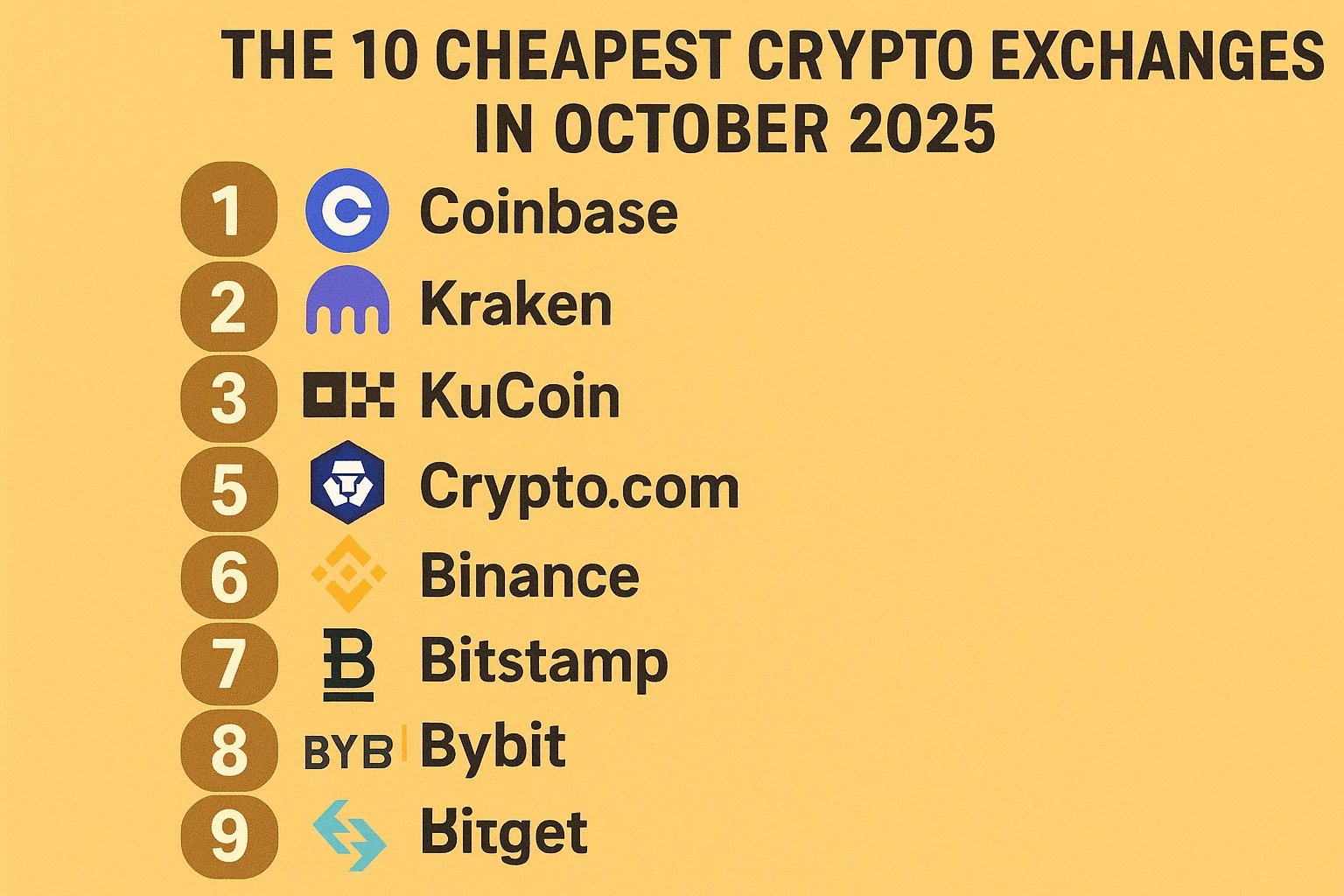
The 10 cheapest crypto exchanges in October 2025

Binance

For years, Binance has set the pricing anchor. The baseline spot maker/taker is typically around the 0.10% mark with additional rebates through BNB fee payment and volume tiers. The live fee schedule is public and updated as tiers and promos change, so confirm current spot percentages and discounts there.

Why it’s cheap in practice: aggressive VIP tiering can cut fees sharply for active traders, and paying with BNB reduces them further on eligible pairs. Occasional zero-fee pair campaigns on large stablecoin pairs have historically pushed realized costs down even more. Third-party comparisons as of late September 2025 still find Binance’s structure among the most competitive globally, especially for higher-volume accounts.

Bybit

Bybit’s spot fees are in the same bargain band, and the company recently refreshed its structure for higher-tier derivatives traders, which speaks to a platform in active price competition. The public help page shows maker/taker spot tiers and VIP pathways, with example spot taker and maker rates dropping as your 30-day volume climbs. Pro-level/market-maker derivatives pricing was regrouped this summer to favor liquid pairs.

Independent fee roundups in September 2025 likewise put Bybit near the front of the pack for both spot and perpetuals, especially if you qualify for discounted tiers.

OKX

OKX posts public regular vs. VIP fee tables and, crucially for new users, the regular user starting point for spot is in the 0.08% maker / 0.10% taker neighborhood, with deeper cuts via OKB token discounts and volume. This makes OKX one of the lowest starting points for spot among big-liquidity exchanges.

Note that earlier in 2025, the operator of OKX entered a U.S. plea agreement over legacy compliance gaps and is under an external consultant through 2027. This does not change posted fees, but U.S. readers should be aware of the history and ongoing remediation.

Kraken

Kraken’s spot structure starts higher than the ultra-low platforms, but remains very competitive on Kraken Pro, with volume-based maker-taker discounts and specialized pricing for stablecoin/FX pairs. The official fee schedule details the tiers; third-party updates (September 2025) corroborate the maker-taker model and note that Instant Buy volumes don’t count toward Pro discounts. If you trade on the Pro interface and place resting orders, your effective fees can fall quickly with volume.

KuCoin

KuCoin’s baseline spot pricing is extremely sharp. Recent comparisons peg its entry spot fees around 0.10% maker / 0.12% taker, with KCS token payment reducing costs and VIP tiers cutting them further. That slots KuCoin among the lowest-cost large exchanges for casual and semi-active users. Always confirm specifics on KuCoin’s current fee and VIP grid, as occasional pair reclassifications and token-based adjustments can tweak the calculus.

Bitget

Bitget’s spot structure is simple and cheap at a 0.10% / 0.10% base for maker and taker, with a 20% discount when you pay fees in BGB. Its support center documents the current schedule, and an explanatory article outlines the BGB reduction and futures maker/taker levels (0.02% / 0.06% baseline), keeping Bitget firmly in the low-fee conversation for both spot and derivatives.

MEXC

MEXC competes aggressively on price and frequently touts zero maker spot fees and low taker rates on many pairs. Its public fee page and recent explainer emphasize maker-zero policies and MX token discounts, which can push effective spot costs toward the bottom of the industry range for limit-order traders. As always, verify which pairs and geographies are eligible at the moment you trade.

Gate.io

Gate.io’s fees vary by volume tier and occasional promos; the platform provides a detailed help article on how spot fees are calculated and maintains up-to-date outlines of the tier structure. Some quarterly promos, such as temporary zero withdrawal fees on specific stablecoins earlier in 2025, don’t affect trading fees but do reduce non-trading costs that many users feel every month. For pure spot maker/taker, consult the live tables or a current review to benchmark against competitors.

Bitstamp

After its June 2025 acquisition by Robinhood, Bitstamp refreshed public materials while retaining its tiered maker-taker model. Official pages and updated third-party summaries show that entry-level fees are not the absolute lowest versus Asia-based rivals, but pro-tier pricing can be attractive for higher volumes with solid fiat rails and a long-standing regulatory footprint. If you value fiat on/off-ramp convenience and a simpler experience, Bitstamp’s effective cost can be competitive when you factor in fewer external fees.

Phemex

Phemex documents VIP and non-VIP spot tiers publicly and remains price-competitive for spot and derivatives. Several 2025 reviews and the official help center note 0.10% / 0.10% as a standard spot baseline, with deeper discounts at higher tiers and occasional maker-zero opportunities for top-tier users. If you alternate between perps and spot, Phemex is a tidy, low-friction option with transparent pricing. phemex.com+2Blockchain

Which are truly the “lowest fee” right now?

If you only place limit orders on spot, the platforms with maker-zero policies on many pairs—MEXC and some VIP tiers at Phemex—can deliver the lowest effective fees for pure liquidity provision, assuming your orders actually rest and fill rather than crossing the spread. OKX also starts regular users at 0.08% maker, beating most big exchanges out of the gate, and Binance, Bybit, KuCoin, and Bitget cluster at ~0.10% before discounts. Kraken Pro and Bitstamp trend a touch higher on starting tiers, but catch up fast with volume and offer highly regarded fiat rails and compliance. For a U.S. resident concerned with jurisdiction, Kraken and Coinbase Advanced are familiar, though Coinbase’s posted Advanced spot tiers typically start higher than global rivals. Always check the live table for your exact 30-day volume.

Beyond percentages: the hidden fee traps

Token discounts and volatility

Token-based fee reductions are a double-edged sword. Paying with BNB, KCS, BGB, OKB, or MX can lop 10–25% off trading fees, but the token price risk can outweigh the savings if you hold a large balance just to unlock the discount. Independent comparisons caution users to compute expected savings versus the volatility of the token used for discounts.

Maker vs. taker execution reality

Posting a limit order does not guarantee maker status. If your order crosses the spread immediately, you’ll pay the taker fee. On fast moves, partial fills can switch between maker/taker, creating an effective blended rate above your plan. Exchanges like Kraken explicitly classify this on their fee pages, and most exchanges document the rule similarly. Crypto Exchanges with Lowest Fees.

Network and fiat rails

Even with zero-fee trading, you still pay network fees to withdraw crypto and bank/wire fees for fiat. Some platforms run temporary withdrawal promotions or offer cheaper networks (e.g., BEP-20) that can cut costs. Gate.io, for example, previously offered zero withdrawal fees on select stablecoins for a limited window in early 2025. Always check the asset-network combo before you move funds.

Deep dives: who suits which trader?

Low-frequency spot buyer

If you buy once a month and hold, the difference between 0.10% and 0.16% might be less important than asset selection, fiat on-ramps, and custody practices. Kraken and Bitstamp stand out for regulated fiat rails and security history; Binance, OKX, Bybit, and KuCoin provide wider coin coverage and aggressive pricing if you scale up. Crypto Exchanges with Lowest Fees.

Active spot scalper

If you place many limit orders and care about maker rebates or maker-zero tiers, MEXC and Phemex can be cost leaders, with OKX an excellent all-rounder at 0.08% maker for regular users. Bitget is also highly predictable at 0.10% / 0.10% and easy to discount via BGB.

Perpetuals and futures trader

Perp traders should look beyond spot fees. Bybit and Bitget document competitive futures tiers (e.g., ~0.02% maker / 0.05–0.06% taker starting points), while Phemex and OKX sit in the same bandwidth with nuanced VIP ladders. Check the exact contract type (coin-margined vs. USDT/USDC margined) as rates can differ.

U.S.-centric trader

If you need a U.S.-regulated venue, Kraken Pro and Coinbase Advanced are the usual picks. Kraken’s Pro tiers can be far cheaper than Coinbase Advanced’s entry tier, which commonly starts higher for makers and especially takers; confirm the current Coinbase Advanced table before you trade.Crypto Exchanges with Lowest Fees.

Exchange-by-exchange snapshots (October 2025)

Binance: broad discounts and deep liquidity

Binance’s 0.10% base spot fees, BNB discounts, and rotating pair promos keep realized costs low for many traders. The fee schedule page is the canonical reference and should be checked for your VIP tier and any zero-fee pairs currently active. If you already trade high volume, Binance’s upper VIPs remain among the cheapest globally. Crypto Exchanges with Lowest Fees.

Bybit: sleek interface, consistently low pricing

Bybit’s help center lists maker/taker spot tiers and a straightforward VIP pathway. The August 2025 derivatives update bundled contract groups for more competitive pricing, which is relevant if you primarily trade perps and options. For spot, expect numbers in the 0.10% band at the entry level with reductions through VIP and occasional promotions.

OKX: lowest regular maker, flexible VIP

OKX’s public fee page shows its regular user spot maker rate starting at 0.08%, with 0.10% taker, undercutting most large exchanges for new accounts. OKB holdings and volume move you down the grid quickly. Liquidity on majors is excellent; for long-tail tokens, always compare spreads before assuming “cheap fees” equals “cheapest fills.” Crypto Exchanges with Lowest Fees.

Kraken: Pro tiers and strong fiat rails

Kraken’s Pro fee schedule uses a familiar maker-taker ladder. If you’re coming from standard “Instant Buy,” you’ll see major savings by switching interfaces. Volume pushes you toward much lower effective rates, and the platform’s stablecoin/FX pricing can be especially sharp.

KuCoin: token discounts and deep alt coverage

KuCoin’s entry spot fees—~0.10% maker / 0.12% taker—plus KCS discounts come in well under industry averages, according to September 2025 comparisons. With a big roster of altcoins, KuCoin is a cost-effective venue if you handle stablecoin routing and consider withdrawal networks to keep non-trading costs low. Crypto Exchanges with Lowest Fees.

Bitget: simple, cheap, and derivatives-friendly

Bitget’s 0.10%/0.10% spot baseline, optional BGB 20% fee payment discount, and 0.02%/0.06% futures starting tier give you predictable math. If you value an uncluttered fee story without hunting promos, Bitget is easy to model.

MEXC: maker-zero on many pairs

MEXC highlights 0% maker and low taker spot fees on numerous markets, plus MX token deductions. If your strategy is post-only, MEXC can drive your effective fee nearly to zero. Double-check eligible markets and your region’s access.

Gate.io: competitive tiers and helpful promos

Gate.io’s fee calculation guide walks through the math, and the platform occasionally layers withdrawal promos that, while separate from trading, reduce your total cost of ownership. For strict spot fee comparisons, use the live tier table or a fresh 2025 review.

Bitstamp: regulated rails, improving tiers

Bitstamp maintains a clear maker-taker table and, post-acquisition by Robinhood (June 2025), remains focused on compliance and fiat access. Entry-level fees aren’t always the lowest, but high-volume tiers and reliable banking make it a good value for traditional finance users moving size.

Phemex: low baseline with VIP headroom

Phemex’s official help page and mid-2025 reviews place spot at 0.10%/0.10% baseline, with VIP levels knocking those figures down, and sometimes to make zero at the top. If you split time between spot and perps, Phemex’s grid is easy to plan around.

Practical ways to pay less—without changing your strategy
Practical ways to pay less—without changing your strategy

Use post-only and good-til-canceled (GTC) orders

If your exchange charges maker-zero or reduced maker rates, using post-only helps you avoid accidental taker fills in fast markets. On platforms like MEXC (often 0% maker on many pairs) and OKX (low maker baseline), this small toggle meaningfully lowers effective costs over a month.

Pick the right network for withdrawals.

When you move stablecoins or ETH, the network matters as much as the exchange. A BEP-20 withdrawal can be a fraction of the cost of an ERC-20 one. Watch for temporary promos like Gate.io’s past zero-fee stablecoin withdrawals on specific networks; those savings stack with your trading discounts.

Don’t over-optimize with volatile fee tokens.

Exchange tokens can slash fees but add portfolio risk. Independent reviews flag this trade-off; if your account balance is small, a token drawdown can erase a year of fee savings. Consider paying with the token only in small, rolling amounts—enough for fees, not as a core holding. Crypto Exchanges with Lowest Fees.

See More: Best Cryptocurrency Exchange for Beginners 2025 Complete Guide

Methodology and what to check before you switch

We prioritized public fee schedules and exchange help pages updated in 2025, and cross-checked against recent third-party comparisons to confirm practical, user-observed costs. Because campaigns change, always:

  1. Confirm the current maker/taker table and your VIP tier on the exchange’s official fee page.

  2. Check the eligible networks and withdrawal fees for your top assets.

  3. If you are U.S.-based or travel, verify geo restrictions and compliance notes that may affect your account.

Conclusion

The cheapest exchange for you is the one whose fee grid aligns with your order style, volume, and cash-flow habits. If you mostly place limit orders, MEXC, Phemex (VIP), and OKX can drive maker costs to the floor. If you want big-brand liquidity and deep markets with predictable savings, Binance, Bybit, KuCoin, and Bitget hit the sweet spot, especially when you layer token discounts and VIP tiers.U.S.-centric or prioritize regulated fiat rails, Kraken Pro and Bitstamp often deliver the best total cost once you factor in funding and withdrawals.

Whatever you choose, keep a simple checklist: confirm today’s fee table, enable post-only for maker pricing, route withdrawals on cheaper networks, and avoid over-allocating to fee tokens. Do that, and your effective trading fees should fall—quietly but materially—every month.

FAQs

Q: What’s the difference between maker and taker fees, and why does it matter?

Maker fees apply when your order adds liquidity to the book; taker fees apply when your order executes immediately and removes liquidity. On exchanges that set maker lower than taker—or maker zero—a post-only limit strategy can significantly reduce costs. Check each exchange’s definition on its fee page; Kraken’s explanation is representative of how the model works. Crypto Exchanges with Lowest Fees.

Q: Which exchange has the absolute lowest spot fees right now?

At the entry tier, OKX posts 0.08% maker / 0.10% taker for regular users, which is among the lowest published baselines on major venues. MEXC frequently offers 0% maker and low taker on many spot pairs, which can be even cheaper for post-only traders. Verify pair eligibility and your region before relying on a headline rate.

Q: Are token-based discounts (BNB, KCS, OKB, BGB, MX) worth it?

They can be, but remember the price risk of holding volatile assets purely to cut fees. Third-party fee reviews advise calculating expected savings against token volatility; a 15–25% discount can be wiped out by a bad week in the token price. A balanced approach is to keep a small buffer just for fee payment, not a strategic position.

Q: I’m in the U.S. Which low-fee options make sense?

Kraken Pro is a strong low-fee candidate with transparent tiers. Coinbase Advanced is convenient but typically starts higher on maker and taker rates—check the live table before assuming cost parity with global exchanges. Also consider venue history and current compliance updates when making a decision.

Q: Do withdrawal promotions actually matter if I trade a lot?

Yes. If you move funds frequently, network and withdrawal fees can rival trading fees. Temporary promos—like Gate.io’s early-2025 zero-fee stablecoin withdrawals on certain networks—meaningfully lower total costs even if your spot fee is already low. Always compare networks and watch for time-boxed promotions.

Explore more articles like this

Subscribe to the Finance Redefined newsletter

A weekly toolkit that breaks down the latest DeFi developments, offers sharp analysis, and uncovers new financial opportunities to help you make smart decisions with confidence. Delivered every Friday

By subscribing, you agree to our Terms of Services and Privacy Policy

READ MORE

Supply Chain Blockchain Technology Implementation Tips

blockchain technology for supply chain management

COIN4U IN YOUR SOCIAL FEED

In today’s interconnected global economy, supply chain transparency and efficiency have become critical competitive advantages. Blockchain technology for supply chain management emerges as the game-changing solution that addresses decades-old challenges including counterfeiting, lack of transparency, and inefficient tracking systems. This revolutionary technology creates an immutable, transparent ledger that tracks products from origin to consumer, fundamentally transforming how businesses manage their supply chains. Companies implementing blockchain technology for supply chain management report up to 30% reduction in logistics costs and 50% improvement in traceability accuracy. As we move into 2025, understanding and implementing this technology isn’t just an option—it’s becoming essential for competitive survival in the global marketplace.

Blockchain Technology for Supply Chain Management

Blockchain technology for supply chain management represents a distributed ledger system that creates permanent, unalterable records of every transaction, movement, and change within a supply chain network. Unlike traditional centralized databases, this technology distributes information across multiple nodes, ensuring no single point of failure or manipulation.

The core principle involves creating digital “blocks” of information that contain transaction data, timestamps, and cryptographic hashes linking them to previous blocks. When applied to supply chains, each product movement, quality check, or ownership transfer becomes a permanent record that all authorized parties can access but none can alter.

This immutable nature addresses fundamental supply chain challenges that have plagued businesses for decades. Traditional supply chain management relies on paper-based documentation and centralized databases vulnerable to manipulation, loss, or corruption. Blockchain eliminates these vulnerabilities by creating a transparent, tamper-proof system where every stakeholder maintains synchronized records.

Key Components of Blockchain Supply Chain Systems

Modern blockchain supply chain implementations incorporate several essential components working in harmony. Smart contracts automate verification processes, triggering actions when predetermined conditions are met. For example, payment releases automatically when delivery confirmation occurs, or quality alerts activate when temperature sensors detect deviations during cold chain transport.

Digital identity management ensures only authorized parties access specific information levels. Suppliers might view their segment data while retailers access comprehensive product histories. This granular permission system maintains confidentiality while enabling necessary transparency.

Consensus mechanisms validate transactions before recording them permanently. Multiple network participants must agree on transaction validity, preventing fraudulent entries or unauthorized changes. This democratic validation process ensures data integrity across the entire network.

Benefits of Implementing Blockchain in Supply Chain Operations

Benefits of Implementing Blockchain in Supply Chain Operations

The advantages of blockchain technology for supply chain management extend far beyond simple tracking improvements. Organizations implementing these systems experience transformational changes across multiple operational areas.

Enhanced Transparency and Traceability

Transparency represents perhaps the most significant benefit blockchain brings to supply chain management. Every product component, manufacturing process, and transportation event becomes visible to authorized stakeholders in real-time. This visibility enables rapid response to quality issues, regulatory compliance verification, and consumer trust building.

Food industry implementations demonstrate this benefit clearly. When contamination occurs, traditional systems require days or weeks to identify affected products and trace distribution paths. Blockchain-enabled systems accomplish the same task in minutes, potentially saving lives and minimizing economic damage.

Luxury goods manufacturers leverage this transparency to combat counterfeiting. Each authentic product receives a unique blockchain identity that consumers can verify through smartphone applications. This authentication process protects brand value while ensuring consumer safety.

Reduced Fraud and Counterfeiting

Counterfeiting costs global businesses over $500 billion annually, with traditional anti-fraud measures proving inadequate against sophisticated criminal operations. Blockchain technology for supply chain management creates virtually unbreakable authentication systems that eliminate counterfeit product entry into legitimate supply chains.

The pharmaceutical industry particularly benefits from these fraud prevention capabilities. Counterfeit medications pose serious health risks while undermining legitimate manufacturer revenues. Blockchain implementation creates tamper-evident packaging linked to immutable digital records, making counterfeiting economically unfeasible.

Diamond certification represents another successful anti-fraud application. Each diamond receives blockchain documentation proving authenticity, origin, and ethical mining practices. Consumers can verify these claims independently, creating market pressure for responsible sourcing practices.

Improved Efficiency and Cost Reduction

Operational efficiency improvements from blockchain implementation often exceed initial expectations. Automated verification processes eliminate manual documentation requirements, reducing labor costs and human error rates. Smart contracts automatically execute payments, quality checks, and compliance verifications without human intervention.

Inventory management becomes more precise through real-time visibility into product locations and conditions. This accuracy reduces safety stock requirements while minimizing stockout situations. Some companies report inventory holding cost reductions exceeding 25% following blockchain implementation.

Administrative costs decrease significantly as blockchain eliminates intermediary verification requirements. Banks, auditors, and certification agencies traditionally required for transaction validation become unnecessary, directly reducing operational expenses.

Real-World Applications Across Industries

Food and Agriculture Supply Chains

The food industry leads blockchain adoption due to increasing consumer demands for transparency and regulatory requirements for traceability. Major retailers now require suppliers to implement blockchain tracking systems, creating market pressure for widespread adoption.

Walmart’s blockchain initiative tracks leafy greens from farm to store shelf, reducing contamination investigation time from weeks to seconds. This capability enables surgical product recalls affecting only contaminated batches rather than entire product categories.

Organic certification verification through blockchain prevents fraud while reducing certification costs. Farmers document growing practices, inspector visits, and certification renewals on immutable ledgers that retailers and consumers can verify independently.

Pharmaceutical and Healthcare

Pharmaceutical supply chain integrity directly impacts patient safety, making blockchain implementation critical for industry stakeholders. Drug authentication, cold chain monitoring, and regulatory compliance documentation benefit significantly from blockchain technology.

Clinical trial data integrity represents another crucial application. Blockchain ensures research data remains unaltered while enabling regulatory access for approval processes. This transparency builds public trust in pharmaceutical research while protecting proprietary information.

Medical device tracking throughout their lifecycle becomes possible through blockchain implementation. From manufacturing to patient implantation, every device interaction creates permanent records enabling rapid recalls if safety issues emerge.

Automotive and Manufacturing

Automotive manufacturers implement blockchain technology for supply chain management to track component origins, ensure quality standards, and enable rapid recall responses. With modern vehicles containing thousands of components from dozens of suppliers, traditional tracking systems prove inadequate.

Quality control improvements through blockchain enable predictive maintenance programs. Component performance data throughout manufacturing and usage lifecycles identifies failure patterns before they cause safety issues.

Sustainability reporting becomes more accurate through blockchain documentation of supplier environmental practices. Carbon footprint calculations, recycling rates, and ethical sourcing claims receive immutable verification that regulators and consumers can trust.

Fashion and Luxury Goods

Fashion industry blockchain implementations address sustainability concerns and authenticity verification. Fast fashion’s environmental impact receives increasing scrutiny, making transparent sourcing documentation essential for brand reputation management.

Luxury goods authentication protects both brand value and consumer investments. High-value items like watches, handbags, and jewelry receive blockchain certificates of authenticity that transfer with ownership, maintaining resale value.

Labor practice documentation through blockchain addresses growing consumer concerns about worker treatment. Suppliers document working conditions, wage payments, and safety compliance on immutable ledgers that brands and consumers can access.

Implementation Challenges and Solutions

Technical Infrastructure Requirements

Implementing blockchain technology for supply chain management requires significant technical infrastructure investments. Legacy systems integration poses particular challenges as existing databases, ERP systems, and communication protocols must interface with blockchain networks.

Scalability concerns arise when transaction volumes exceed blockchain network capacity. Traditional blockchain networks process limited transactions per second, potentially creating bottlenecks in high-volume supply chains. Layer-2 solutions and private blockchain networks address these limitations through increased processing capacity.

Interoperability between different blockchain networks requires careful planning. Supply chains often involve partners using different blockchain platforms, necessitating bridge technologies or standardized protocols for seamless communication.

Organizational Change Management

Successful blockchain implementation requires comprehensive organizational change management addressing employee training, process redesign, and cultural adaptation. Traditional supply chain professionals must develop new skills while adapting to increased transparency levels.

Stakeholder buy-in becomes crucial as blockchain benefits require network-wide participation. Individual companies cannot realize full blockchain advantages without supplier and customer engagement, making collaboration essential for success.

Privacy concerns require careful balance between transparency benefits and confidential information protection. Businesses must determine appropriate information sharing levels while maintaining competitive advantages and protecting sensitive data.

How to Choose the Right Blockchain Platform

Public vs. Private Blockchain Networks

Blockchain platform selection significantly impacts implementation success and ongoing operational effectiveness. Public blockchains offer maximum transparency and decentralization but may lack scalability and privacy controls required for enterprise supply chain applications.

Private blockchain networks provide greater control over access permissions and transaction speeds but sacrifice some decentralization benefits. Consortium blockchains offer middle-ground solutions where multiple organizations share network control while maintaining privacy from external parties.

Hybrid approaches combining public and private elements enable customized solutions meeting specific industry requirements. Sensitive business information remains on private networks while public verification occurs on transparent networks.

Essential Features for Supply Chain Applications

Successful blockchain platforms for supply chain management must support specific features essential for operational effectiveness. Smart contract capabilities enable automated verification and payment processes, reducing manual intervention requirements while ensuring compliance.

IoT device integration allows real-time data collection from sensors monitoring product conditions during transportation and storage. Temperature, humidity, location, and shock sensors provide continuous monitoring that blockchain permanently records.

Mobile accessibility ensures field personnel can access and update blockchain records using smartphones or tablets. User-friendly interfaces encourage adoption while reducing training requirements for non-technical users.

Future Trends and Innovations

Future Trends and Innovations

Integration with Artificial Intelligence

Artificial intelligence integration with blockchain technology for supply chain management creates powerful analytical capabilities. Machine learning algorithms analyze blockchain data patterns to predict disruptions, optimize routing, and identify quality issues before they escalate.

Predictive analytics using blockchain historical data enable proactive supply chain management. AI systems forecast demand fluctuations, identify potential supplier issues, and recommend inventory adjustments based on comprehensive blockchain records.

Automated decision-making through AI-blockchain integration reduces response times to supply chain disruptions. Smart contracts triggered by AI analysis automatically reroute shipments, adjust orders, or notify stakeholders of potential issues.

Sustainability and Environmental Impact

Environmental sustainability becomes increasingly important for supply chain management, with blockchain technology enabling accurate carbon footprint tracking and verification. Each transportation mode, manufacturing process, and energy source contributes to comprehensive environmental impact calculations.

Circular economy implementations benefit from blockchain tracking throughout product lifecycles. From initial manufacturing through multiple use phases to final recycling, blockchain creates permanent records enabling optimized resource utilization.

Regulatory compliance for environmental standards becomes more manageable through blockchain documentation. Automated reporting systems generate compliance reports using immutable blockchain data, reducing administrative burdens while ensuring accuracy.

Step-by-Step Implementation Guide

Phase 1: Assessment and Planning

Successful blockchain implementation begins with comprehensive assessment of current supply chain operations, identifying specific pain points that blockchain technology can address. Stakeholder mapping determines all parties requiring system access while defining their permission levels and data requirements.

Cost-benefit analysis quantifies expected returns on blockchain investment, including efficiency gains, fraud reduction, and regulatory compliance improvements. Timeline development establishes realistic implementation phases while managing business disruption risks.

Technology requirements assessment evaluates existing IT infrastructure capacity for blockchain integration. Network bandwidth, server capacity, and security protocols require evaluation to ensure adequate performance levels.

Phase 2: Pilot Program Development

Pilot program selection focuses on specific supply chain segments where blockchain benefits are most apparent and measurable. Limited scope pilots reduce implementation risks while demonstrating value to stakeholders.

Success metrics definition establishes clear measurement criteria for pilot program evaluation. Key performance indicators should include transparency improvements, cost reductions, and operational efficiency gains.

Stakeholder training programs prepare participants for blockchain system usage while addressing concerns about operational changes. User feedback during pilot phases informs full-scale implementation planning.

Phase 3: Full-Scale Deployment

Full-scale deployment expands successful pilot programs across entire supply chain networks. Phased rollouts manage implementation complexity while maintaining operational continuity during transition periods.

Integration testing ensures blockchain systems interface properly with existing business applications. ERP systems, inventory management platforms, and financial systems require seamless integration for operational effectiveness.

Performance monitoring establishes ongoing system optimization through continuous measurement of key performance indicators. Regular assessment identifies improvement opportunities while ensuring system reliability.

Conclusion

Blockchain technology for supply chain management represents more than just technological advancement—it’s a fundamental shift toward transparency, efficiency, and trust in global commerce. Organizations that embrace this technology today position themselves as industry leaders while those who delay risk competitive disadvantage in increasingly transparent markets.

The evidence overwhelmingly supports blockchain adoption for supply chain optimization. From fraud reduction and operational efficiency to regulatory compliance and consumer trust building, blockchain delivers measurable benefits across multiple business dimensions. Implementation challenges, while significant, are manageable through proper planning and phased deployment approaches.

As we advance through 2025, blockchain technology for supply chain management will become increasingly essential for competitive success. Early adopters enjoy first-mover advantages while establishing market leadership positions that will be difficult for competitors to challenge.

Explore more articles like this

Subscribe to the Finance Redefined newsletter

A weekly toolkit that breaks down the latest DeFi developments, offers sharp analysis, and uncovers new financial opportunities to help you make smart decisions with confidence. Delivered every Friday

By subscribing, you agree to our Terms of Services and Privacy Policy

READ MORE

ADD PLACEHOLDER