
AI Crypto Tokens Face Pressure, Strong Growth Narrative

AI Crypto Tokens Face Pressure, Strong Growth Narrative

COIN4U IN YOUR SOCIAL FEED

The cryptocurrency market in 2026 is evolving rapidly, and one of the most talked-about sectors is the rise of AI crypto tokens. These digital assets sit at the intersection of two of the most transformative technologies of the modern era: blockchain and artificial intelligence. While the broader crypto market has experienced fluctuations and macro-driven uncertainty, AI-focused tokens have demonstrated a unique blend of resilience and volatility.

Recent data suggests that AI crypto tokens are experiencing mixed pressure in the short term due to market cycles, profit-taking, and macroeconomic conditions. However, the underlying narratives driving their growth remain exceptionally strong. From decentralized compute networks to autonomous AI agents and data marketplaces, the use cases for AI tokens are expanding rapidly.

In fact, despite broader market declines earlier in 2026, certain AI tokens significantly outperformed traditional cryptocurrencies due to real-world revenue generation and increasing adoption . This divergence highlights a critical shift: the market is beginning to reward utility-driven crypto assets rather than purely speculative ones.

This article explores the current state of AI crypto tokens, examining why they face short-term pressure while maintaining powerful long-term narratives that could shape the future of Web3.

The Current Market Landscape for AI Crypto Tokens

The broader cryptocurrency market in 2026 is characterized by volatility and macroeconomic influence. Bitcoin continues to dominate sentiment, and its price movements often dictate the direction of altcoins. Even as the total crypto market capitalization has surged to trillions, market rotations and corrections are common .

Short-Term Pressure Across AI Tokens

Despite their strong narrative, AI crypto tokens are not immune to market cycles. Several factors contribute to the current pressure:

Macroeconomic tightening and shifting liquidity conditions have led investors to become more selective. As a result, speculative assets—including some AI tokens—face selling pressure during risk-off periods. Additionally, the rapid growth of the sector has led to overvaluation concerns, with some analysts suggesting that enthusiasm for AI-related investments may have outpaced fundamentals .

Moreover, as Bitcoin dominance remains high during uncertain periods, capital tends to flow away from smaller altcoins, including AI tokens. This creates a cyclical pattern where even fundamentally strong projects experience temporary declines.

Mixed Performance Signals

Interestingly, while some AI tokens have declined, others have surged due to strong fundamentals. This mixed performance highlights a key transition in the crypto market: investors are increasingly distinguishing between projects with real utility and those driven purely by hype.

The sector has seen capital inflows driven by new AI-driven products, improving sentiment, and institutional interest, even during broader market uncertainty . This suggests that while short-term pressure exists, it is not uniform across all AI tokens.

The Rise of Decentralized AI Narratives
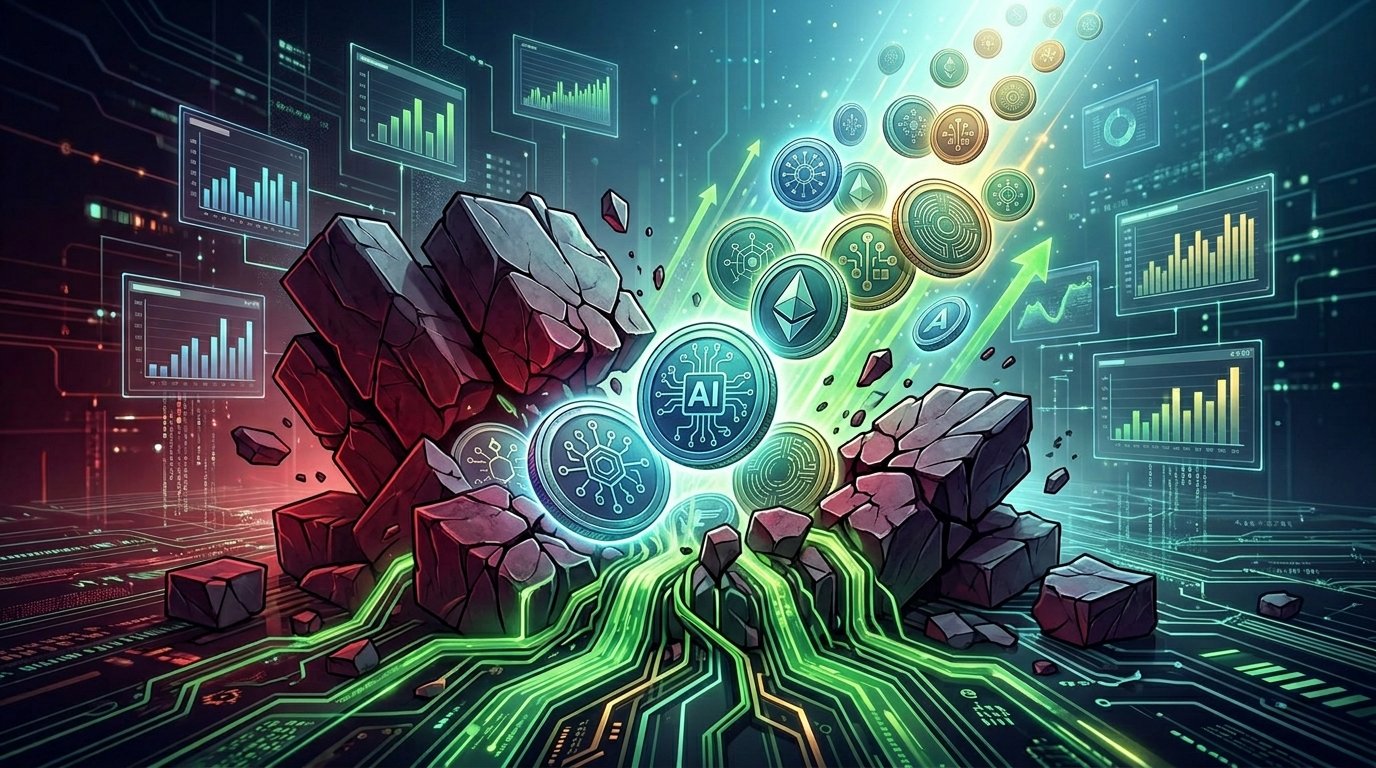
The Rise of Decentralized AI NarrativesOne of the most compelling reasons behind the resilience of AI crypto tokens is the emergence of decentralized AI, often referred to as DeAI.

Breaking the Centralized AI Monopoly

Traditional AI development is dominated by large tech companies, leading to concerns about data monopolies and centralized control. Decentralized AI networks aim to disrupt this model by distributing computation, data, and model training across blockchain-based ecosystems.

This shift has attracted significant capital and attention. In 2026, decentralized AI has been described as one of the most significant trends in crypto, driven by the realization that open and permissionless systems can challenge centralized dominance .

Infrastructure-Led Growth

AI crypto tokens are increasingly tied to infrastructure rather than speculation. Projects are building decentralized networks for:

Distributed GPU computing, enabling users to rent computational power
AI model marketplaces, where developers can monetize algorithms
Data pipelines, allowing secure sharing and training of machine learning models

These use cases provide tangible value, making AI crypto tokens more than just tradable assets—they become integral components of a growing digital economy.

Key Drivers Behind Strong AI Crypto Narratives

Despite short-term volatility, several powerful narratives continue to support the long-term growth of AI tokens.

The Expansion of Autonomous AI Agents

One of the most exciting developments is the rise of autonomous AI agents. These agents can perform tasks, transact, and interact with blockchain networks independently.

The market for AI agents is expected to grow significantly, with projections highlighting billions in valuation for this emerging sector . These agents often rely on blockchain for payments, identity, and coordination, creating a natural demand for AI crypto tokens.

Real Revenue and On-Chain Economics

Unlike many earlier crypto projects, modern AI tokens are generating real economic activity. Some decentralized AI networks are already producing measurable annual revenue, signaling a transition from speculative hype to functional ecosystems .

This shift is crucial because it aligns token value with actual usage. As demand for AI services increases, the tokens powering these ecosystems gain intrinsic value.

Institutional Interest and Adoption

Institutional players are increasingly exploring the intersection of AI and crypto. Research indicates that AI-linked tokens have outperformed other sectors during certain periods, driven by growing attention and capital allocation .

As institutions seek exposure to both AI and blockchain, AI crypto tokens offer a unique investment thesis that combines both trends.

Types of AI Crypto Tokens and Their Use Cases

The AI crypto sector is diverse, encompassing several categories of tokens, each serving different functions.

Compute and Infrastructure Tokens

These tokens power decentralized computing networks, allowing users to access GPU resources for AI workloads. They form the backbone of decentralized AI ecosystems and are essential for training and deploying models.

Projects in this category are particularly attractive because they address a critical bottleneck: the high cost of AI computation.

AI Agent and Application Tokens

Another category focuses on AI-driven applications and autonomous systems. These tokens enable agents to interact with blockchain networks, execute transactions, and perform complex tasks.

This segment represents the application layer of AI crypto, where real-world use cases are most visible.

Data and Training Tokens

Data is the lifeblood of AI, and some tokens are designed to facilitate secure data sharing and monetization. These platforms allow users to contribute datasets while maintaining privacy and control.

This creates a decentralized data economy, where contributors are rewarded for their participation.

Challenges Facing AI Crypto Tokens

While the narrative is strong, the sector faces several challenges that contribute to mixed market pressure.

Overhype and Speculation

The rapid rise of AI has led to significant hype, attracting speculative capital. This can result in inflated valuations and subsequent corrections when expectations are not met.

Not all projects will succeed, and distinguishing between genuine innovation and marketing-driven hype is essential.

Technical Limitations

Some AI crypto projects face scalability and performance challenges. Research indicates that many platforms still rely heavily on off-chain computation, limiting true decentralization .

Addressing these limitations will be critical for long-term success.

Regulatory Uncertainty

As both AI and crypto are rapidly evolving fields, regulatory frameworks are still catching up. Uncertainty in this area can impact investor confidence and slow adoption.

However, clearer regulations are expected to support broader institutional participation in the future .

The Role of Market Cycles in AI Token Performance

Understanding the performance of AI crypto tokens requires a broader view of market cycles.

Correlation With Bitcoin and Macro Trends

AI tokens, like most altcoins, are influenced by Bitcoin’s price movements and macroeconomic conditions. During bullish phases, they often outperform due to higher risk appetite.

However, during corrections, they may experience sharper declines due to their higher volatility.

Rotation Into Narrative-Driven Sectors

Crypto markets are highly narrative-driven. Capital tends to rotate into sectors with strong stories, such as DeFi, NFTs, and now AI.

The concept of an “AI Summer” suggests that this narrative could dominate market attention for an extended period, potentially driving sustained growth .

Why AI Crypto Narratives Remain Strong

Despite challenges, the long-term outlook for AI crypto tokens remains compelling.

Convergence of Two Mega Trends

AI and blockchain are two of the most transformative technologies of the decade. Their convergence creates a powerful synergy, enabling new economic models and applications.

Real-World Integration

AI tokens are increasingly integrated into real-world use cases, from trading bots to enterprise solutions. The rise of AI-driven tools in crypto trading highlights this growing adoption .

Long-Term Growth Potential

The AI crypto market is expected to grow significantly, with some estimates suggesting a multi-billion-dollar valuation in the coming years .

As the technology matures, the gap between narrative and reality is likely to narrow, benefiting projects with strong fundamentals.

Future Outlook for AI Crypto Tokens

Looking ahead, the future of AI crypto tokens will likely be shaped by several key trends.

Increased Token Utility

As AI platforms mature, tokens will play a central role in governance, payments, and incentives. This will strengthen their value proposition.

Expansion of Decentralized AI Ecosystems

The growth of decentralized AI networks will continue to attract developers, users, and capital. This ecosystem expansion will drive demand for related tokens.

Greater Market Maturity

As the market matures, investors will become more discerning, focusing on projects with proven utility and sustainable models.

Conclusion

The current state of AI crypto tokens reflects a dynamic and evolving market. While short-term pressures from macroeconomic factors, market cycles, and overvaluation concerns have created volatility, the underlying narratives remain exceptionally strong.

From decentralized AI infrastructure to autonomous agents and real-world applications, the sector is building the foundations of a new digital economy. The divergence in performance among AI tokens highlights an important shift: the market is moving toward utility, adoption, and real economic value.

As AI and blockchain continue to converge, AI crypto tokens are likely to remain one of the most important and influential sectors in the cryptocurrency space. For investors and enthusiasts alike, understanding both the risks and the narratives will be key to navigating this rapidly growing ecosystem.

FAQs

Q: What are AI crypto tokens?

AI crypto tokens are digital assets that power blockchain-based artificial intelligence platforms, enabling functions like computation, data sharing, and autonomous agent interactions.

Q: Why are AI crypto tokens facing pressure?

They are experiencing short-term pressure due to market cycles, macroeconomic conditions, and profit-taking, despite strong long-term fundamentals.

Q: What makes AI crypto tokens valuable?

Their value comes from real-world utility, including decentralized computing, AI model training, and on-chain economic activity.

Q: Are AI crypto tokens a good investment?

They have strong growth potential, but investors should carefully evaluate project fundamentals, as not all tokens will succeed.

Q: What is the future of AI in crypto?

The future is promising, with increasing adoption of decentralized AI, autonomous agents, and real-world applications driving long-term growth.


Explore more articles like this

Subscribe to the Finance Redefined newsletter

A weekly toolkit that breaks down the latest DeFi developments, offers sharp analysis, and uncovers new financial opportunities to help you make smart decisions with confidence. Delivered every Friday

By subscribing, you agree to our Terms of Services and Privacy Policy

READ MORE

How Blockchain Technology Transforms Supply Chain Management

blockchain supply chain software development company

COIN4U IN YOUR SOCIAL FEED

The global supply chain landscape is experiencing a revolutionary transformation, and at the heart of this change lies blockchain technology. Understanding how blockchain technology transforms supply chain management has become crucial for businesses seeking competitive advantages in today’s interconnected marketplace.blockchain supply chain software development company.

This distributed ledger technology offers unprecedented transparency, security, and efficiency improvements that address long-standing supply chain challenges. From food safety and pharmaceutical authentication to luxury goods verification and manufacturing optimization, blockchain is reshaping how companies track, verify, and manage their supply chains. As organizations worldwide grapple with increasing consumer demands for transparency and accountability, blockchain emerges as the solution that can deliver end-to-end visibility while reducing costs and enhancing trust among supply chain partners.

Understanding Blockchain Technology in Supply Chain Context

Blockchain technology represents a paradigm shift in how supply chain data is stored, verified, and shared across multiple stakeholders. Unlike traditional centralized databases, blockchain creates an immutable, distributed ledger that records every transaction and movement within the supply chain network. This technological foundation enables unprecedented levels of transparency and accountability.

The core components of blockchain technology include cryptographic hashing, consensus mechanisms, and smart contracts. These elements work together to create a tamper-proof system where every supply chain event is permanently recorded and verified by multiple network participants. This eliminates the possibility of fraudulent data manipulation while ensuring all stakeholders have access to the same accurate information.blockchain supply chain software development company.

Key Features of Blockchain in Supply Chains

Immutability stands as one of blockchain’s most valuable features for supply chain applications. Once data is recorded on the blockchain, it cannot be altered or deleted without network consensus, creating an permanent audit trail. This characteristic proves invaluable for compliance reporting, quality assurance, and dispute resolution.

Decentralization removes the need for intermediaries and single points of failure. Traditional supply chains often rely on centralized systems that can become bottlenecks or security vulnerabilities. Blockchain distributes control across the network, enhancing resilience and reducing operational risks.

Real-time visibility enables all authorized participants to access current supply chain status information simultaneously. This shared visibility eliminates information silos and reduces delays caused by manual data sharing processes.

How Blockchain Technology Transforms Supply Chain Management Operations

How Blockchain Technology Transforms Supply Chain Management Operations

The transformation begins with enhanced traceability capabilities that allow companies to track products from raw materials to final consumers. Traditional supply chains often lack visibility into multi-tier supplier networks, making it difficult to identify the source of problems when they occur. Blockchain creates a complete digital thread that connects every step in the supply chain journey.

Smart contracts automate many supply chain processes that previously required manual intervention. These self-executing contracts with predetermined conditions can automatically trigger payments, quality checks, compliance verifications, and inventory updates based on real-world events. This automation reduces processing time, eliminates human errors, and ensures consistent execution of business rules.

The technology also enables new business models based on trust and transparency. Companies can now offer consumers detailed product provenance information, supporting premium pricing for ethically sourced or sustainably produced goods. This capability particularly benefits industries where authenticity and origin verification add significant value.

Enhancing Supply Chain Transparency

Transparency represents one of the most significant benefits of blockchain implementation in supply chain management. Every participant in the network can access relevant information about product movements, quality certifications, and compliance status in real-time. This shared visibility builds trust among trading partners and enables faster response to supply chain disruptions.

Consumer-facing transparency applications allow end customers to verify product authenticity, sustainability claims, and safety certifications by scanning QR codes or accessing digital certificates. This level of transparency meets growing consumer demands for ethical consumption and helps brands differentiate themselves in competitive markets.

Regulatory compliance becomes more efficient when all required documentation and certifications are recorded on the blockchain. Auditors and regulatory bodies can access complete compliance histories without requiring extensive documentation requests from individual companies.

Industry Applications and Real-World Examples

Food and Agriculture Supply Chains

The food industry has emerged as an early adopter of blockchain technology due to stringent safety requirements and increasing consumer demand for transparency. Major retailers like Walmart have implemented blockchain systems to track produce from farms to store shelves, reducing the time needed to trace contamination sources from weeks to seconds.

These systems record critical information including farm locations, harvest dates, processing facilities, transportation conditions, and quality inspections. When food safety issues arise, companies can quickly identify affected products and implement targeted recalls, minimizing health risks and reducing waste.

Organic and fair-trade certifications benefit significantly from blockchain verification. Consumers can verify that products meet claimed standards by accessing certification records stored on the blockchain, building confidence in premium product claims.

Pharmaceutical and Healthcare

Pharmaceutical supply chains face unique challenges related to counterfeit drugs, temperature-sensitive products, and regulatory compliance. Blockchain technology addresses these concerns by creating tamper-evident records of drug manufacturing, distribution, and handling processes.

Temperature monitoring throughout cold chain logistics ensures vaccine and medication efficacy. IoT sensors integrated with blockchain systems can record continuous temperature data, automatically flagging any deviations that might compromise product quality.

Drug authentication capabilities help combat the estimated $200 billion annual loss to counterfeit medications. Each pharmaceutical product receives a unique blockchain identity that can be verified by healthcare providers and patients before consumption.

Manufacturing and Automotive

Manufacturing supply chains involve complex networks of suppliers providing components, raw materials, and sub-assemblies. Blockchain technology enables manufacturers to verify component authenticity, track quality metrics, and ensure compliance with safety standards throughout multi-tier supplier networks.

The automotive industry uses blockchain to track critical safety components from production through installation and maintenance. This capability proves essential for warranty management, recall notifications, and quality investigations.

Conflict mineral compliance requires manufacturers to verify that raw materials don’t originate from regions affected by armed conflict. Blockchain provides the transparency needed to demonstrate compliance with regulations like the Dodd-Frank Act.

Technical Implementation Considerations

Choosing the Right Blockchain Platform

Organizations must evaluate different blockchain platforms based on their specific supply chain requirements. Public blockchains like Ethereum offer maximum transparency but may face scalability and privacy concerns. Private blockchains provide better control and performance but require careful governance structures.

Hybrid blockchain solutions often provide the best balance for supply chain applications, allowing sensitive commercial information to remain private while enabling necessary transparency for compliance and consumer verification purposes.

Interoperability becomes crucial when supply chain partners use different blockchain platforms. Organizations should prioritize solutions that support cross-platform communication and data exchange standards.

Integration with Existing Systems

Successful blockchain implementation requires seamless integration with existing enterprise resource planning (ERP), warehouse management (WMS), and customer relationship management (CRM) systems. APIs and middleware solutions facilitate this integration without requiring complete system replacements.

Legacy system compatibility ensures that companies can adopt blockchain technology incrementally rather than through disruptive complete overhauls. This approach reduces implementation risks and allows for gradual staff training and process adaptation.

Data standardization across all integrated systems ensures consistent information quality and reduces integration complexity. Organizations should establish clear data governance policies before beginning blockchain implementation.blockchain supply chain software development company.

Scalability and Performance Optimization

Supply chain blockchain networks must handle high transaction volumes while maintaining acceptable performance levels. Transaction throughput, confirmation times, and network latency all impact system usability and adoption rates.

Layer 2 scaling solutions can improve blockchain performance without sacrificing security or decentralization. These solutions process transactions off-chain while maintaining the security guarantees of the underlying blockchain platform.

Consensus mechanism selection affects both performance and energy consumption. Proof-of-stake and other energy-efficient consensus mechanisms may be preferable for sustainability-conscious organizations.

Benefits and Challenges of Implementation

Benefits and Challenges of Implementation

Quantifiable Benefits

Cost reduction represents a primary driver for blockchain adoption in supply chain management. Organizations typically see 10-20% reductions in supply chain costs through improved efficiency, reduced fraud, automated processes, and enhanced supplier collaboration.

Risk mitigation capabilities help companies avoid costly supply chain disruptions, product recalls, and compliance violations. The ability to quickly identify and isolate problems prevents small issues from becoming major crises.

Customer trust and brand value increase when companies can demonstrate transparency, authenticity, and ethical sourcing practices through blockchain verification systems.

Implementation Challenges

Technical complexity requires organizations to develop new capabilities in blockchain technology, smart contract development, and distributed system management. This learning curve can slow initial implementation and increase costs.

Stakeholder coordination becomes more challenging as blockchain networks require collaboration among multiple supply chain participants. Achieving consensus on technical standards, governance policies, and cost-sharing arrangements often proves difficult.

Regulatory uncertainty in many jurisdictions creates compliance risks for early blockchain adopters. Organizations must carefully monitor evolving regulations and ensure their implementations remain compliant.

Change Management Strategies

Staff training programs should focus on both technical blockchain concepts and practical applications within existing business processes. Hands-on training with blockchain tools and interfaces helps accelerate adoption.

Pilot project approaches allow organizations to test blockchain solutions on limited supply chain segments before full-scale deployment. These pilots provide valuable learning opportunities while minimizing risks.

Partner engagement strategies should emphasize mutual benefits and shared value creation to encourage supply chain partner participation in blockchain networks.

Future Trends and Innovations

Emerging Technologies Integration

Internet of Things (IoT) integration with blockchain creates powerful combinations for supply chain monitoring and automation. IoT sensors can automatically record environmental conditions, location data, and handling events directly to the blockchain without human intervention.

Artificial intelligence and machine learning algorithms can analyze blockchain supply chain data to identify patterns, predict disruptions, and optimize routing decisions. These capabilities enhance the value of blockchain transparency by providing actionable insights.

5G connectivity will enable real-time blockchain updates and support more sophisticated IoT integrations, making supply chain monitoring more responsive and accurate.

Industry-Specific Developments

Sustainability reporting requirements are driving blockchain adoption in industries with significant environmental impacts. Carbon footprint tracking, circular economy initiatives, and ESG (Environmental, Social, Governance) compliance all benefit from blockchain transparency.

Cross-border trade facilitation through blockchain-based trade finance and documentation systems will reduce international supply chain complexity and costs. Smart contracts can automate letter of credit processing, customs declarations, and payment settlements.blockchain supply chain software development company.

Conclusion

Understanding how blockchain technology transforms supply chain management is no longer optional for forward-thinking organizations—it’s essential for maintaining competitive advantages in an increasingly transparent and accountable business environment. The technology’s ability to provide end-to-end visibility, automate complex processes through smart contracts, and build trust among supply chain partners makes it a transformative force across industries.

The evidence is clear: organizations that embrace blockchain supply chain solutions early will benefit from reduced costs, improved efficiency, enhanced compliance capabilities, and stronger customer relationships. While implementation challenges exist, the long-term benefits far outweigh the initial investment and learning curve requirements.

READ MORE:Small Business Blockchain Technology Consulting Services

Explore more articles like this

Subscribe to the Finance Redefined newsletter

A weekly toolkit that breaks down the latest DeFi developments, offers sharp analysis, and uncovers new financial opportunities to help you make smart decisions with confidence. Delivered every Friday

By subscribing, you agree to our Terms of Services and Privacy Policy

READ MORE

ADD PLACEHOLDER