
“Gold Analysis 22/10: Bullish Despite a 6% Drop (chart)” may sound counterintuitive at first glance, yet that is precisely what the price action and momentum context suggest. Over recent sessions, gold has shed roughly six percent from its local high, pressuring late longs and emboldening short-term sellers. Still, the broader structure of XAU/USD—supported by a steady uptrend on the higher time frames, resilient safe-haven demand, and persistent central bank buying—remains constructive.
The current setback looks more like a textbook bullish pullback within a larger advance than a trend break. In this comprehensive review, we unpack the multi-time-frame technicals, examine the fundamental drivers from U.S. dollar dynamics to Treasury yields, and map the risk levels that separate a healthy correction from a deeper reversal. The goal is not to chase headlines but to interpret the chart’s message, clarify the strategy, and identify high-probability levels where the risk-reward tilts back in favor of the bulls.
The Big Picture: Why a 6% Decline Can Still Be Bullish
Corrections are the price of admission in any trending market. In gold, pullbacks of five to eight percent have been common waypoints during broader cycles, often shaking out weak hands before trend resumption. The current retracement, highlighted in our Gold Analysis 22/10 review, fits that historical rhythm. On weekly charts, the primary trendline drawn from prior swing lows remains intact, and price is reacting near widely watched Fibonacci retracement zones. When momentum oscillators cool from overbought conditions without breaking structural supports, the market often resets, builds energy, and advances again.
What reinforces the constructive bias is the confluence of macro underpinnings. The Federal Reserve’s path—whether it pauses, cuts, or simply guides a slower policy trajectory—has an outsized impact on real yields and the U.S. dollar. Any hint of easing financial conditions tends to underpin gold. Meanwhile, ongoing geopolitical risk and the metal’s role as an inflation hedge continue to draw strategic allocation from institutions and reserve managers. When these forces align with favorable technicals, a dip can be opportunity rather than omen.
Weekly Structure: Trend Intact, Momentum Reset
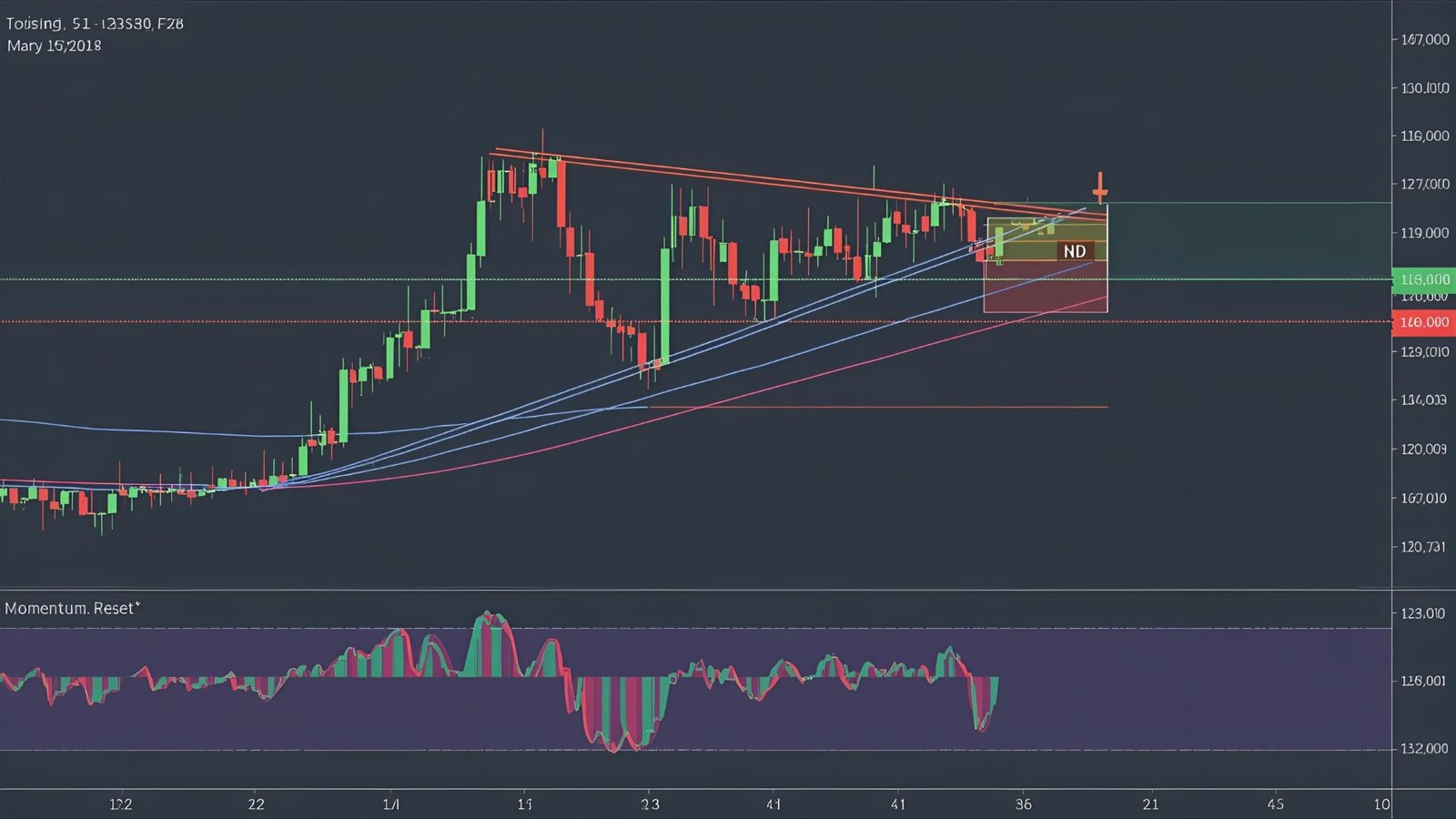
On the weekly timeframe, the chart tells a story of higher swing lows that have not been violated. Price has retreated toward a prior breakout shelf that now acts as support, an area where buying previously overcame supply. The 200-week moving average trends upward, asserting long-run bullish control, while the 50-week moving average sits above it, preserving a classic golden-cross configuration that typically develops early in durable advances.
Weekly RSI has cooled toward neutral readings after flagging overbought conditions at the last peak. This is healthy. Markets cannot sprint indefinitely, and weekly momentum resets often precede fresh legs higher. The MACD histogram has narrowed, but the signal line has not produced a firm bearish crossover below the zero line. In Gold Analysis 22/10, this combination suggests consolidation rather than capitulation.
Daily Chart: Where the Battle Is Fought
Zooming into the daily chart sharpens the tactical picture. The six percent decline has carried price into a dense cluster of reference points: a rising 50-day moving average, a 38.2% to 50% Fibonacci retracement of the prior leg, and the top of a previously broken range. This is the type of three-way confluence that often defines inflection zones. If buyers continue to defend the area on daily closes, the pullback can graduate into a higher-low—the bedrock of any uptrend.
Daily RSI has normalized into the 40–50 band, a region that frequently marks bull-market support. The MACD shows waning downside momentum, with shorter histograms that hint at stabilization. A small inside-day or a bullish engulfing session at this support would be a powerful tell that sellers are losing control. In our Gold Analysis 22/10, such a candle becomes a trigger candidate with stops set below the recent swing low.
Intraday Rhythm: Timing the Re-Entry
For traders fine-tuning entries, the four-hour and one-hour frames can reveal the first signs of a turn. During the decline, intraday price action has formed lower highs beneath a descending minor trendline. The path toward a long setup is clear: a trendline break, followed by a retest that holds, converts resistance into support. Intraday RSI patterns that shift from bear-market ceilings near 60 to bull-market floors near 40 often accompany this transition. Volume, while not always perfectly visible in spot markets, tends to expand on up-swings when the tide turns.
Key Levels: Support and Resistance to Respect
The present correction has spotlighted several levels. The first is the retracement zone around the 38.2%–50% area of the prior advance. This band aligns with the top of the last breakout range, creating a potential demand pocket. Beneath that, a rising swing-low shelf defines the line in the sand where the bullish structure would begin to erode if broken decisively on a daily close. On the topside, the path back to the prior high includes interim resistance at the descending intraday trendline and a pivot area where sellers previously defended. Clearing those obstacles on expanding momentum would confirm that the correction has run its course.
The Dollar, Yields, and Gold’s Macro Gravity

Gold’s most consistent macro counterpart is the U.S. dollar, with an inverse relationship strengthened by the role of Treasury yields. When the dollar firms and real yields push higher, non-yielding assets such as gold often correct as the opportunity cost rises. The recent six percent slide coincided with firmer yields and a resilient dollar bid. However, if incoming data suggest softening growth or disinflation, yields can ease, the dollar can soften, and gold typically finds fresh sponsorship. In Gold Analysis 22/10, we emphasize that a loosening in financial conditions, not necessarily outright rate cuts, is sufficient to stabilize XAU/USD.
Central Banks and Structural Demand
Beyond speculative flows, a powerful underpinning of this cycle has been sustained central bank buying. Reserve managers have been diversifying away from concentrated currency exposure, adding to their gold holdings as a long-term store of value. This layer of structural demand does not eliminate volatility, but it raises the floor during corrections. When combined with demand from emerging-market households and investors who view gold as a savings instrument, the market gains durable depth that can absorb temporary shocks.
Sentiment: From Euphoria to Caution—A Good Thing
Extremes in sentiment often precede turning points. At the peak before the six percent drop, positioning and commentary tilted exuberant, the kind of one-way optimism that frequently draws contrarian supply. The ensuing selloff has reset sentiment toward caution, reducing leverage and dampening exuberance. For trend traders, this is constructive. A healthy uptrend prefers a wall of worry, not a field of euphoria. The Gold Analysis 22/10 framework interprets the sentiment reset as a needed purge that preserves the bullish primary structure.
“Chart” Takeaways (Narrative)
While we cannot embed a live chart here, imagine a daily candlestick sequence that surged to a local high, flagged overbought RSI, and then retraced into a former resistance band now acting as support. An overlay of the 50-day moving average hugs price from below, while a gently rising 200-day moving average validates the longer-term trend. A descending minor trendline from the recent top caps the pullback. A decisive daily close above that line, ideally alongside a bullish MACD curl and RSI reclaiming the midline, would complete a classic pullback-and-go pattern. The narrative chart points remain the same: uptrend intact, correction contained, buyers probing for control.
Trading Plan Logic: Conditions, Not Predictions
The hallmark of a sound plan is conditionality. Instead of predicting, Gold Analysis 22/10 lays out if-then logic anchored to price. If the market defends the confluence support on daily closes and breaks the intraday trendline, then a trend-continuation long is justified. If price fails to hold the support band and carves a lower low on heavy momentum, then the bullish thesis is delayed, and the next weekly shelf becomes the focal point. This adaptability protects capital and keeps trades aligned with the actual tape rather than a fixed narrative.
See More: Best Cryptocurrency Market Analysis Tools 2025 Complete Trading
Risk Management: The Only Non-Negotiable
Even compelling setups can fail. That is why risk parameters precede entries. In a pullback-long context, the structurally sound place for stop-losses sits just beneath the defended swing low or the lower edge of the demand pocket. Position sizing should reflect the distance to that invalidation point and the trader’s maximum portfolio risk per idea. The six percent drawdown that prompted this Gold Analysis 22/10 serves as a reminder: volatility is part of the edge, but it must be harnessed. Define the risk, accept it, and let the trade work without micromanagement.
Volatility and the Anatomy of a Reversal
How do we know whether a pullback is morphing into a bear phase? Watch for the trio of lower-lows and lower-highs on the daily chart, failed retests of broken supports that convert into resistance, and momentum signatures that shift from RSI holding 40–90 to capping beneath 60 while breaking below 40. A persistent negative MACD below the zero line, combined with repeated rejections at the 20- and 50-day moving averages, would confirm a regime shift. Nothing in the current Gold Analysis 22/10 profile points to that yet, but these are the diagnostic signs that would turn caution into defense.
Seasonality and Flow Considerations
While seasonality is not destiny, gold often benefits from periods of jewelry demand and festival-driven buying in several economies. Meanwhile, flows from ETFs and managed futures can magnify moves around macro data and policy meetings. The six percent drop may have been accelerated by de-risking into event risk, but those flows can unwind just as quickly when uncertainty clears. A chart that bases along support while volatility contracts is often a coiled spring. Breaks from such bases typically travel in the direction of the dominant trend—which, in this Gold Analysis 22/10, remains upward.
Fundamentals vs. Technicals: A Productive Tension
Some traders favor fundamental analysis—inflation prints, growth trends, policy rates—while others rely on technical analysis—levels, trends, and indicators. The best Gold Analysis 22/10 integrates both. Fundamentals set the backdrop by influencing yields and currency dynamics, which in turn shape gold’s medium-term path. Technicals translate that backdrop into entry and exit points, offering disciplined ways to express the view. When the two align—easing real yields and a chart defending support—the probability of trend continuation rises.
A Word on Over-Optimization
The request for LSI keywords such as inflation hedge, safe-haven asset, U.S. dollar, Treasury yields, central bank buying, support and resistance, and breakout is sensible for discoverability, but the quality of your research and clarity of your levels matter more to real traders and investors. Over-optimizing copy cannot save a poor plan. The purpose of Gold Analysis 22/10 is to offer a reasoned map that respects uncertainty and edges probability in your favor.
Scenario Mapping: Three Paths from Here
The first and most probable scenario is trend resumption. Price defends the confluence band, breaks the intraday trendline, and starts stair-stepping higher, using minor pullbacks to form higher lows. In this case, prior highs come back into view, and momentum pushes RSI comfortably above 50 on the daily chart. The second scenario is extended consolidation. Price ranges sideways, absorbing supply between the 50-day average and the descending trendline. This frustrates both bulls and bears but allows moving averages to catch up, compress volatility, and set up a stronger breakout. The third and least favorable is trend degradation. If the lower shelf fails on a decisive daily close with heavy momentum, the market opens a path toward the next weekly demand zone. The strategy then shifts from buying dips to waiting for stabilization and evidence of accumulation.
How to Read News Without Losing the Chart
Macro headlines can be loud, but the chart is fluent in context. A hawkish surprise that does not break support is just information about positioning, not a thesis killer. Conversely, a dovish turn that fails to generate a breakout suggests fatigue rather than a hidden bid. In Gold Analysis 22/10, we treat news as a catalyst whose impact is measured by the market’s reaction at levels that already matter. This approach preserves focus and prevents headline-chasing that leads to whipsaw.
Psychology: Patience as an Edge
A six percent drop stings, especially for late entrants. But impatience to “get back to even” can be costly. Let the market confirm your bias. Require at least an intraday trendline break and a daily close reclaiming a prior pivot before scaling up. Many of the best XAU/USD trades begin when the tape transitions from fear to reluctance, not from panic to euphoria. In that corridor, risk is definable and the ladder of higher lows becomes visible.
Putting It All Together
The message of Gold Analysis 22/10: Bullish Despite a 6% Drop (chart) is straightforward. The higher-time-frame trend is intact. The daily chart is testing a meaningful confluence of support. Momentum has cooled without collapsing. Macro gravity can turn supportive if yields and the dollar soften, while structural demand from central banks and risk-averse investors remains in play. None of this guarantees immediate upside, but together these elements define a market that looks more paused than broken.
Conclusion
A sharp correction can feel like a narrative ending, but more often it is a chapter turn. The six percent decline in gold has reset sentiment, refreshed momentum, and led price into a critical support cluster where trends often recommit. Stay focused on structure, not noise. Invalidate the view if the market erases the higher-low scaffold with decisive daily closes below the shelf. Otherwise, treat stabilization and a measured reclaim of intraday trendlines as an invitation to rejoin the prevailing advance. The essence of Gold Analysis 22/10 is conditional confidence: bullish, but only as long as the chart continues to earn it.
FAQs
Q: What confirms that the pullback is over?
A pullback ends when the price closes back above the descending intraday trendline, holds a retest as new support, and pushes the daily RSI sustainably above 50. A bullish engulfing candle at support or a MACD curl can strengthen the case, but structure and closes matter most.
Q: Which levels are the most important right now?
The most important levels are the confluence band around the 38.2%–50% Fibonacci retracement of the prior leg, the rising 50-day moving average, and the recent swing low that defines invalidation. On the topside, watch the trendline cap and the prior high where supply last won.
Q: How do yields and the dollar affect gold day to day?
Higher Treasury yields and a firmer U.S. dollar generally pressure gold because they raise the opportunity cost of holding a non-yielding asset. If yields soften or the dollar retreats, gold often stabilizes or advances as financial conditions ease.
Q: Is central bank demand enough to stop declines?
No single factor guarantees support, but steady central bank buying raises the floor by adding structural demand. It does not prevent volatility; it makes deeper dips more likely to attract long-term buyers, especially near major support zones.
Q: How should risk be managed in this setup?
Define your stop-loss beneath the defended swing low or the lower edge of the demand pocket and size positions so a loss fits your overall risk plan. Let confirmation guide entries, avoid chasing, and respect invalidation if the structure breaks on a daily close.