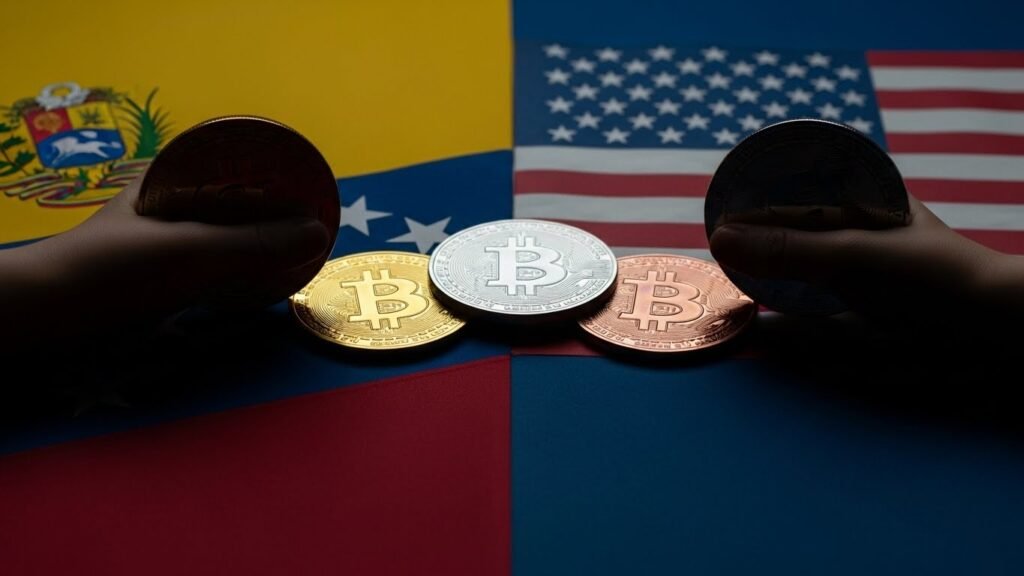
The global financial system is undergoing a slow but profound transformation as geopolitical tensions, economic sanctions, and shifting power dynamics challenge the dominance of the US dollar. One of the most debated outcomes of this transformation is sanction-driven de-dollarization, a process in which countries seek alternatives to dollar-based trade and finance. Within this evolving landscape, cryptocurrencies have emerged as potential tools for bypassing traditional financial rails. The question many investors and policymakers are asking is whether Bitcoin and XRP benefit from sanction-driven de-dollarization, particularly when examining real-world cases such as the long-standing US-Venezuela standoff.
The US-Venezuela case provides a compelling lens through which to analyze this issue. Venezuela has faced years of economic sanctions that restrict access to global banking systems, limit dollar liquidity, and complicate international trade. In response, the country has explored alternative payment mechanisms, experimented with digital assets, and sought ways to reduce reliance on the US dollar. This environment naturally raises interest in decentralized assets like Bitcoin and network-focused solutions like XRP.
Understanding whether Bitcoin and XRP benefit from sanction-driven de-dollarization requires a nuanced analysis. It is not simply about price movements or speculative interest but about structural shifts in how value is transferred, stored, and settled across borders. This article explores the dynamics of de-dollarization, the unique roles of Bitcoin and XRP, and how the US-Venezuela case illustrates broader global trends shaping the future of digital finance.
Understanding Sanction-Driven De-Dollarization
Sanction-driven de-dollarization occurs when countries targeted by economic sanctions actively seek to reduce their dependence on the US dollar and dollar-based financial systems. Sanctions often limit access to international payment networks, freeze assets, and restrict trade settlement in dollars. As a result, affected nations look for alternative currencies, bilateral trade agreements, or non-traditional financial instruments.
In the case of Venezuela, sanctions have constrained oil exports, foreign reserves, and access to global banking infrastructure. These restrictions have accelerated efforts to explore non-dollar settlement mechanisms. De-dollarization trends are not unique to Venezuela but are increasingly visible across regions facing similar pressures.
The broader implication of sanction-driven de-dollarization is a gradual diversification of the global monetary system. While the US dollar remains dominant, its exclusivity is being challenged. This creates potential openings for alternative assets, including cryptocurrencies, to play a supporting or complementary role in international finance.
The US-Venezuela Case as a Catalyst for Change
The US-Venezuela relationship highlights how sanctions can reshape financial behavior. Venezuela’s economy, heavily reliant on oil exports, has historically depended on dollar-denominated transactions. Sanctions disrupted this model, forcing the country to explore unconventional solutions.
Cryptocurrencies entered the conversation as tools for cross-border transactions and value storage outside traditional banking systems. While state-led initiatives have faced mixed results, the broader population and private actors have shown increasing interest in decentralized alternatives. This environment provides a real-world testing ground for understanding crypto adoption under sanctions.
The US-Venezuela case also illustrates the limitations of centralized financial control. When access to dollars is restricted, the appeal of borderless digital assets increases. This does not automatically translate into widespread adoption, but it does create conditions where cryptocurrencies become more relevant.
Bitcoin’s Role in a De-Dollarizing World
Bitcoin is often positioned as a neutral, decentralized asset that operates independently of any single government. In the context of sanction-driven de-dollarization, Bitcoin’s core attributes become particularly relevant. Its fixed supply, censorship resistance, and global accessibility make it attractive to individuals and entities seeking alternatives to dollar-based systems.
For countries like Venezuela, Bitcoin offers a way to store value outside the domestic currency, which has suffered from severe inflation. It also provides a mechanism for cross-border transfers that are less reliant on traditional intermediaries. These characteristics support the argument that Bitcoin benefits from de-dollarization, at least in specific contexts.
However, Bitcoin’s volatility and scalability challenges limit its use as a primary settlement currency for large-scale trade. While it may serve as a hedge or supplemental asset, its role in replacing the dollar entirely remains constrained. The US-Venezuela case shows that Bitcoin’s benefits are more pronounced at the individual and small-business level rather than at the state level.
XRP and Its Position in Cross-Border Finance
XRP occupies a different niche within the cryptocurrency ecosystem. Designed to facilitate fast and low-cost cross-border payments, XRP aims to improve the efficiency of international settlements rather than replace existing currencies outright. In a de-dollarizing environment, this positioning offers unique advantages.
For countries facing sanctions, efficient settlement mechanisms are critical. XRP’s ability to act as a bridge asset between different currencies aligns with the needs of markets seeking alternatives to dollar-based correspondent banking. This supports the view that XRP use cases in sanctions could expand as traditional payment channels become less accessible.
The US-Venezuela case highlights the potential appeal of such solutions, although regulatory and infrastructure challenges remain. XRP’s effectiveness depends on institutional adoption and integration with existing financial systems, which can be complicated under sanctions. Nonetheless, its design aligns closely with the practical needs of cross-border trade in a fragmented financial landscape.
Comparing Bitcoin and XRP in De-Dollarization Scenarios
While both Bitcoin and XRP may benefit from sanction-driven de-dollarization, they do so in fundamentally different ways. Bitcoin functions as a store of value and a censorship-resistant network, while XRP focuses on transaction efficiency and liquidity management.
In the Venezuelan context, Bitcoin’s decentralized nature makes it more accessible to individuals seeking financial autonomy. XRP, on the other hand, is more relevant for institutions and payment providers looking to maintain cross-border operations despite restrictions. This distinction underscores the importance of understanding Bitcoin vs XRP de-dollarization roles rather than viewing them as direct competitors.
The coexistence of these assets reflects a broader trend toward financial pluralism. Different tools serve different needs, and de-dollarization does not imply a single replacement for the dollar but a mosaic of alternatives.
Geopolitical Implications of Crypto Adoption
The intersection of sanctions, de-dollarization, and cryptocurrency adoption has significant geopolitical implications. As countries explore alternatives to the dollar, the influence of US monetary policy may gradually diminish at the margins. Cryptocurrencies contribute to this shift by offering non-sovereign options for value transfer.
The US-Venezuela case demonstrates how geopolitical pressure can accelerate experimentation with digital assets. While this does not immediately undermine the dollar’s dominance, it introduces new variables into global finance. Geopolitics and cryptocurrency are becoming increasingly intertwined as states reassess their financial strategies.
This dynamic also raises questions about regulation and control. Governments may seek to balance the benefits of crypto innovation with concerns about capital flight, compliance, and financial stability. The outcome of this balancing act will shape how cryptocurrencies evolve within a de-dollarizing world.
Economic Realities and Adoption Barriers
Despite the theoretical benefits, practical barriers limit the extent to which Bitcoin and XRP can benefit from sanction-driven de-dollarization. Infrastructure gaps, regulatory uncertainty, and technological literacy remain significant challenges, particularly in developing economies.
In Venezuela, inconsistent internet access and regulatory ambiguity complicate widespread crypto adoption. Volatility also poses risks for users relying on cryptocurrencies for daily transactions. These factors highlight that crypto adoption challenges cannot be ignored when assessing real-world impact.
Nevertheless, incremental progress continues. Each instance of successful use reinforces confidence and builds experience, gradually lowering barriers to entry. Over time, these small steps contribute to a broader shift in financial behavior.
The Role of Public Perception and Trust
Public perception plays a crucial role in determining whether Bitcoin and XRP benefit from de-dollarization. Trust in traditional institutions often erodes under sanctions and economic hardship, creating space for alternative systems. Cryptocurrencies can fill this gap, but only if users perceive them as reliable and secure.
In Venezuela, trust in the local currency has declined sharply, increasing openness to alternatives. Bitcoin’s global reputation as a decentralized asset enhances its appeal, while XRP’s association with efficiency and speed supports its use in payments. Crypto trust and adoption are deeply interconnected and shaped by lived economic experiences.
Building trust requires education, transparency, and consistent performance. As more people become familiar with digital assets, their role in de-dollarization scenarios becomes more tangible.
Long-Term Outlook for Bitcoin and XRP
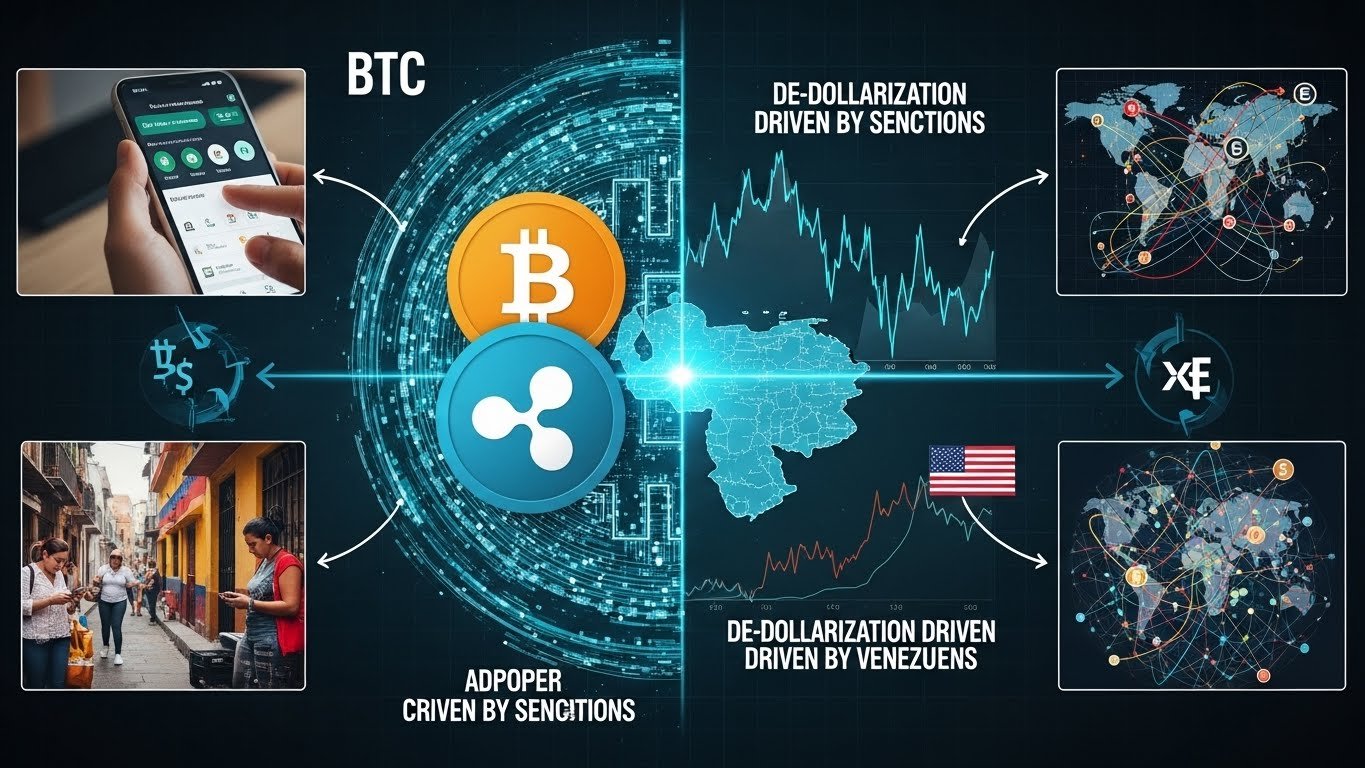
Looking ahead, the relationship between sanction-driven de-dollarization and cryptocurrency adoption is likely to deepen. Bitcoin and XRP are positioned to benefit, but within specific parameters. Bitcoin’s role as a hedge and alternative store of value may strengthen, while XRP’s utility in cross-border settlements could expand where infrastructure and regulation allow.
The US-Venezuela case serves as an early indicator rather than a definitive blueprint. Other countries may follow different paths based on their economic structures and political objectives. Future of de-dollarization and crypto will likely involve a combination of digital assets, regional currencies, and new financial technologies. The key takeaway is that cryptocurrencies are no longer peripheral to discussions of global finance. They are increasingly part of strategic considerations, particularly in environments shaped by sanctions and monetary constraints.
Conclusion
So, does Bitcoin and XRP benefit from sanction-driven de-dollarization? The evidence suggests that they do, but in nuanced and context-dependent ways. The US-Venezuela case illustrates how sanctions can accelerate interest in alternatives to the dollar, creating opportunities for both decentralized and utility-focused digital assets.
Bitcoin benefits as a store of value and a censorship-resistant network, particularly for individuals seeking financial autonomy. XRP benefits through its potential to facilitate efficient cross-border payments in a fragmented financial system. Neither asset replaces the dollar outright, but both contribute to a more diversified and resilient global monetary landscape.
As de-dollarization trends continue to evolve, Bitcoin and XRP are likely to remain relevant components of the conversation. Their ultimate impact will depend on technological progress, regulatory clarity, and the willingness of users and institutions to embrace new financial paradigms.
FAQs
Q: How do economic sanctions encourage de-dollarization in countries like Venezuela?
Sanctions restrict access to dollar-based financial systems, forcing countries to seek alternative currencies and payment methods. This pressure accelerates de-dollarization by reducing reliance on the US dollar for trade and reserves.
Q: Why is Bitcoin often associated with sanction-driven de-dollarization?
Bitcoin’s decentralized nature allows it to operate outside traditional financial systems, making it attractive in environments where access to banks and dollars is limited due to sanctions.
Q: In what ways can XRP support cross-border transactions under sanctions?
XRP is designed to enable fast and low-cost cross-border settlements. In sanction-affected regions, it can act as a bridge asset to improve transaction efficiency when traditional correspondent banking is constrained.
Q: Does the US-Venezuela case prove that cryptocurrencies can replace the dollar?
The case shows that cryptocurrencies can supplement existing systems but does not prove they can fully replace the dollar. Their role is complementary rather than substitutional at this stage.
Q: What factors will determine whether Bitcoin and XRP benefit more from de-dollarization in the future?
Key factors include regulatory clarity, technological infrastructure, user education, and global economic conditions. These elements will shape how effectively cryptocurrencies integrate into de-dollarizing financial systems.