
















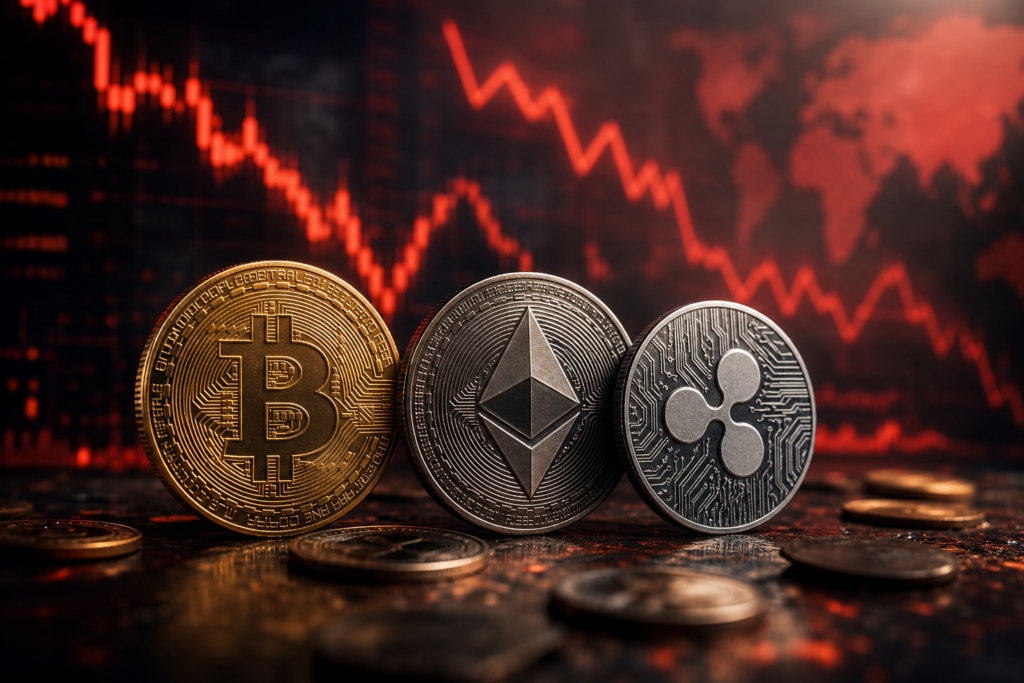
The cryptocurrency market is once again facing intense pressure as Bitcoin, Ethereum and XRP prices drop sharply following a combination of macroeconomic and geopolitical shocks. Investors who had been anticipating a more supportive monetary environment were caught off guard when the U.S. Federal Reserve decided to hold interest rates steady, while escalating tensions between the United States and Iran further rattled global markets.
Recent developments highlight how deeply interconnected the crypto market has become with traditional financial systems and geopolitical events. The crypto market volatility, often driven by sentiment and liquidity, is now increasingly shaped by central bank policies, inflation expectations, and global conflicts. According to recent reports, Bitcoin slipped below key levels, while Ethereum and XRP also recorded notable declines as investors moved toward safer assets.
This article explores in detail why Bitcoin, Ethereum, and XRP prices are falling, how the Federal Reserve’s stance impacts crypto markets, and why geopolitical tensions—particularly involving Iran—are amplifying downside risks.
Why Bitcoin, Ethereum and XRP Prices Drop Today
The recent drop in Bitcoin, Ethereum and XRP prices is not driven by a single factor but rather a convergence of economic and geopolitical forces. The crypto market has entered a phase where macro signals dominate price action, and this latest downturn reflects that shift.
Bitcoin fell to around $75,000, Ethereum dropped near $2,200, and XRP slid toward $1.35 amid growing uncertainty. These declines come at a time when market participants were expecting bullish catalysts such as rate cuts or easing geopolitical tensions—neither of which materialized.
Instead, the opposite occurred. The Federal Reserve signaled caution on inflation, and U.S.-Iran tensions escalated after diplomatic efforts stalled. This combination created a risk-off environment, pushing investors away from speculative assets like cryptocurrencies.
The Federal Reserve’s Role in the Crypto Market Decline
Interest Rates Hold Steady but Impact Remains Strong
The Federal Reserve’s decision to keep interest rates unchanged may seem neutral on the surface, but its implications for crypto are far from benign. By maintaining higher rates, the Fed effectively reduces liquidity in financial markets, making riskier assets less attractive.
The central bank kept rates in the 3.5%–3.75% range amid rising inflation concerns and economic uncertainty. This decision signals a “higher for longer” environment, which historically puts pressure on assets like Bitcoin and Ethereum that thrive on excess liquidity.
For crypto investors, this means fewer inflows, reduced speculative activity, and increased caution.
Inflation Concerns Weigh on Risk Assets
One of the most critical aspects of the Fed’s latest decision is its changing tone on inflation. Officials now describe inflation as “elevated,” indicating that rate cuts may not come anytime soon.
This shift matters because cryptocurrency prices often rise when monetary policy is loose. Conversely, tighter policy and persistent inflation tend to suppress demand for digital assets.
As a result, Bitcoin, Ethereum and XRP prices drop when investors anticipate prolonged monetary tightening.
Trump’s Rejection of the Iran Deal and Market Impact
Geopolitical Tensions Trigger Market Uncertainty
Adding to the economic pressure, U.S. President Donald Trump’s rejection of an Iran deal has intensified geopolitical risks. The refusal to reopen the Strait of Hormuz and the threat of further military action have heightened global uncertainty.
This region is critical to global energy supply, and any disruption leads to rising oil prices and inflation fears. When energy costs spike, inflation follows—forcing central banks to remain hawkish.
For crypto markets, this is a double blow: rising inflation and reduced likelihood of monetary easing.
Oil Prices and Crypto Correlation
Oil prices surged above $100 per barrel amid escalating tensions, contributing to inflationary pressures. Historically, rising oil prices have been associated with declining risk appetite in global markets.
As investors shift toward commodities and safe-haven assets, cryptocurrencies often experience sell-offs. This explains why Bitcoin, Ethereum and XRP prices drop during periods of geopolitical escalation.
How Global Macro Trends Are Shaping Crypto Prices

The Rise of Risk-Off Sentiment
The combination of high interest rates and geopolitical instability has created a classic “risk-off” environment. In such conditions, investors prefer assets like bonds and gold over cryptocurrencies.
Global markets, including equities, have also shown signs of weakness, further reinforcing cautious sentiment. This broader market trend directly impacts crypto, as it is often viewed as a high-risk asset class.
Liquidity Crunch and Market Behavior
Liquidity is the lifeblood of crypto markets. When central banks tighten policy, liquidity dries up, leading to reduced trading volumes and increased volatility.
Recent data shows declining open interest and trading activity, indicating that investors are stepping back from the market. This lack of participation exacerbates price declines and makes recoveries more difficult.
Bitcoin Price Analysis Amid Market Pressure
Bitcoin remains the dominant cryptocurrency, and its price movements set the tone for the entire market. The recent decline below key resistance levels suggests weakening bullish momentum.
Despite earlier gains in 2026, Bitcoin is still facing headwinds due to macroeconomic uncertainty. Analysts note that support levels around $73,000 are critical for maintaining stability.
If these levels fail, further downside could follow, especially if the Fed maintains its current stance and geopolitical tensions persist.
Ethereum and XRP: Why Altcoins Are Also Falling
Ethereum’s Sensitivity to Market Liquidity
Ethereum, as the leading smart contract platform, is highly sensitive to liquidity conditions. When capital flows out of the market, Ethereum often experiences sharper declines than Bitcoin.
Recent price drops reflect reduced investor confidence and lower demand for decentralized applications and DeFi projects.
XRP and Institutional Sentiment
XRP’s price movements are influenced not only by market conditions but also by institutional activity. While there have been positive developments in XRP futures trading, broader market weakness has overshadowed these factors.
As a result, XRP prices drop alongside Bitcoin and Ethereum, highlighting the interconnected nature of the crypto market.
The Role of Fear and Market Psychology
Investor Sentiment Turns Bearish
Market sentiment plays a crucial role in determining cryptocurrency prices. The Fear and Greed Index has shifted toward “fear,” indicating that investors are becoming increasingly cautious.
When fear dominates, selling pressure intensifies, leading to further declines.
Herd Behavior and Market Reactions
Crypto markets are particularly prone to herd behavior. When prices begin to fall, panic selling often accelerates the decline.
This psychological factor explains why Bitcoin, Ethereum and XRP prices drop rapidly during periods of uncertainty.
Could the Crypto Market Recover Soon
Potential Catalysts for Recovery
Despite the current downturn, there are several factors that could trigger a recovery in crypto markets. A shift in Federal Reserve policy, easing geopolitical tensions, or improved economic data could restore investor confidence.
For example, earlier in 2026, crypto prices surged when optimism around Iran negotiations increased. This demonstrates how quickly sentiment can change.
Long-Term Outlook Remains Positive
While short-term volatility remains high, the long-term outlook for cryptocurrencies is still supported by adoption trends, technological innovation, and institutional interest.
However, investors should be prepared for continued fluctuations as macroeconomic conditions evolve.
Conclusion
The recent decline in Bitcoin, Ethereum and XRP prices underscores the growing influence of macroeconomic and geopolitical factors on the cryptocurrency market. The Federal Reserve’s decision to hold interest rates steady, combined with escalating tensions between the U.S. and Iran, has created a challenging environment for digital assets.
As inflation concerns persist and global uncertainty increases, cryptocurrencies are likely to remain volatile. While the long-term potential of blockchain technology and digital assets remains strong, short-term price movements will continue to be shaped by external factors.
For investors, understanding these dynamics is essential for navigating the market effectively. The key takeaway is clear: crypto is no longer isolated—it is deeply connected to the global financial system.
FAQs
Q. Why are Bitcoin, Ethereum, and XRP prices dropping?
Bitcoin, Ethereum, and XRP prices are dropping due to a combination of Federal Reserve policies, rising inflation, and geopolitical tensions involving Iran, which have reduced investor risk appetite.
Q. How does the Federal Reserve affect crypto prices?
The Federal Reserve influences crypto prices through interest rates and liquidity. Higher rates reduce market liquidity, making cryptocurrencies less attractive to investors.
Q. What impact does the Iran conflict have on crypto markets?
The Iran conflict affects oil prices and inflation, which in turn influence central bank policies and investor sentiment, leading to increased volatility in crypto markets.
Q. Can crypto recover after this drop?
Yes, crypto markets can recover if macroeconomic conditions improve, such as lower inflation, rate cuts, or easing geopolitical tensions.
Q. Is this a good time to invest in cryptocurrencies?
It depends on your risk tolerance and investment strategy. While prices are lower, uncertainty remains high, so careful analysis and long-term planning are essential.