

















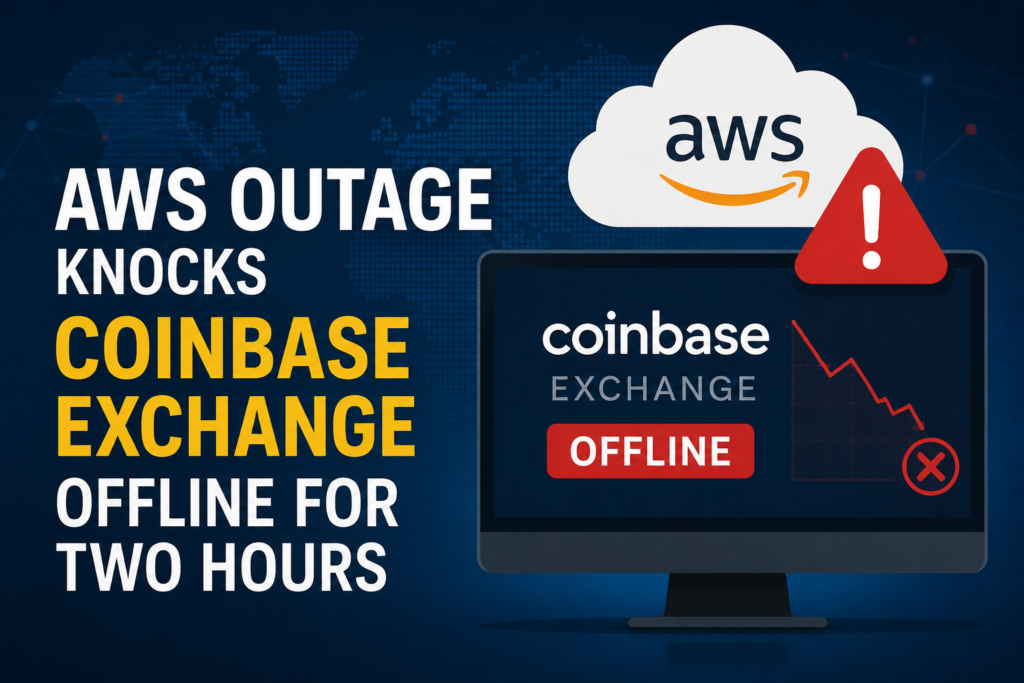
The cryptocurrency industry experienced another major disruption after a widespread AWS outage temporarily forced Coinbase Exchange offline for nearly two hours. The incident quickly sparked debate across the digital asset market about the risks of centralized cloud infrastructure and the vulnerability of crypto trading platforms during technical failures. As traders attempted to access their accounts, execute transactions, and monitor market movements, many users were met with connection errors, delayed updates, and service interruptions.
The outage highlighted how deeply connected the modern crypto ecosystem is to large-scale cloud computing providers like Amazon Web Services. While exchanges promote decentralization and financial independence, the backend systems powering many of these platforms remain heavily dependent on centralized technology infrastructure. When AWS services encounter disruptions, the effects can ripple through exchanges, wallets, fintech apps, and even institutional trading systems.
For Coinbase, one of the largest cryptocurrency exchanges in the world, the downtime came at a sensitive time for the broader digital asset market. Investors have increasingly demanded stability, reliability, and uninterrupted access to trading services. A temporary outage may sound minor in traditional industries, but in crypto markets where prices move within seconds, even a short disruption can create panic and financial losses.
This event also renewed discussions about cloud redundancy, exchange reliability, and the long-term future of crypto infrastructure. As the digital asset industry matures, users expect exchanges to operate with the same resilience as traditional financial institutions. The Coinbase outage serves as another reminder that technical failures can still impact even the largest and most established platforms.
Understanding the AWS Outage and Its Impact
The AWS outage affected multiple online services across different industries, but the crypto sector immediately felt the consequences because of its dependence on real-time connectivity and trading execution. Amazon Web Services is one of the largest cloud computing providers globally, offering hosting, storage, networking, and server infrastructure to businesses ranging from startups to multinational corporations.
When AWS systems experience performance issues or outages, the impact spreads quickly. Coinbase Exchange reportedly experienced connectivity problems that disrupted account access, order execution, and market data synchronization. Many users took to social media to report difficulties logging in or completing trades during the outage period.
The incident demonstrated how cloud infrastructure problems can directly affect cryptocurrency trading environments. Unlike traditional banking systems that often use geographically distributed and highly redundant networks, some crypto exchanges still rely heavily on single cloud providers for critical operations. That concentration of infrastructure creates a single point of failure during major service disruptions.
The outage also raised concerns among institutional traders who rely on uninterrupted exchange access for algorithmic trading and high-frequency transactions. When systems become unavailable, traders may miss opportunities, fail to hedge positions, or suffer losses from sudden price volatility.
Why Coinbase Exchange Went Offline
Coinbase Exchange has become one of the most recognized names in the cryptocurrency industry, serving millions of retail and institutional users worldwide. The exchange offers trading services for Bitcoin, Ethereum, and numerous altcoins while supporting advanced trading tools and custodial solutions.
During the AWS outage, Coinbase acknowledged that certain systems were experiencing degraded performance. Users reported delayed balance updates, failed withdrawals, and difficulty accessing trading interfaces. Although the company restored services within approximately two hours, the downtime was enough to trigger frustration among traders and investors.
The outage showed that even highly regulated and publicly traded crypto companies remain vulnerable to infrastructure disruptions. Coinbase has invested heavily in security and operational reliability over the years, yet dependence on cloud infrastructure still presents operational risks.
One of the major concerns during such outages is market accessibility. Cryptocurrency markets operate 24/7 without traditional closing hours. Unlike stock markets that pause overnight or during weekends, crypto exchanges must maintain continuous uptime. Any interruption can prevent users from reacting to rapid market movements.
The event also revived criticism from crypto advocates who argue that centralized exchanges contradict the decentralized philosophy of blockchain technology. While blockchain networks themselves may remain functional, centralized platforms connecting users to those networks can still fail because of infrastructure issues.
The Growing Dependence on Cloud Providers in Crypto
The crypto industry has rapidly expanded over the past decade, but much of its infrastructure depends on centralized technology companies. Cloud providers such as Amazon Web Services, Microsoft Azure, and Google Cloud host a significant portion of blockchain applications, trading platforms, and decentralized finance services.
This dependence creates both advantages and risks. Cloud infrastructure allows exchanges to scale quickly, manage traffic spikes, and reduce operational costs. However, it also introduces vulnerabilities when outages occur. A single cloud provider disruption can affect multiple crypto companies simultaneously.
The Coinbase outage highlighted the need for stronger redundancy systems and distributed hosting strategies. Many industry experts believe exchanges should diversify infrastructure across multiple cloud providers instead of relying heavily on one provider.
Another concern involves systemic risk. If several major exchanges use the same cloud infrastructure, a large-scale outage could temporarily impact significant portions of the crypto market. This scenario raises questions about resilience during periods of extreme market volatility.
As institutional adoption of cryptocurrency continues growing, infrastructure reliability will become increasingly important. Hedge funds, asset managers, and payment companies expect enterprise-grade performance from crypto platforms. Frequent outages could weaken trust among institutional participants.
Market Reactions Following the Coinbase Downtime
The crypto market reacted quickly after reports emerged that Coinbase Exchange had gone offline. Social media platforms were flooded with complaints, memes, and speculation regarding the cause of the disruption. Some traders worried that the outage might trigger broader market instability, especially if trading activity remained interrupted for an extended period.
Although Bitcoin and other major cryptocurrencies did not experience catastrophic price declines during the outage, the incident intensified concerns about exchange reliability during volatile market conditions. Traders often rely on fast execution speeds and real-time access to manage positions effectively.
The outage also affected market sentiment because Coinbase is widely viewed as a trusted entry point for retail investors. When a major exchange encounters technical issues, confidence across the broader crypto ecosystem can weaken temporarily.
Some analysts pointed out that crypto users have become increasingly sensitive to platform stability after several high-profile exchange collapses and technical failures in recent years. Even temporary disruptions now receive intense scrutiny from both regulators and the investing public.
Meanwhile, competitors used the incident to emphasize their own reliability and infrastructure capabilities. Several exchanges promoted their uptime records and distributed systems shortly after Coinbase services were restored.
How AWS Outages Affect Cryptocurrency Trading
An AWS outage can create serious problems for crypto exchanges because cryptocurrency trading depends heavily on real-time data processing and continuous connectivity. Exchanges must process thousands of transactions per second while maintaining accurate account balances and order books.
When cloud services fail, several issues may occur simultaneously. Users can lose access to their accounts, order execution can become delayed, and market prices may fail to update correctly. These problems create uncertainty and can lead to trading losses.
Latency is another critical factor in crypto markets. Professional traders and institutional firms often use automated trading systems that rely on millisecond-level execution. Even short interruptions can disrupt algorithms and create unexpected risks.
Liquidity may also decline during outages because fewer traders can access the market. Lower liquidity can increase price volatility and widen bid-ask spreads, making trading more expensive for users.
In some cases, outages may also delay deposits and withdrawals. Users attempting to move funds between wallets or exchanges may experience longer confirmation times or temporary freezes until systems stabilize.
The Coinbase incident demonstrated that infrastructure resilience is becoming just as important as cybersecurity in the crypto sector. Exchanges must prepare not only for hacking attempts but also for operational disruptions caused by third-party providers.
The Debate Over Centralization in Crypto Infrastructure
The Coinbase Exchange outage reignited one of the crypto industry’s biggest philosophical debates: decentralization versus centralized infrastructure. Cryptocurrencies were originally designed to reduce dependence on centralized financial systems, yet many crypto services now rely on centralized technology providers.
Blockchain networks like Bitcoin and Ethereum are decentralized at the protocol level, but the platforms people use to access those networks often are not. Centralized exchanges, custodians, and cloud providers continue to dominate the ecosystem.
Critics argue that relying on major cloud companies undermines the resilience of the crypto industry. If exchanges depend heavily on a handful of technology providers, the ecosystem remains exposed to centralized points of failure.
Supporters of centralized infrastructure argue that cloud providers offer unmatched scalability, security, and operational efficiency. Building independent global infrastructure is extremely expensive and difficult for most exchanges.
The future may involve hybrid solutions combining decentralized technologies with enterprise-grade cloud systems. Some blockchain developers are already exploring decentralized cloud computing alternatives that distribute workloads across independent networks instead of centralized servers.
However, large-scale adoption of decentralized hosting solutions remains limited. Most major exchanges continue relying on traditional cloud providers because of performance and cost considerations.
Regulatory Attention After the Outage
Regulators worldwide have become increasingly focused on operational resilience within the cryptocurrency industry. The AWS outage affecting Coinbase is likely to intensify discussions about risk management, infrastructure redundancy, and investor protection.
Financial regulators expect critical trading platforms to maintain strong disaster recovery systems and contingency planning. In traditional finance, stock exchanges and banking institutions must comply with strict operational standards designed to minimize downtime.
Crypto exchanges may soon face similar expectations as regulators push for stronger oversight. Authorities are especially concerned about outages occurring during periods of market volatility when investors need immediate access to their funds and trading tools.
The incident may also influence future compliance requirements regarding third-party service providers. Regulators could require exchanges to demonstrate diversified infrastructure strategies and backup systems capable of maintaining operations during cloud outages.
Coinbase has generally maintained a stronger regulatory reputation compared to many offshore exchanges, but incidents like this still attract scrutiny from policymakers and financial watchdogs.
As cryptocurrency adoption expands, governments are likely to demand greater transparency regarding exchange infrastructure and operational resilience measures.
Lessons for Crypto Exchanges and Investors

The Coinbase downtime provides important lessons for both exchanges and investors. For trading platforms, the incident reinforces the need for stronger infrastructure diversification, real-time monitoring, and disaster recovery systems.
Exchanges may increasingly invest in multi-cloud environments to reduce dependence on a single provider. By distributing workloads across multiple infrastructure platforms, companies can improve resilience during outages.
Communication also plays a major role during service disruptions. Users expect transparent updates, estimated recovery timelines, and clear explanations regarding technical problems. Coinbase provided status updates during the outage, but many traders still expressed frustration over limited information.
For investors, the outage highlights the importance of risk management and self-custody strategies. Relying entirely on a centralized exchange during volatile market conditions can create accessibility risks.
Some crypto users responded to the outage by emphasizing the importance of decentralized exchanges and private wallets. While decentralized platforms have their own limitations, they may offer alternative access routes during centralized exchange disruptions.
Investors are also reminded to avoid excessive leverage during uncertain market conditions. Technical outages can prevent traders from managing leveraged positions effectively, potentially increasing losses.
Could Future Outages Become More Common?
As the crypto industry grows larger and more interconnected, infrastructure-related disruptions may become increasingly significant. Trading volumes continue rising, institutional participation is expanding, and blockchain applications are becoming more complex.
Cloud infrastructure providers generally maintain extremely high reliability standards, but no system is immune to failures. Hardware problems, networking issues, software bugs, and cyberattacks can all contribute to outages.
The growing reliance on artificial intelligence, automated trading systems, and real-time blockchain analytics also increases infrastructure demands. Exchanges must process enormous amounts of data continuously while ensuring low latency and high availability.
Future outages may become more disruptive if exchanges fail to strengthen redundancy systems. However, the industry is also learning from each incident and improving operational practices over time.
Many crypto companies are now prioritizing resilience engineering, geographic distribution, and failover systems. These improvements could reduce the impact of future cloud disruptions.
At the same time, the industry’s rapid growth means operational risks will remain a constant challenge. Exchanges must balance scalability, cost efficiency, and reliability while competing in a highly volatile market.
The Broader Implications for the Crypto Industry
The AWS outage knocking Coinbase Exchange offline represents more than a temporary technical issue. It reflects broader challenges facing the cryptocurrency industry as it transitions from a niche market into a global financial sector.
Reliability, infrastructure resilience, and operational transparency are becoming critical factors for mainstream adoption. Retail investors and institutions alike expect crypto platforms to function with minimal downtime.
The incident also reveals the complex relationship between decentralization and practicality. While blockchain networks promote distributed systems, the surrounding infrastructure often remains centralized for efficiency reasons.
Over time, the crypto industry may evolve toward more decentralized hosting and infrastructure models. However, achieving enterprise-grade reliability through decentralized systems remains a significant technical challenge.
For now, centralized exchanges and cloud providers will likely continue playing dominant roles in the digital asset ecosystem. The key question is whether companies can build sufficient redundancy and resilience to prevent future outages from disrupting users.
The Coinbase incident serves as a warning that operational infrastructure matters just as much as blockchain innovation. As competition intensifies, exchanges capable of delivering stable and uninterrupted services may gain a significant advantage.
Conclusion
The AWS outage that temporarily forced Coinbase Exchange offline for two hours exposed the ongoing infrastructure challenges facing the cryptocurrency industry. Although services were restored relatively quickly, the incident raised important concerns about cloud dependency, operational resilience, and centralized points of failure within digital asset markets.
As crypto adoption continues expanding, exchanges will face increasing pressure to improve reliability and maintain uninterrupted access for users worldwide. Investors now expect the same level of stability from crypto platforms that they receive from traditional financial institutions.
The outage also highlighted the broader tension between decentralization ideals and centralized infrastructure realities. While blockchain technology itself may remain decentralized, the systems supporting user access still depend heavily on centralized providers like AWS.
Moving forward, exchanges will likely invest more heavily in redundancy, multi-cloud strategies, and disaster recovery planning. At the same time, regulators may push for stronger operational standards across the crypto sector.
Ultimately, the Coinbase outage serves as another reminder that the cryptocurrency industry is still evolving. Technical resilience, infrastructure diversification, and transparent communication will play increasingly important roles in shaping the future of digital finance.
FAQs
Q. Why did Coinbase Exchange go offline?
Coinbase Exchange went offline because an AWS outage disrupted critical cloud infrastructure services that supported parts of the platform’s operations.
Q. How long was Coinbase offline during the AWS outage?
The exchange experienced service disruptions for approximately two hours before systems were restored.
Q. Did the AWS outage affect cryptocurrency prices?
While the outage caused concern among traders, major cryptocurrencies like Bitcoin did not experience extreme crashes solely because of the disruption.
Q. What is AWS and why is it important for crypto exchanges?
Amazon Web Services is a major cloud computing provider that supplies hosting, storage, networking, and infrastructure services used by many crypto exchanges and technology companies.
Q. Can crypto exchanges prevent outages like this in the future?
Exchanges can reduce risks by using multi-cloud infrastructure, geographic redundancy, stronger failover systems, and improved disaster recovery planning.