











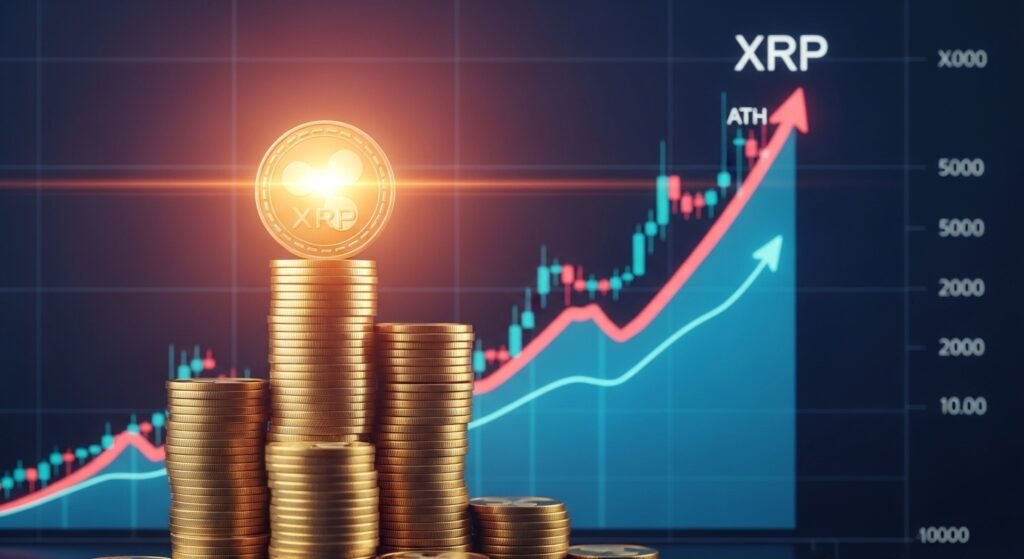
XRP new ATH: Whales, Institutions, and the Road to a New ATH

XRP new ATH

COIN4U IN YOUR SOCIAL FEED

XRP new ATH speculation grows as whales and institutions increase exposure. Explore on-chain signals, adoption trends, and price outlook. XRP has spent years moving in and out of favor, often overshadowed by louder narratives from newer blockchains and meme-driven rallies. Yet markets have a habit of revisiting assets that quietly strengthen their foundations while attention is elsewhere. Over recent months, XRP has re-entered serious conversations among traders, analysts, and long-term investors, not because of hype alone, but because multiple structural signals are aligning at once. From increased whale accumulation to renewed institutional interest, the conditions are forming that often precede major price expansions. This is why talk of an XRP new ATH is no longer limited to speculation on social media but is increasingly grounded in measurable data.

What makes this phase especially interesting is the type of capital involved. Retail enthusiasm can move price quickly, but it rarely sustains long trends on its own. Whales and institutions, on the other hand, tend to position early, accumulate patiently, and wait for liquidity events or narrative shifts before pushing exposure into the spotlight. XRP appears to be entering that phase, where quiet accumulation replaces noisy hype. When this transition happens, volatility often compresses, price ranges tighten, and pressure builds beneath the surface.

This article explores why the XRP new ATH narrative is gaining credibility. We’ll examine whale behavior, institutional adoption, on-chain activity, market structure, and psychological factors that could drive the altcoin toward uncharted territory. Rather than focusing on short-term price targets, the goal is to understand the mechanics that could support a sustained breakout if momentum continues to build.

Understanding XRP’s Market Position in the Current Cycle

XRP occupies a unique position within the altcoin ecosystem. Unlike many speculative assets, it has a long operational history, established infrastructure, and a focus on real-world financial use cases. This background gives XRP a different risk profile compared to experimental protocols, and it’s one reason institutions often view it through a separate lens. As the broader market matures, assets with clearer utility narratives tend to regain attention, especially when capital becomes more selective.

In previous cycles, XRP experienced explosive moves driven by retail enthusiasm. In the current environment, however, the drivers appear more structural. Liquidity conditions, regulatory clarity in key regions, and renewed partnerships have gradually improved sentiment. These shifts don’t always produce immediate price spikes, but they create the conditions where an XRP new ATH becomes technically and psychologically feasible.

Another factor is relative valuation. Compared to many newer tokens that have already gone through aggressive re-pricing, XRP is often viewed as lagging. Markets frequently rotate into laggards once leaders show signs of exhaustion, and that rotation can be powerful. When combined with accumulation by larger players, this dynamic strengthens the case for a significant upside move.

Whale Accumulation: Smart Money Positioning Early

Whales are among the most closely watched participants in crypto markets because their actions often precede major trends. Large holders typically accumulate during periods of low volatility and muted sentiment, when prices can be absorbed without attracting attention. Recent on-chain patterns suggest that XRP whales have been steadily increasing their positions, a behavior that aligns with early-stage positioning rather than late-cycle chasing.

This accumulation matters because it reduces available supply on exchanges. When fewer tokens are readily available for trading, even modest increases in demand can have an outsized impact on price. Over time, this supply tightening can create the kind of imbalance that fuels sharp rallies. For those tracking the XRP new ATH narrative, whale behavior is one of the strongest supporting signals.

Equally important is the patience whales demonstrate. They are less likely to react to short-term volatility and more likely to hold through consolidations. This stabilizing effect can dampen downside risk while increasing the probability of a sustained breakout once momentum returns. When whales accumulate quietly and hold firmly, markets often underestimate how much pressure is building beneath the surface.

Institutional Interest: Why Bigger Players Are Paying Attention

Institutions don’t move like retail traders. Their involvement is slower, more deliberate, and often tied to infrastructure readiness rather than price alone. XRP’s focus on cross-border payments, liquidity solutions, and integration with financial systems makes it particularly relevant for institutional use cases. As traditional finance continues to explore blockchain-based settlement and efficiency gains, XRP naturally re-enters the conversation.

Institutional interest also changes market dynamics. Larger players require deep liquidity, reliable custody solutions, and regulatory clarity. As these components improve, the barrier to entry lowers, allowing more capital to participate. This type of demand is not speculative in the short-term sense; it’s strategic. When institutions allocate, they often do so with multi-year horizons, which supports the idea of an eventual XRP new ATH driven by sustained adoption rather than a fleeting pump.

Another important aspect is signaling. Even limited institutional involvement can influence broader sentiment. When markets believe that “serious money” is watching or positioning, confidence grows. This confidence can attract additional capital, creating a feedback loop where price strength validates the narrative and the narrative attracts more buyers.

On-Chain Activity: What the Data Says About Network Health

Price tells one story, but on-chain data tells another. Healthy networks often show growth in transaction volume, active addresses, and consistent usage. XRP’s ledger activity has demonstrated resilience during market downturns, suggesting that its utility-driven transactions continue regardless of speculative cycles. This consistency is a critical factor when evaluating long-term potential.

An increase in on-chain activity often precedes price appreciation because it reflects genuine usage rather than pure speculation. When demand for network services grows, it creates organic reasons for holding and transacting the token. Over time, this usage-based demand can support higher valuations and make the case for an XRP new ATH more compelling.

Additionally, on-chain transparency allows analysts to observe accumulation patterns, exchange flows, and holder behavior. Reduced exchange inflows, for example, often indicate that holders are less interested in selling. When combined with rising activity, this suggests confidence in future price appreciation rather than fear of decline.

Market Structure and Technical Setup

From a technical perspective, XRP has spent extended periods consolidating within defined ranges. While this can be frustrating for traders seeking quick returns, long consolidations often precede strong directional moves. The longer price compresses, the more energy builds for an eventual breakout.

Key resistance levels act as psychological barriers. Once breached, they often trigger momentum-based buying and short covering, accelerating the move. If XRP can establish higher lows and reclaim major resistance zones, the path toward an XRP new ATH becomes clearer from a market structure standpoint.

Volume behavior is also crucial. Sustainable breakouts are usually accompanied by rising volume, signaling genuine participation rather than thin liquidity spikes. Traders watching for confirmation often wait for this combination of price and volume before committing, which can further fuel upside once the breakout is validated.

Psychological Factors: Sentiment, Patience, and FOMO

Markets are driven as much by psychology as by fundamentals. XRP’s long period of underperformance relative to other altcoins has created skepticism among some investors. Ironically, this skepticism can be bullish. When expectations are low, positive developments have a greater impact because they surprise the market.

As price begins to move and narratives shift, fear of missing out can spread quickly. Retail traders who ignored XRP during consolidation may rush in once momentum is obvious. If this retail interest coincides with ongoing whale and institutional positioning, the resulting demand surge can be powerful. This is often how an XRP new ATH scenario unfolds: slow accumulation, sudden attention, rapid repricing.

Patience is another psychological factor. Assets that reward patience tend to produce more sustainable trends because holders are less likely to panic sell. XRP’s community includes many long-term believers who have weathered multiple cycles. Their willingness to hold through volatility can reduce sell pressure during rallies, allowing price to extend further than skeptics expect.

Broader Market Conditions and Altcoin Rotation

No asset moves in isolation. XRP’s potential for a new high is influenced by broader market trends, including Bitcoin dominance and overall risk appetite. Historically, altcoins tend to outperform when Bitcoin stabilizes after a major move. In such environments, capital rotates into assets perceived as undervalued or lagging.

XRP often benefits from this rotation because of its established reputation and liquidity. When traders look for alternatives to overheated markets, they gravitate toward assets with clear narratives and room to run. This rotational behavior can amplify momentum and strengthen the case for an XRP new ATH during favorable market phases.

Macroeconomic conditions also play a role. When liquidity increases and risk-on sentiment returns, speculative and semi-speculative assets tend to benefit. While XRP has utility-driven demand, it still responds to broader liquidity cycles, which can act as a tailwind or headwind depending on conditions.

Risks and Challenges to Watch

No analysis is complete without acknowledging risks. XRP’s path toward a new high is not guaranteed. Market sentiment can shift quickly, regulatory developments can introduce uncertainty, and macroeconomic shocks can suppress risk appetite. Overconfidence is one of the biggest dangers when a narrative gains momentum.

Another risk is premature breakout failure. False breakouts can trap late buyers and damage confidence, delaying future attempts. This is why confirmation through volume, follow-through, and broader market support is critical. Even in a bullish scenario, pullbacks and consolidations are normal parts of the journey toward an XRP new ATH.

Understanding these risks doesn’t weaken the bullish case; it strengthens it by grounding expectations in reality. Investors who plan for volatility are better positioned to hold through it, increasing their chances of benefiting if the larger trend plays out.

Conclusion

XRP’s renewed attention is not the result of a single catalyst but the convergence of several meaningful factors. Whale accumulation suggests smart money positioning early. Institutional interest points to growing confidence in XRP’s role within evolving financial infrastructure. On-chain activity reflects consistent network usage, while market structure hints at a potential breakout after prolonged consolidation.

Together, these elements form a credible foundation for the XRP new ATH narrative. While challenges and volatility remain part of the journey, the alignment of capital, utility, and sentiment creates conditions that are difficult to ignore. For investors willing to look beyond short-term noise and focus on structural trends, XRP’s current phase may represent an important inflection point.

As always, patience, risk management, and independent research remain essential. Markets reward those who understand why they hold an asset, not just those who hope it will go up. If XRP continues to strengthen its fundamentals while capital quietly positions, the road to a new high may be closer than many expect.

FAQs

Q: What does XRP new ATH mean for investors?

An XRP new ATH refers to XRP reaching a price level higher than any previous peak, signaling strong momentum and renewed market confidence.

Q: Why are whales important for XRP’s price movement?

Whales control large amounts of supply. Their accumulation reduces available tokens on exchanges, which can amplify price moves when demand increases.

Q: How does institutional interest impact XRP?

Institutional involvement adds long-term capital, improves liquidity, and boosts credibility, all of which can support sustained growth toward an XRP new ATH.

Q: Can on-chain data really predict price direction?

On-chain data doesn’t predict price directly, but it reveals usage, accumulation, and behavior patterns that often precede major trends.

Q: What are the main risks to XRP reaching a new ATH?

Key risks include regulatory uncertainty, broader market downturns, and failed breakouts that weaken sentiment. Proper risk management is essential.

Explore more articles like this

Subscribe to the Finance Redefined newsletter

A weekly toolkit that breaks down the latest DeFi developments, offers sharp analysis, and uncovers new financial opportunities to help you make smart decisions with confidence. Delivered every Friday

By subscribing, you agree to our Terms of Services and Privacy Policy

READ MORE

Education Ministry refers five schools Principals to investigation over exam violations

Education Ministry

COIN4U IN YOUR SOCIAL FEED

The integrity of examination systems lies at the heart of any credible education framework. Exams not only assess student learning but also determine academic progression, career opportunities, and public trust in educational institutions. When this integrity is compromised, the consequences extend far beyond individual schools or students. Recently, the Education Ministry refers five schools Principals to investigation over exam violations, sending a strong signal that misconduct within the education system will not be tolerated.

This development has sparked widespread debate among educators, parents, and policymakers. Allegations of exam violations raise uncomfortable questions about supervision, accountability, and ethical leadership in schools. The decision to investigate senior school leadership, rather than focusing solely on students or invigilators, highlights a shift toward addressing systemic issues rather than isolated incidents. It suggests that the ministry recognizes how deeply school leadership influences examination culture and compliance.

In this article, we explore the background of the investigation, the nature of the alleged violations, the role of school principals in safeguarding exam integrity, and the broader implications for the education system. By examining why the Education Ministry refers five schools Principals to investigation over exam violations, we gain insight into how accountability, reform, and trust intersect in modern education systems.

Background of the Investigation

Rising Concerns Over Examination Integrity

Over the past few years, examination integrity has become an increasingly sensitive issue. Reports of cheating, leaked question papers, unauthorized assistance, and manipulation of exam conditions have surfaced in various regions. These incidents undermine not only student merit but also public confidence in national assessment standards. Against this backdrop, education authorities have intensified monitoring mechanisms to detect irregularities.

The decision that the Education Ministry refers five schools Principals to investigation over exam violations follows a series of audits and complaints that pointed to irregular practices during examinations. While exam violations are not new, the involvement of school leadership elevates the seriousness of the matter. It suggests that these were not random or isolated breaches but potentially systemic failures in oversight and enforcement.

How the Allegations Emerged

The alleged violations reportedly came to light through a combination of internal inspections, whistleblower reports, and post-exam analysis. Education ministries often rely on statistical data to identify anomalies, such as unusually high pass rates or identical answer patterns across multiple candidates. When such red flags appear, further scrutiny becomes inevitable.

In this case, preliminary findings were serious enough for the ministry to move beyond routine inquiry and initiate formal investigations. The fact that principals themselves are under scrutiny indicates that responsibility may extend to administrative decisions, exam supervision policies, or failure to prevent known violations.

Nature of the Exam Violations

Types of Violations Under Investigation

Although detailed findings have not yet been made public, exam violations typically fall into several categories. These may include unauthorized access to exam materials, inadequate supervision during exams, allowing external assistance, or failure to follow standardized examination procedures. In some cases, violations also involve altering exam environments to favor certain students.

The seriousness of these allegations explains why the Education Ministry refers five schools Principals to investigation over exam violations rather than issuing warnings or minor disciplinary actions. Principals are ultimately responsible for ensuring that examination protocols are implemented correctly and consistently within their schools.

Impact on Students and Results

Exam violations do not only affect institutional credibility; they have a direct impact on students. Those who benefit unfairly gain an advantage over peers who follow the rules, while honest students may feel demoralized and disillusioned. In severe cases, entire cohorts can face uncertainty if exam results are questioned or invalidated.

This ripple effect underscores why education authorities take such matters seriously. When exam results are compromised, universities, employers, and society at large may question the value of qualifications issued by affected schools.

Role of School Principals in Examination Oversight

School Principals

Leadership and Accountability

School principals occupy a pivotal position in the education system. They set the tone for ethical behavior, enforce policies, and ensure compliance with regulations. During examination periods, their responsibilities intensify, as they must coordinate invigilation, secure exam materials, and enforce strict adherence to rules.

When the Education Ministry refers five schools Principals to investigation over exam violations, it highlights the expectation that principals act as guardians of academic integrity. Any lapse in this responsibility, whether through negligence or deliberate misconduct, carries serious consequences.

Delegation Versus Responsibility

While principals often delegate exam-related tasks to senior teachers or examination officers, delegation does not absolve them of responsibility. Effective leadership requires oversight and accountability mechanisms to ensure delegated tasks are performed correctly. Investigations often examine whether principals established clear procedures and monitored their implementation.

This distinction is crucial because it determines whether violations resulted from individual misconduct or broader administrative failures. Understanding this helps shape future reforms aimed at strengthening examination governance.

Education Ministry’s Response and Rationale

Zero Tolerance for Exam Misconduct

The ministry’s decision reflects a zero-tolerance approach toward exam violations. By referring principals to investigation, the authorities aim to demonstrate that seniority does not shield individuals from accountability. This approach reinforces the principle that ethical standards apply equally at all levels of the education system.

The message is clear: when the Education Ministry refers five schools Principals to investigation over exam violations, it is asserting its commitment to fairness, transparency, and rule of law within education.

Restoring Public Confidence

Public trust in examinations is essential for the legitimacy of educational outcomes. Any perception that exams are compromised can erode confidence in schools, teachers, and governing bodies. The ministry’s proactive stance helps reassure parents and students that irregularities are taken seriously and addressed promptly.

By acting decisively, the ministry aims to restore confidence and prevent speculation or misinformation from damaging the broader education system.

Legal and Disciplinary Implications

Possible Outcomes of the Investigation

Investigations into exam violations can lead to a range of outcomes, depending on the findings. These may include formal warnings, suspension, demotion, or dismissal of principals found culpable. In extreme cases, legal action may follow if violations breach national education laws or regulations.

The fact that the Education Ministry refers five schools Principals to investigation over exam violations suggests that outcomes could be significant, serving as a deterrent to others who might consider compromising exam standards.

Due Process and Fair Inquiry

It is important to note that referral to investigation does not imply guilt. Education authorities typically follow due process, allowing accused individuals to respond to allegations and present evidence. This ensures fairness and protects the rights of school leaders while maintaining accountability.

Transparent and impartial investigations are essential to ensure that disciplinary actions are justified and credible.

Broader Implications for the Education System

Strengthening Examination Policies

Incidents like this often prompt broader policy reviews. Education ministries may revise examination guidelines, enhance training for school leaders, or introduce stricter monitoring mechanisms. These reforms aim to prevent future violations and close loopholes that enable misconduct.

When the Education Ministry refers five schools Principals to investigation over exam violations, it creates an opportunity to strengthen systemic safeguards rather than merely addressing individual cases.

Emphasizing Ethical Education Leadership

Beyond technical rules, this situation highlights the importance of ethical leadership in education. Principals serve as role models for teachers and students alike. Upholding integrity during examinations reinforces values such as fairness, honesty, and responsibility.

By holding principals accountable, education authorities emphasize that leadership is not only about academic performance but also about moral stewardship.

Reactions from Stakeholders

Teachers and School Staff

Teachers often find themselves at the frontline of exam administration. Investigations involving principals may lead to mixed reactions among staff, ranging from concern about increased scrutiny to support for stronger oversight. Many educators welcome measures that protect the credibility of their profession.

Clear communication from authorities helps ensure that staff understand the purpose of investigations and the importance of compliance.

Parents and Students

Parents and students are directly affected by exam-related controversies. Concerns about fairness and future prospects can cause anxiety, especially if exam results are questioned. However, decisive action by the ministry can also reassure families that issues are being addressed responsibly.

The decision that the Education Ministry refers five schools Principals to investigation over exam violations may ultimately strengthen trust by showing that misconduct is neither ignored nor concealed.

Lessons for the Future

examination regulation

Prevention Through Training and Monitoring

One of the key lessons from this situation is the importance of continuous training for school leaders on examination regulations. Clear guidelines, regular audits, and transparent reporting mechanisms can reduce the risk of violations. Investing in preventive measures is often more effective than punitive action alone, as it fosters a culture of compliance and awareness.

Building a Culture of Integrity

Examination integrity cannot rely solely on rules and penalties. It requires a shared commitment to ethical behavior across the education community. Schools that prioritize transparency, accountability, and open communication are less likely to experience serious violations. The current investigation serves as a reminder that integrity must be actively cultivated and protected.

Conclusion

The decision that the Education Ministry refers five schools Principals to investigation over exam violations marks a significant moment for the education system. It underscores the seriousness with which exam integrity is treated and highlights the critical role of school leadership in upholding ethical standards. While the investigations are ongoing, their implications are already clear: accountability applies at every level, and safeguarding examinations is a collective responsibility.

By addressing alleged violations transparently and fairly, the education ministry has an opportunity not only to resolve individual cases but also to strengthen the system as a whole. Ultimately, maintaining trust in examinations is essential for students, educators, and society, and decisive action today can help secure that trust for the future.

FAQs

Q: Why did the Education Ministry decide to investigate school principals instead of only exam invigilators?

The Education Ministry chose to investigate school principals because they hold ultimate responsibility for examination administration within their institutions. While invigilators oversee exams directly, principals are accountable for policies, supervision, and enforcement of exam rules, making their role central to maintaining integrity.

Q: Does being referred to an investigation mean the principals are guilty of exam violations?

No, referral to an investigation does not mean guilt. It indicates that there are sufficient concerns to warrant a formal inquiry. The process allows principals to respond to allegations and ensures that any conclusions are based on evidence and due process.

Q: How can exam violations at the school level affect the wider education system?

Exam violations can undermine public trust in qualifications, disadvantage honest students, and damage the credibility of educational institutions. When such issues are not addressed, they can affect university admissions, employment decisions, and confidence in national education standards.

Q: What steps can schools take to prevent exam violations in the future?

Schools can prevent exam violations by strengthening supervision, providing regular training on examination regulations, implementing clear accountability structures, and fostering a culture of integrity where ethical behavior is prioritized at all levels.

Q: Will this investigation lead to changes in national examination policies?

While the investigation focuses on specific cases, it may prompt broader policy reviews. Education authorities often use such incidents to identify systemic weaknesses and introduce reforms aimed at improving monitoring, transparency, and compliance across all schools.

Explore more articles like this

Subscribe to the Finance Redefined newsletter

A weekly toolkit that breaks down the latest DeFi developments, offers sharp analysis, and uncovers new financial opportunities to help you make smart decisions with confidence. Delivered every Friday

By subscribing, you agree to our Terms of Services and Privacy Policy

READ MORE

ADD PLACEHOLDER